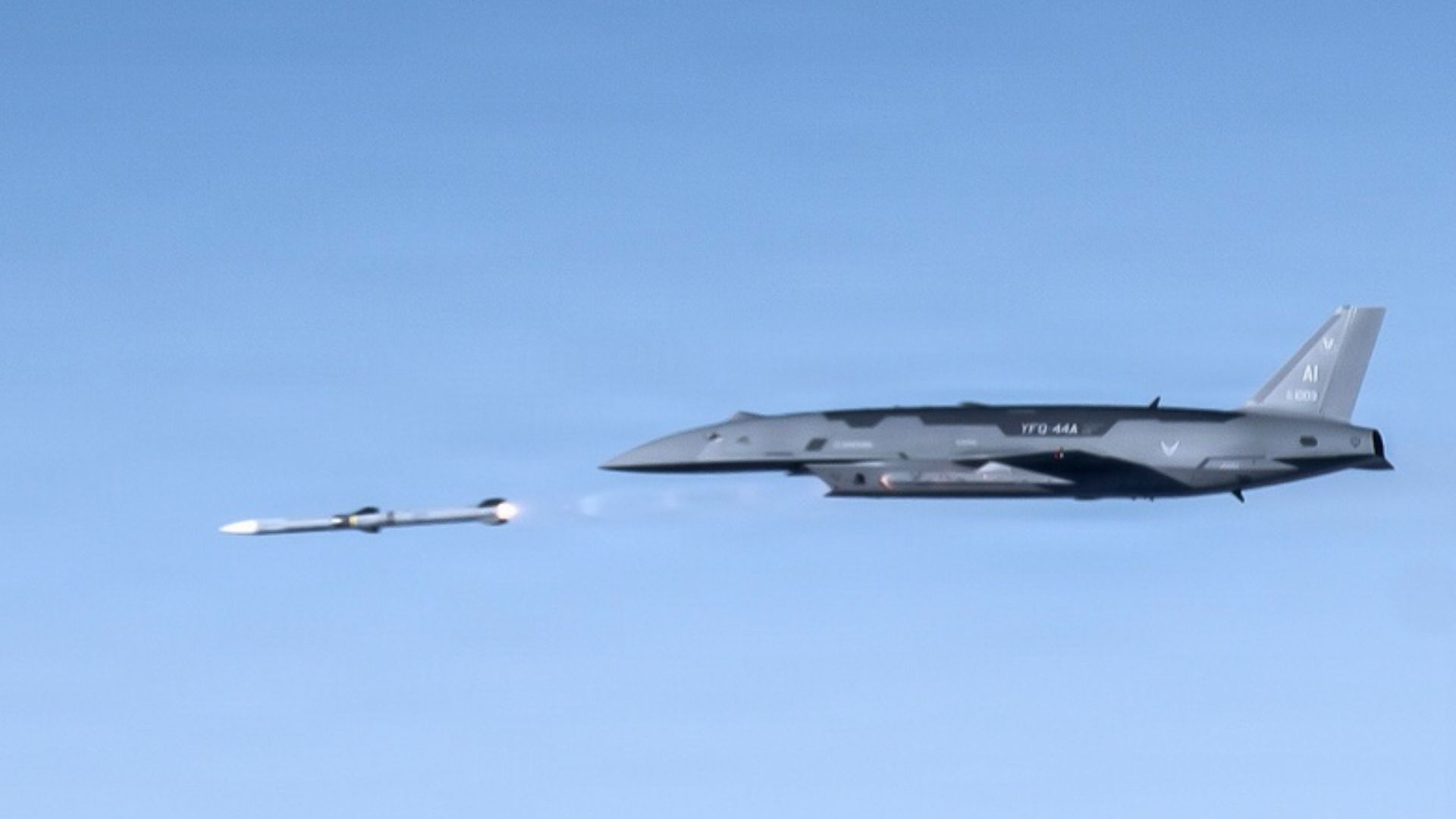
The US Air Force has completed its first successful missile launch from a Collaborative Combat Aircraft (CCA), marking an important step in the development of autonomous combat drones.
During the test, the YFQ-44A Loyal Wingman fired a live AIM-120 air-to-air missile while carrying out most of the mission on its own. The event highlights the growing role of software-driven aircraft designed to operate alongside human pilots.
Historic Combat Test
The test took place in restricted airspace over California’s Mojave Desert in partnership with Anduril Industries. The YFQ-44A launched a live AIM-120 medium-range air-to-air missile at a digital target during the exercise. It marked the first time a US Collaborative Combat Aircraft completed a live missile launch.
Earlier flights had carried missiles only as test payloads without firing them. This latest exercise went beyond that stage by demonstrating the aircraft’s ability to complete the full weapon-employment process. The test was conducted with support from the 412th Test Wing’s Air Dominance Combined Test Force.
READ ALSO: 1X’s Neo Robot Gets Washable, Tactile Hands That Sense Touch Like Humans
Software-Led Mission
Unlike traditional drones that rely on constant remote control, the YFQ-44A handled most of the engagement independently. Its onboard computer used Anduril’s Lattice software to detect the target, lock onto it, and calculate the best interception path. A human supervisor on the ground gave the final command to fire the missile, following US military policy that does not allow autonomous weapon release.
After receiving the launch approval, the aircraft completed the missile release on its own. This approach combines automated decision-making with human oversight during the most critical stage. It allows the aircraft to react quickly while keeping people responsible for the use of weapons.
Loyal Wingman Passes Combat Test
General Dale White said the successful launch confirms that the program has advanced from carrying inactive missiles to using live weapons during testing.
He added that the exercise also helped validate digital integration models with real-world data collected during flight. According to White, the results show that Collaborative Combat Aircraft can complete the weapon employment sequence within limits defined by human operators.
The US Air Force is developing Collaborative Combat Aircraft to fly alongside crewed fighter jets as robotic teammates. These aircraft are expected to support pilots by carrying weapons, gathering intelligence, and taking on higher-risk missions. Using drones in these roles can help expand combat capability without placing additional pilots in danger.
Future Combat Operations
The successful missile launch represents another step toward integrating autonomous aircraft into future air operations. It also reflects the increasing role of artificial intelligence and advanced software in modern military aviation while maintaining human control over lethal decisions.