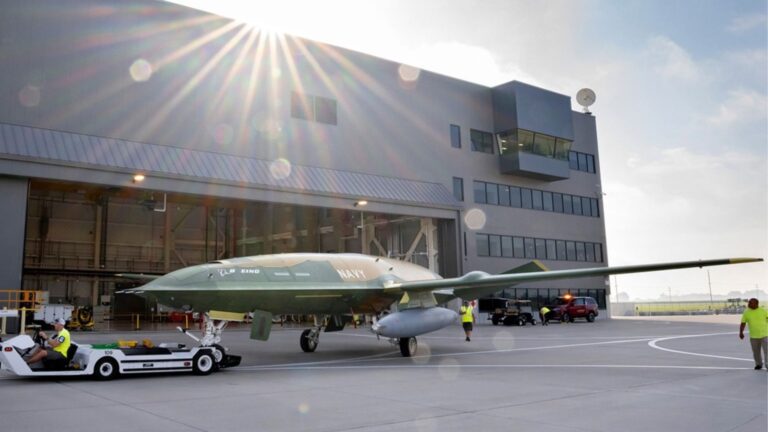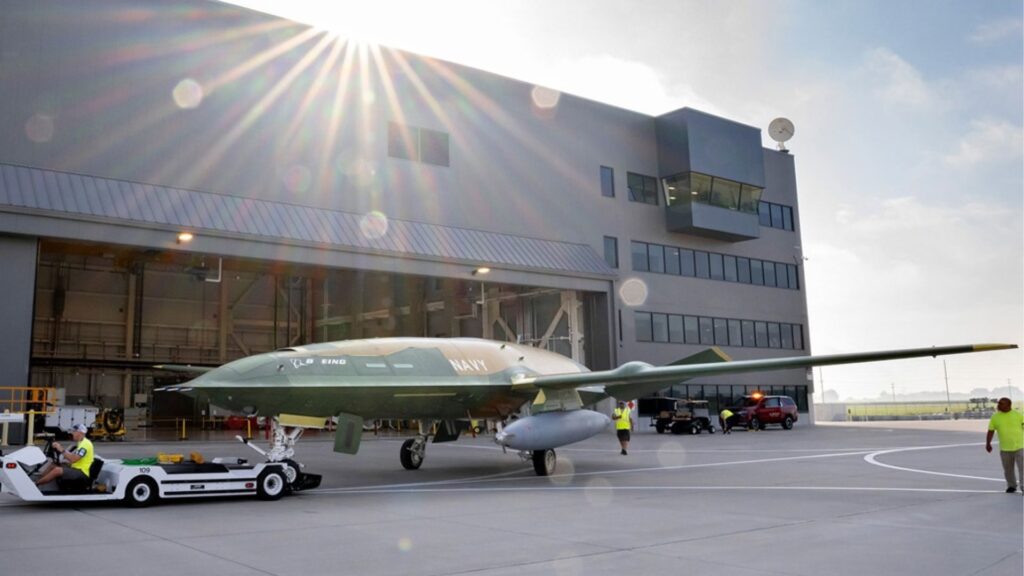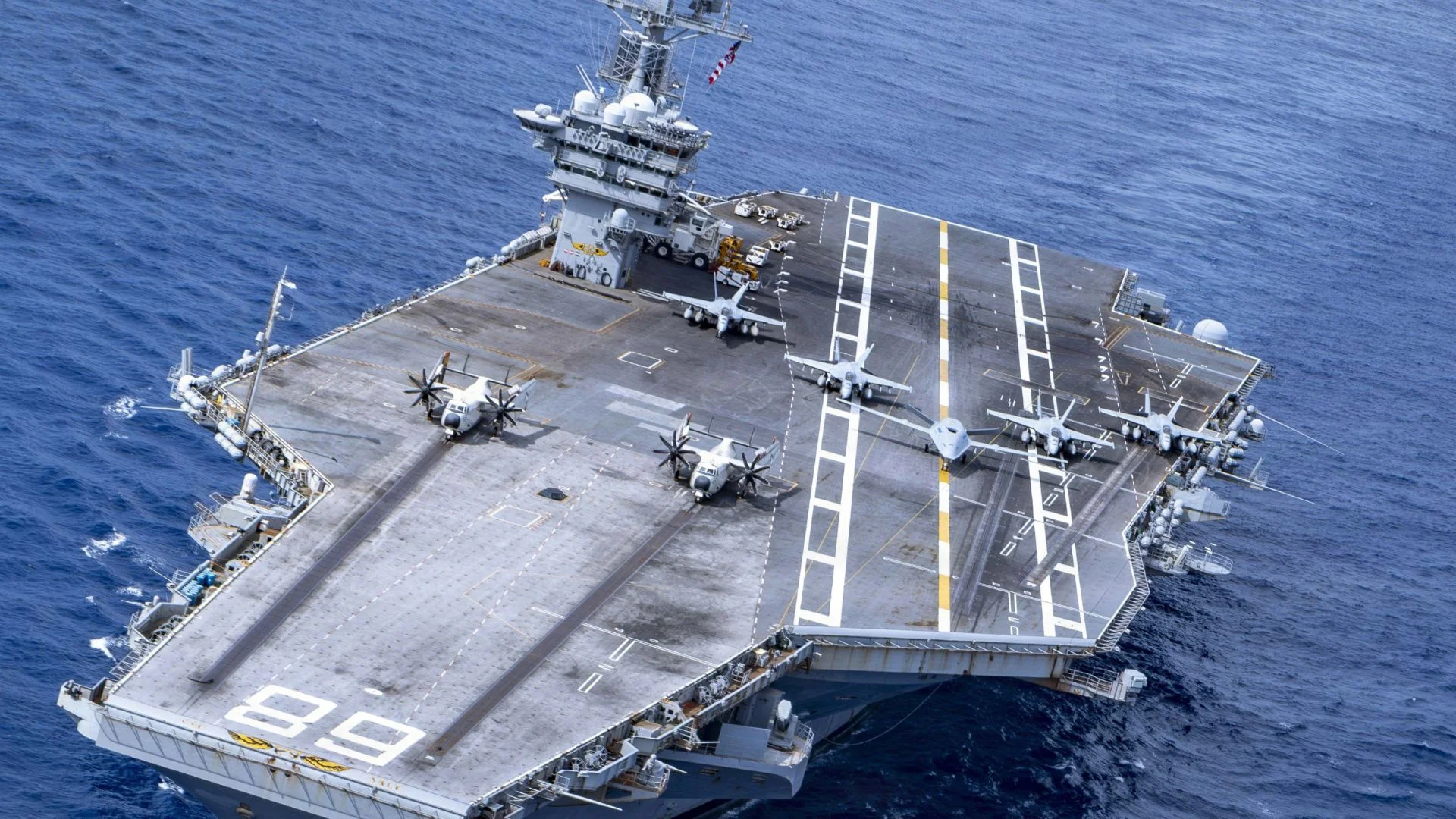
The US Navy has revealed new photographs of the Boeing-owned MQ-25 Stingray T1 demonstrator aboard the aircraft carrier USS Nimitz.
The aircraft was embarked during Fleet Exercise (FLEETEX) 250 in the Atlantic Ocean. The appearance marks another visible milestone in the Navy’s effort to introduce carrier-based uncrewed aircraft into frontline service.
The MQ-25 T1 demonstrator first flew in 2019 and continues to support testing and development activities. It represents the aircraft that helped prove the Navy’s new aerial refueling concept. While it is not a production aircraft, it remains an important part of the program.
Fleet Exercise 250 brought together the US and 13 partner and allied nations. The exercise focused on improving coordination between participating naval forces. It also tested tactical procedures and strengthened interoperability during complex maritime operations.
During one official photo session, the MQ-25 stood between four F/A-18E Super Hornet fighter jets. The images offered one of the clearest views yet of the drone alongside operational carrier aircraft. They also helped illustrate the aircraft’s overall size compared with the Super Hornet and the C-2 Greyhound transport aircraft.
This was not the first time the MQ-25 operated aboard an aircraft carrier. Boeing and the US Navy completed a flight deck demonstration aboard a carrier in December 2021. That event tested the drone’s remote handling system and confirmed that it could safely navigate the busy flight deck like other naval aircraft.
The aircraft now carries a plain gray paint scheme instead of the earlier gray-and-orange test colors. It also features new ‘250’ markings on both sides. Another visible marking reads ‘Boeing Backs America,’ reflecting the company’s participation in activities marking the US’s 250th anniversary.
The Navy has not explained whether the MQ-25 performed operational tasks during Fleet Exercise 250. Available photographs mainly show the aircraft during display activities. It was also seen without the Cobham Aerial Refueling Store mounted under its left wing.
READ ALSO: Skyryse Turns Robinson’s R66 Helicopter Into a Pilotless Military Drone
That refueling pod is one of the MQ-25’s most important mission systems. It allows the drone to transfer fuel to other aircraft while flying. Without the pod installed, the aircraft was not configured for aerial refueling operations during its appearance.
Boeing described the deployment as a look at the future of carrier aviation. The company said the aircraft’s presence aboard USS Nimitz honored America’s 250th anniversary. It also highlighted the future composition of the Navy’s carrier air wing.
Why the MQ-25 Stingray Is Important
The MQ-25 Stingray was developed under the Carrier-Based Aerial Refueling System program. That program evolved from the earlier Unmanned Carrier-Launched Airborne Surveillance and Strike project. The Navy eventually shifted its focus to building an uncrewed tanker rather than an armed strike drone.
Its main mission is simple but highly valuable. The MQ-25 refuels carrier-based aircraft while they remain in flight. This allows fighters to travel farther and stay on missions longer without returning to the carrier for fuel.
Today, many aerial refueling missions are conducted by F/A-18E/F Super Hornets carrying external fuel tanks. Those aircraft must give up weapons and combat missions to serve as tankers. The MQ-25 removes that burden by taking over the refueling role.
This change allows Super Hornets to carry more weapons instead of fuel tanks. More fighters also become available for combat operations rather than support duties. As a result, the overall effectiveness of a carrier air wing increases.
The drone also supports recovery tanking missions. These missions provide extra fuel to aircraft returning to the carrier if they need it before landing. In addition, the MQ-25 will perform intelligence, surveillance, and reconnaissance missions as a secondary role.
One of the program’s biggest achievements came in 2021. The MQ-25 completed the world’s first successful air-to-air refueling between an unmanned tanker and a manned military aircraft. The demonstration used the same Cobham Aerial Refueling Store carried by Navy Super Hornets.
Production Moves Forward
The MQ-25 program has recently entered a new stage of development. On April 25, 2026, Boeing completed the first flight of the production-representative MQ-25 aircraft. Soon afterward, the US Navy approved the program to move into Low-Rate Initial Production.
The Navy plans to acquire 76 MQ-25 aircraft, including engineering development and system demonstration aircraft. These aircraft will eventually serve across multiple carrier air wings. They will become the Navy’s first operational carrier-based unmanned aircraft.
WATCH ALSO: Tesla’s Optimus humanoid robot steals spotlight at ‘Tron: Ares’ premiere
To support future operations, the Navy established Unmanned Carrier-Launched Multi-Role Squadron Ten, known as VUQ-10, at Naval Air Station Patuxent River, Maryland, in October 2022. The squadron serves as the Fleet Replacement Squadron responsible for pilot and operator training. Two operational squadrons, VUQ-11 and VUQ-12, are also planned as the fleet expands.
Testing will continue over the coming months as engineers evaluate the aircraft’s performance. Additional flight sorties are scheduled before the MQ-25 moves to Naval Air Station Patuxent River for carrier qualification preparations.
Carrier qualification testing is expected to take place aboard USS Theodore Roosevelt, bringing the Navy another step closer to introducing the MQ-25 Stingray into regular carrier operations and reshaping the future of naval aviation.