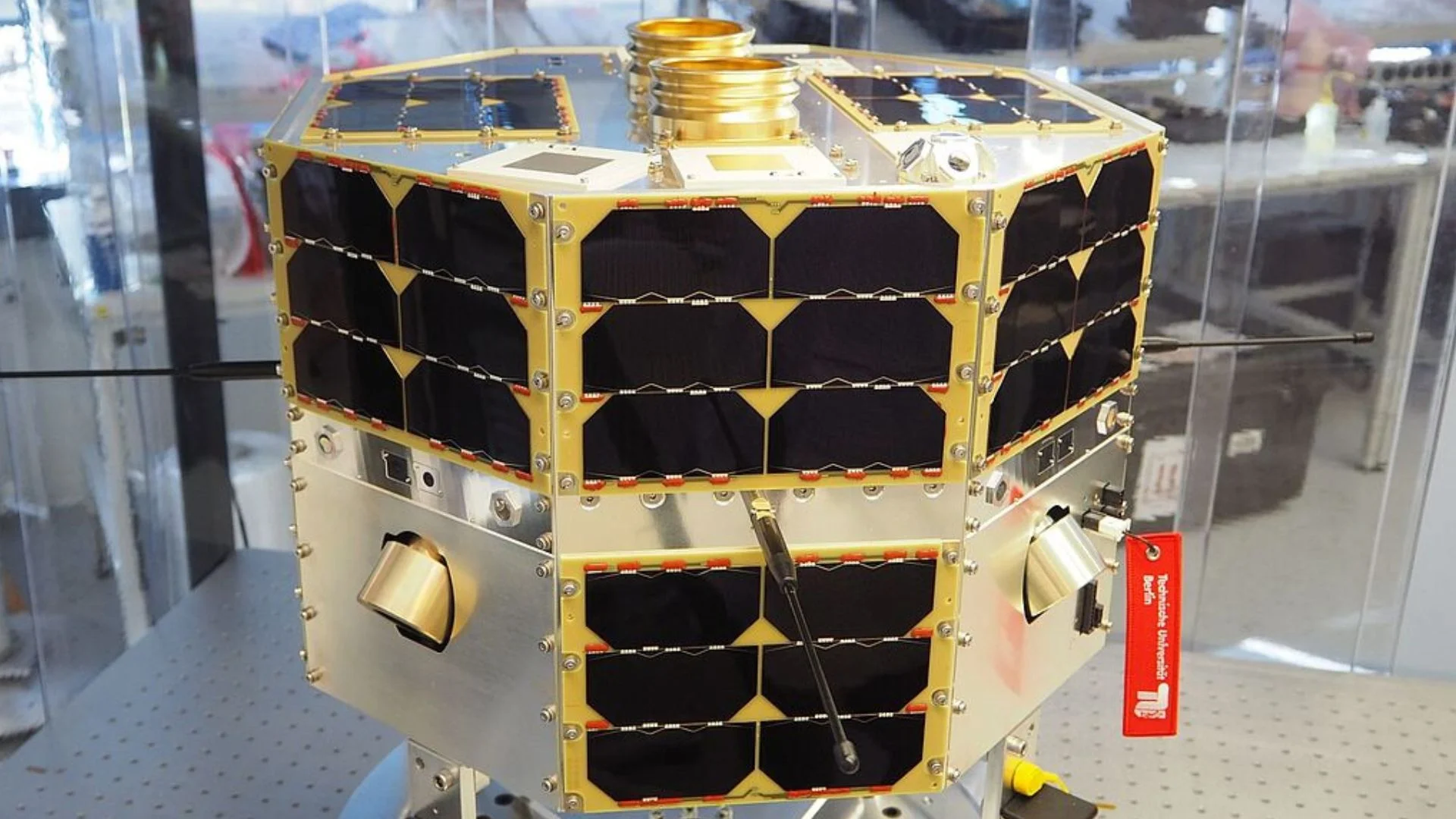
TU Berlin and its industry partners are developing a new lithium-sulfur battery system that aims to make satellites lighter, more efficient, and better prepared for future space missions.
Satellites spend part of every orbit in Earth’s shadow, where their solar panels stop producing electricity. During these periods, batteries become the only power source for onboard systems.
Researchers at the Technical University of Berlin (TU Berlin) are now working on a new battery system to improve how satellites store and use energy in space.
The project, called SpaceBox, brings together scientists and companies based in Berlin. Their goal is to develop a lighter, more efficient, and fully integrated battery system for future satellite missions. The project focuses on improving energy storage while meeting the strict safety and reliability standards required for space.
Lithium-Sulfur Technology Promises Higher Energy Storage
The heart of the SpaceBox project is a battery module built with lithium-sulfur technology. This type of battery stores much more energy than the lithium-ion batteries widely used in satellites today. The improvement allows satellites to carry the same amount of energy while reducing overall weight.
The research team expects the batteries to deliver energy densities above 300 watt-hours per kilogram (Wh/kg). Conventional lithium-ion batteries commonly used in space usually provide around 150 Wh/kg. That means the new batteries can potentially store about twice as much energy for the same weight.
Reducing weight is one of the biggest goals in satellite engineering. Every kilogram removed from a spacecraft lowers launch costs because rockets require less fuel to lift lighter payloads. The saved weight also creates room for additional scientific instruments, communication equipment, or other mission hardware.
Smaller battery systems also support the growing demand for compact satellites. Many modern missions rely on CubeSats and other small spacecraft that have limited space and weight capacity. Better batteries allow these satellites to perform more complex tasks without increasing their size.
Satellites depend on batteries whenever they move into Earth’s shadow during each orbit. Solar panels cannot generate electricity without sunlight, making stored energy essential for uninterrupted operations. Batteries also provide extra power whenever onboard systems temporarily need more electricity than solar panels can supply.
The SpaceBox battery is designed as a fully integrated module instead of a collection of separate components. Engineers are combining battery cells, electronics, and management systems into one compact unit. This design helps improve efficiency while reducing unnecessary weight and complexity.
READ ALSO: Scientists Find Cheaper Way to Make Rare R8 Silicon for Batteries, Electronics
SpaceBox Enters Testing Phase
Building a battery for space requires much more than increasing energy storage. Every component must continue working under extreme temperatures, strong vibrations, radiation, and the vacuum of space. The research team is testing the complete battery system under these demanding conditions before it is approved for future missions.
The Aerospace Engineering Department at TU Berlin leads many of these qualification tests. Engineers examine the battery cells, electronic systems, battery management software, and complete battery module. Their goal is to confirm that the system performs safely and reliably throughout a mission.
Testing includes thermal-vacuum experiments that simulate the temperature changes and the airless environment of space. Engineers also conduct shock and vibration tests that simulate the forces encountered during rocket launches. Charge and discharge cycles measure how well the batteries perform after repeated use.
Radiation testing is another important part of the project. Satellites in low Earth orbit receive protection from Earth’s magnetic field, but radiation exposure increases as spacecraft travel farther away. High radiation levels can damage electronics and reduce battery performance over time.
Researchers want to understand how the battery behaves under different mission conditions. The tests also help engineers identify operational limits before the technology is used in real spacecraft. This process improves reliability and reduces the risk of failures once satellites are launched.
The first target application is low Earth orbit, where thousands of satellites currently operate. However, the research team is also considering future missions beyond this region. Batteries that survive higher radiation environments could support exploration missions deeper into space.
TU Berlin Leads System Integration
TU Berlin plays a central role in the SpaceBox consortium by serving as the system integrator. The university defines the technical requirements for the battery module and oversees its development. It also coordinates testing and combines all parts into a complete, working system.
One of the most important components is the battery management system. This electronic control system constantly monitors each battery cell during operation. It checks voltage, current, temperature, and the state of charge to ensure safe performance.
Continuous monitoring allows the system to detect problems before they become serious. If abnormal conditions occur, protective measures can be automatically activated. This improves safety and helps protect expensive satellite equipment.
The battery management system also balances energy across all battery cells. Keeping every cell at similar charge levels reduces uneven wear over time. As a result, battery performance remains stable for longer missions.
The new system builds on knowledge gained from earlier TU Berlin satellite programs. Engineers previously developed battery technologies for the successful TechnoSat and TUBIN satellite missions. Experience from those projects has already produced qualified hardware and modular software that now supports the SpaceBox program.
Philipp Werner, a systems engineer at TU Berlin’s Aerospace Engineering Department, said the project combines years of satellite development experience with advanced battery technology.
He explained that the goal is to create a fully integrated, space-qualified energy storage system that improves future satellite missions. He also noted that having a strong German supplier for space battery cells strengthens the country’s space industry and reduces dependence on international sources.
READ ALSO: Vanguard Opens as First US Underwater Habitat in 40 Years in the Florida Keys
The project includes battery developer Theion GmbH, which is creating the lithium-sulfur cells. Space Structures GmbH is responsible for designing a lightweight but durable battery housing. Together with TU Berlin, the partners combine expertise in battery chemistry, spacecraft engineering, and structural design.
The German Federal Ministry of Education and Research funds the project through the German Aerospace Center (DLR). The program has a budget of around €3 million and will run for 30 months. The funding supports research, testing, engineering, and final qualification of the battery system.
Beyond developing new technology, the project also supports education and workforce development. Doctoral researchers, students, and student assistants actively participate in battery research and spacecraft engineering. They gain practical experience in energy storage, battery management, system integration, and space technologies.
TU Berlin has extensive experience in satellite development that supports this effort. Since 1991, the university has participated in the launch and operation of 31 small satellites. Its current research includes CubeSats, microsatellites, and future missions to destinations such as the Moon and Venus.
As satellite missions continue to expand for communications, Earth observation, science, and exploration, reliable energy storage is becoming important. Lighter batteries with higher energy capacity can improve mission efficiency while reducing launch costs and increasing operational flexibility.
If the SpaceBox project achieves its objectives, it will provide a new generation of space-qualified batteries that support more capable satellites and strengthen Europe‘s future space missions.