Japanese electric aircraft developer SkyDrive has reached an important milestone in the development of its compact air taxi, an electric vertical takeoff and landing (eVTOL) aircraft.
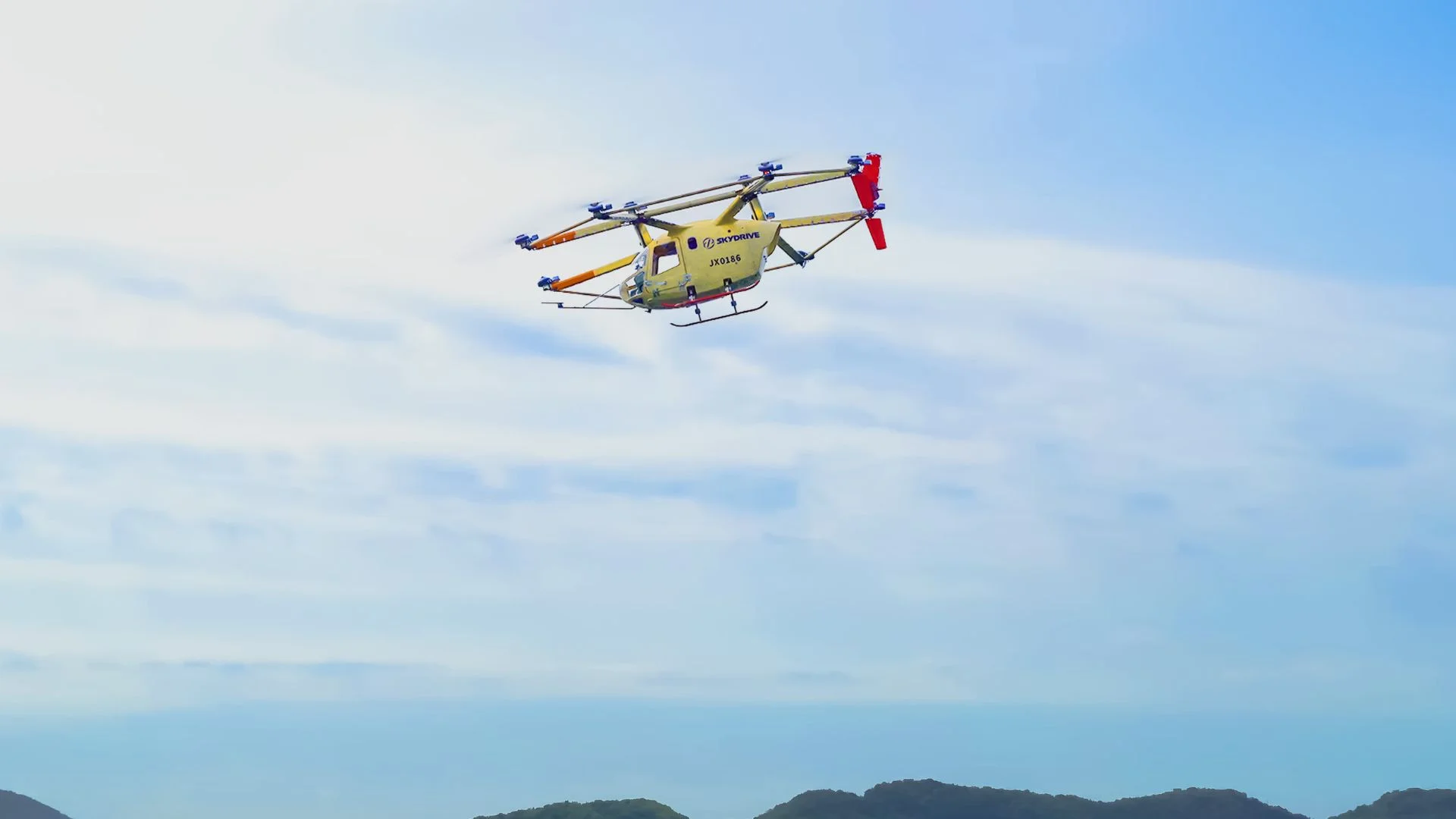
The company successfully flew its SKYDRIVE Model SD-05 at 100 kilometers per hour during a series of flight tests. The achievement provides valuable data to support the aircraft’s design and moves the program closer to certification and to commercial operations planned for 2028.
The company said the aircraft remained stable while demonstrating reliable handling and predictable flight characteristics. Engineers also verified the performance of the propulsion system, flight controls, and onboard avionics during the tests.
The successful tests provide much more than a new speed record for the aircraft. They help engineers compare real flight performance with predictions from computer simulations and engineering analyses. Matching those results increases confidence that the aircraft is performing as designed.
Aircraft development follows a long process before commercial service becomes possible. Engineers first create digital designs and run computer simulations before testing individual systems on the ground. Full-scale flight testing comes only after these earlier stages are completed successfully.
Flight testing remains one of the most important stages of aircraft development. Some aircraft behaviors only become visible when the aircraft is actually flying. This becomes even more important during high-speed flights, when aerodynamic forces and structural loads increase significantly.
As speed increases, vibrations become stronger and flight control systems work much harder to keep the aircraft stable. Engineers also monitor how different systems interact under real operating conditions. The collected information helps identify any unexpected behavior before certification.
READ ALSO: US Space Force Backs Orbital Composites With $1.9M to Scale Extreme Heat Manufacturing
SkyDrive explained that its aircraft follows a different design philosophy than traditional airplanes or helicopters. Instead of fixed wings, the aircraft relies on multiple electric rotors to generate lift and control movement. That means engineers cannot simply depend on decades of data collected from conventional aircraft.
SkyDrive Air Taxi Tested
Because the aircraft represents a new category of aviation, every stage of testing becomes especially valuable. Engineers must gather fresh data that reflects the unique flight characteristics of the multicopter design. Regulators also require this evidence before approving commercial passenger operations.
The company said reaching 100 km/h demonstrates that its engineering approach is working as expected. High-speed flight creates new aerodynamic conditions that place greater stress on the aircraft structure and flight systems. Successfully handling those conditions confirms that the design remains stable during faster operations.
The flight campaign also validated the aircraft’s controllability and maneuverability. Pilots maintained stable flight while engineers monitored structural performance and system responses throughout the tests. The collected information closely matched the behavior predicted during the design phase.
This result is important because differences between simulation and actual flight sometimes require major redesigns. Unexpected performance can delay certification and increase development costs. SkyDrive said its latest testing did not reveal significant differences between prediction and reality.
The company believes this milestone improves visibility for the remaining stages of development. Engineers can now continue expanding the aircraft’s flight envelope with greater confidence. Each successful test reduces uncertainty as the certification program progresses.
Another important objective was to prove the practicality of SkyDrive’s compact multicopter design. Unlike many eVTOL aircraft that include fixed wings for forward flight, SkyDrive has chosen a simpler configuration with twelve independently controlled electric rotors. A central flight control computer continuously manages these rotors to keep the aircraft balanced.
WATCH ALSO: A giant mobile elevated work platform has been launched
According to the company, the compact design offers several operational advantages. Smaller aircraft require less space for takeoff and landing, making them better suited for crowded urban environments. A simpler airframe also helps reduce maintenance needs and operating costs over the aircraft’s service life.
Compact Design Supports Urban Air Mobility
SkyDrive believes its aircraft is designed specifically for short-distance urban transportation. The compact multicopter configuration allows the aircraft to operate in places where larger aircraft would face space limitations. This makes it suitable for connecting cities, airports, business districts, and other destinations with short flight times.
The company says proving safe flight at higher speeds is essential for making urban air mobility practical. Commercial air taxi services must travel fast enough to save passengers time while maintaining high safety standards. The latest tests show that the aircraft can continue moving toward those operational goals.
The aircraft uses twelve independent electric rotors that work together under a central flight control system. If flight conditions change, the system continuously adjusts rotor output to maintain stable flight. The recent testing confirmed that this architecture performs as expected during high-speed forward flight.
For SkyDrive, reaching 100 km/h represents more than achieving a performance figure. It confirms that the multicopter concept remains stable under more demanding flight conditions. That confidence becomes increasingly important as testing moves toward even higher operating speeds.
Years of Testing Built This Milestone
The latest achievement is the result of years of engineering work and gradual testing. SkyDrive has steadily expanded its flight test program since developing its earlier SD-03 prototype. Over that time, the company has completed hundreds of test flights while refining aircraft systems.
The development program also extends far beyond flight testing alone. Engineers have performed standalone testing of batteries, electric motors, and rotor systems to evaluate reliability and performance. Each component must meet strict safety and durability requirements before certification.
Aerodynamic performance has also been evaluated through wind-tunnel testing conducted by the Japan Aerospace Exploration Agency (JAXA). These tests help engineers understand how air flows around the aircraft at different speeds and flight attitudes. The information is then compared with data collected during actual flights.
SkyDrive has also completed ground vibration testing before expanding flight operations. These tests measure how the aircraft structure responds to different loads and operating conditions. Understanding these responses helps engineers improve structural safety and long-term durability.
The company follows a careful step-by-step approach throughout the flight test campaign. Engineers review data collected after every flight before approving more demanding test profiles. This process helps reduce risk while allowing gradual expansion of the aircraft’s capabilities.
Data collected from lower-speed flights plays an important role in future testing. Engineers use this information to fine-tune the flight control software before attempting higher speeds. Pilots also provide detailed feedback after every mission to support further improvements.
Certification Work Continues
The global eVTOL industry has entered a new stage of development. Many companies have already demonstrated that electric vertical flight is possible. The industry’s main focus has now shifted toward certification, safety validation, and preparing aircraft for commercial passenger service.
READ ALSO: Western Star Launches Nevada Tungsten Exploration Ahead of US Defense Procurement Deadline
Certification authorities require manufacturers to demonstrate that every aircraft system operates safely across a wide range of operating conditions. This includes demonstrating stable flight, structural integrity, reliable flight controls, and consistent system performance. Extensive flight testing provides much of the evidence needed during this process.
SkyDrive plans to continue expanding the flight envelope of the SKYDRIVE Model SD-05 in future test campaigns. Engineers will collect additional data at higher operating speeds while confirming that the aircraft continues to match its original design predictions. Every successful test brings the company one step closer to regulatory approval.
The company continues targeting commercial operations in 2028. If development progresses as planned, the SKYDRIVE aircraft will become part of a growing generation of electric air vehicles designed to improve short-distance transportation. The latest 100 km/h milestone marks another important step toward bringing compact electric air mobility into everyday commercial use.