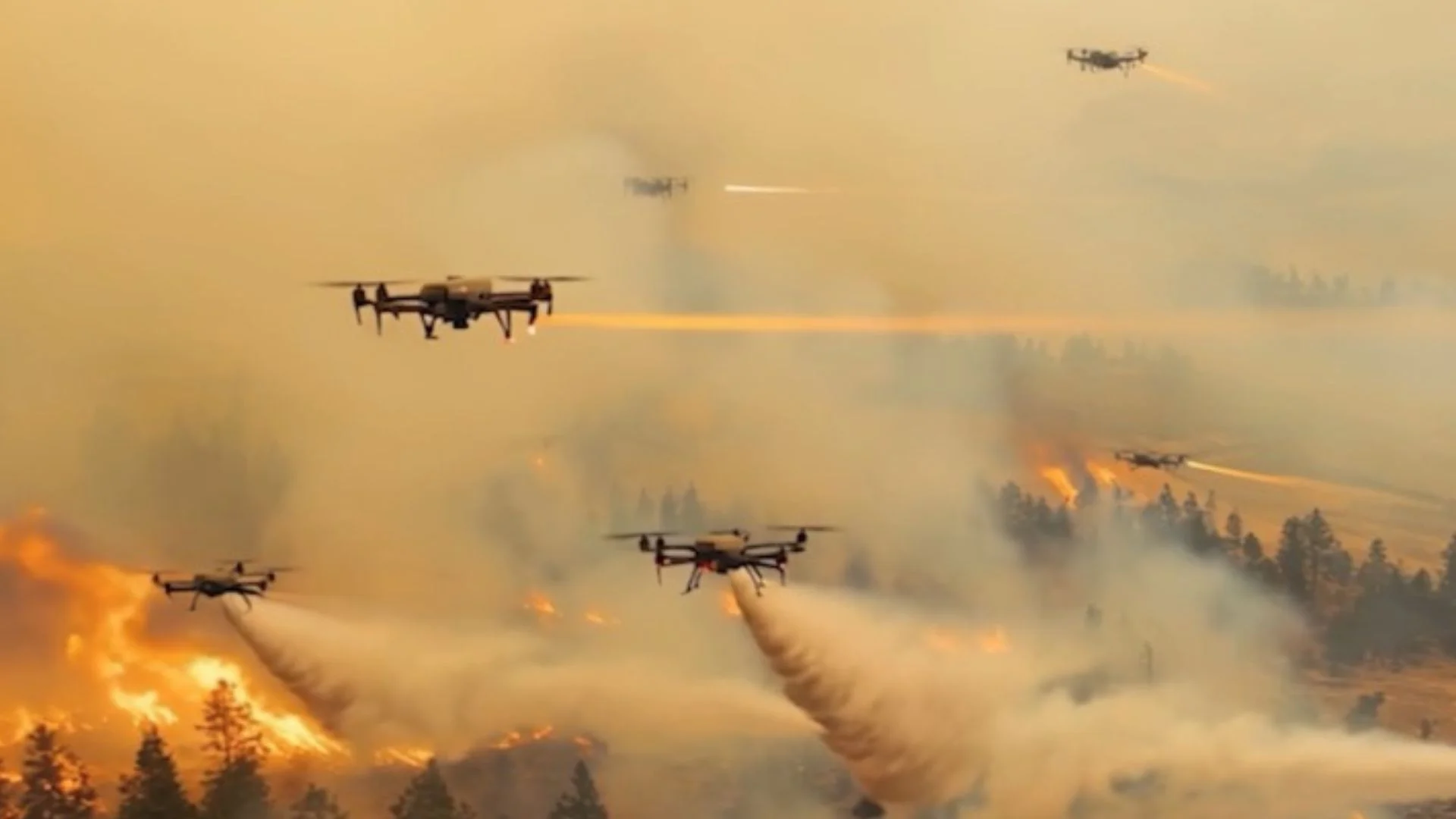
The US Army has demonstrated a new artificial intelligence-powered drone swarm capability during its Ivy Mass exercise.
The test demonstrated that a single soldier can manage multiple autonomous drones through a single control system. The effort reflects the military’s increasing focus on AI and autonomous technologies for future operations.
The demonstration was conducted with support from defense technology company Palladyne AI. The company integrated its SwarmOS autonomy software into a group of military drones. The system was also connected to the Army’s Next-Generation Command and Control network(NGC2).
The exercise involved several types of unmanned aircraft. These included intelligence, surveillance, and reconnaissance drones as well as the Gremlin-X reusable mini-bomber. Together, the aircraft operated as a coordinated team rather than as separate systems.
SwarmOS served as the central software platform during the test. The AI system enabled the drones to communicate, share information, and autonomously carry out assigned tasks. Human operators remained in control of mission objectives while the software handled much of the coordination.
One of the most important parts of the demonstration was the ability to operate in communications-contested environments. In modern warfare, communication networks can be disrupted by enemy jamming or cyber attacks. The system was designed to continue functioning even when access to cloud-based services was unavailable.
The AI software ran directly on the drones and supporting hardware. This approach is often described as edge computing. It enables data processing and decision-making to occur close to where information is collected, rather than relying on distant servers.
READ ALSO: Quantum Sensor Defeats Noise Barrier, Opening New Path to Dark Matter Detection
According to Palladyne AI, the software was designed for size-, weight-, and power-constrained hardware. These limitations are important for military drones because aircraft must carry lightweight equipment. Efficient software helps preserve flight performance while supporting advanced capabilities.
During the exercise, the drones worked together as a coordinated network. Information gathered by one aircraft could support the actions of another. This created a broader and more detailed picture of the battlefield for operators.
The connection to the Army’s NGC2 network added another layer of capability. Target information and tracking data were shared across command systems in real time. This allowed military personnel to receive updated battlefield information as events unfolded.
Military planners view drone swarms as force multipliers. Instead of controlling each aircraft individually, operators can assign missions to a group of drones. The AI system then manages many of the details required to complete those tasks.
This approach reduces operator workload significantly. Traditional drone operations often require dedicated personnel for each aircraft. Swarm technology enables a single soldier to oversee multiple drones through a single interface.
Palladyne AI stated that even personnel with limited training could use the system effectively. Simplifying drone control is an important goal as militaries seek to expand the use of autonomous platforms. An easier operating environment allows units to deploy advanced technology more quickly.
Denis Garagić, Chief Technology Officer and co-founder of Palladyne AI, said the demonstration achieved an important milestone for battlefield autonomy.
He explained that the software transformed individual drones into a coordinated, multi-sensor team. This provided operators with greater situational awareness while maintaining a simple user experience.
Doug Dynes, President of Palladyne Aerospace and Defense, highlighted the operational value of the exercise. He said the event placed the company’s autonomous technology directly in soldiers’ hands. The demonstration provided an opportunity to evaluate how the system performs in realistic military conditions.
The growing interest in drone swarms is not limited to the US. Several countries are investing heavily in autonomous systems for reconnaissance, surveillance, logistics, and combat missions. Military organizations view AI as a way to improve efficiency while expanding operational capabilities.
WATCH ALSO: Apple launches iPhone 17 lineup with contoured edges, and thinner borders
Drone swarms also offer advantages over traditional single-aircraft operations. Multiple drones can cover larger areas, collect more data, and continue missions even if one platform is lost. This distributed approach improves resilience and mission effectiveness.
Drone Swarm Transforms Battlefield Control
The Ivy Mass demonstration comes as the US military accelerates efforts to modernize command and control systems. Future battlefield concepts rely on faster information sharing and quicker decision-making. AI-powered autonomy is becoming an important part of achieving those goals.
The test also demonstrated how autonomous systems can support human decision-makers rather than replace them. Soldiers remained responsible for mission oversight and critical choices. The AI handled routine coordination tasks, allowing personnel to focus on higher-level decisions.
The successful Ivy Mass exercise provides another example of how autonomous systems are moving from experimental concepts into practical battlefield tools. Future testing will focus on expanding these capabilities and integrating them into larger military networks.