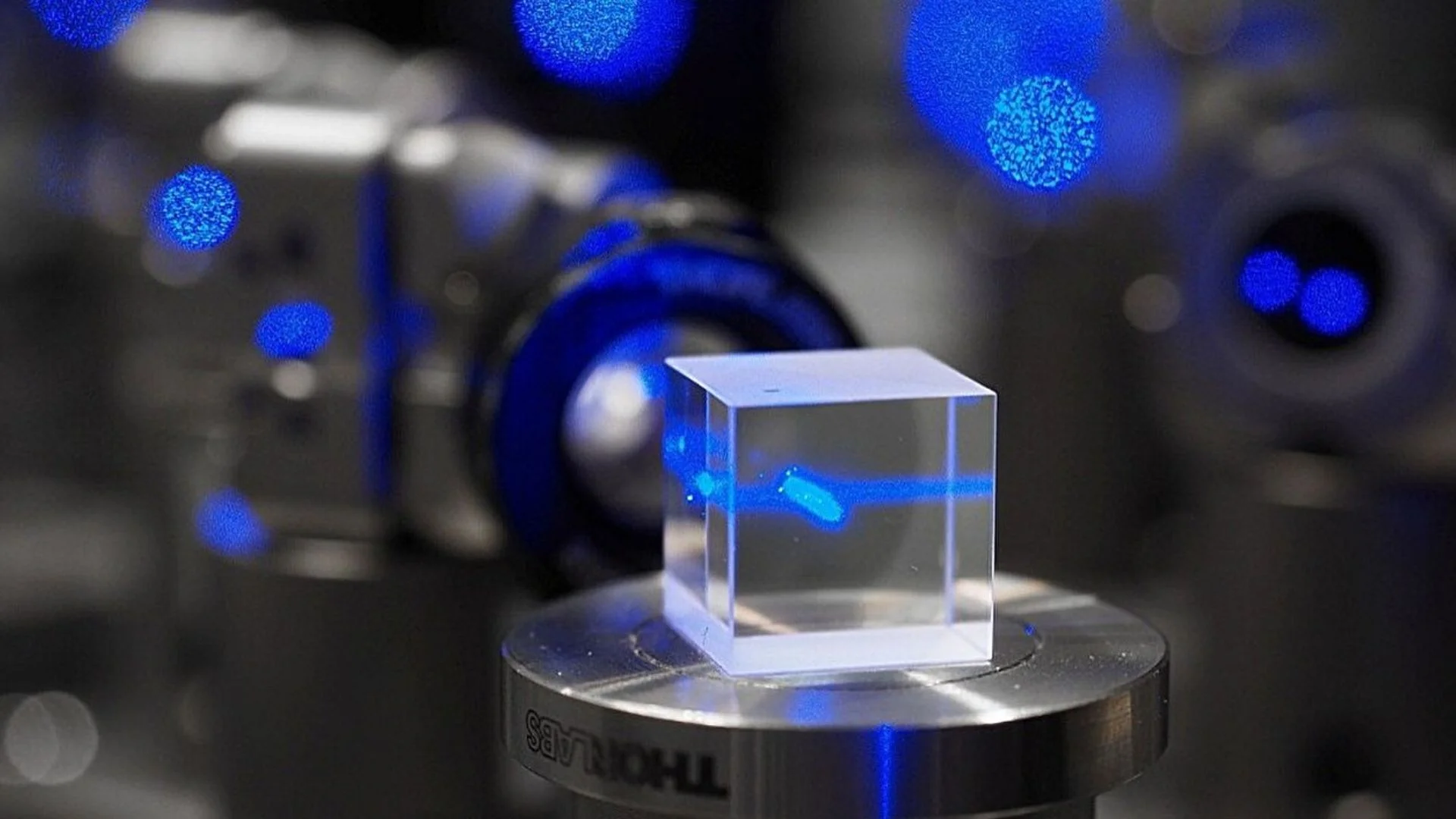
Researchers at Imperial College London have demonstrated a quantum sensor technique that overcomes a major obstacle facing next-generation physics experiments.
The new study shows how scientists can cancel out substantial measurement noise and recover extremely weak signals. This capability is essential for future efforts to detect dark matter and observe gravitational waves from the early universe.
The work was carried out as part of the Atom Interferometer Observatory and Network(AION). The collaboration brings together researchers from several institutions across the UK. Their goal is to develop advanced quantum technologies that can probe parts of the universe beyond the reach of current instruments.
The findings were published in the journal Nature.
They provide the first experimental demonstration of a key measurement method needed for future long-baseline atom interferometers. These devices are expected to play an important role in the next generation of fundamental physics experiments.
Scientists still do not know what most of the universe is made of. Dark matter is believed to account for a large portion of the universe’s mass, yet it has never been directly detected. At the same time, researchers are searching for new types of gravitational waves that carry information from distant cosmic events and the earliest moments after the Big Bang.
Detecting such signals is extremely difficult because they are incredibly small. Even tiny disturbances from the environment or experimental equipment can hide them. Finding ways to separate genuine signals from unwanted noise remains one of the biggest challenges in modern physics.
READ ALSO: From Waste to Nylon: Scientists Turn Lignin Into High-Value Adipic Acid With Higher Yield
One promising solution is the atom interferometer. This instrument uses lasers to manipulate clouds of ultracold atoms and measure their motion with exceptional precision. By tracking how atoms behave under carefully controlled conditions, scientists can search for tiny effects caused by dark matter or gravitational waves.
The basic principle is similar to comparing two highly accurate rulers. If both rulers experience the same disturbance, researchers can compare their measurements and remove the common error. What remains could reveal a previously hidden signal.
Long-baseline atom interferometers use two separate clouds of atoms positioned at different locations. A single laser interacts with both atomic clouds during the measurement process. Scientists then compare the behavior of the two atom groups to identify subtle differences.
However, this approach faces a major technical challenge. The laser itself introduces phase noise, a type of fluctuation that degrades measurement precision. In many cases, this noise is far stronger than the signals researchers are trying to detect.
If left uncorrected, laser phase noise can completely overwhelm the experiment. Important information becomes buried beneath random fluctuations. As a result, the true signal becomes impossible to identify.
For years, scientists proposed a solution known as differential measurement. The idea is to compare two interferometers so that shared laser noise cancels out naturally. Although the concept was widely accepted, it had not been demonstrated under realistic experimental conditions until now.
To test the method, researchers built a tabletop prototype in the Imperial Ultracold Strontium Laboratory. The experiment used two separate clouds of ultracold strontium-87 atoms. Both clouds were measured using a highly stable clock laser.
The setup was designed to mimic conditions expected in much larger future facilities. Such facilities will operate over far greater distances and face even greater challenges from measurement noise. Demonstrating the technique on a smaller scale was an important step toward future expansion.
READ ALSO: Organic Transistor Combines Memory, Computing and Light at Under 3.5V for Wearables
The team deliberately made the experiment more difficult. They introduced significant additional phase noise into the laser system. The added noise was stronger than expected from the laser itself.
As a result, each interferometer became unusable. The normal interference patterns disappeared beneath the noise. Looking at either measurement alone revealed no useful information.
The situation changed when researchers compared the two interferometers. Even though each signal appeared random, their shared behavior allowed the noise to be removed. The underlying measurement became visible again.
The recovered signal reached the fundamental sensitivity limit allowed by quantum physics. This showed that the noise-cancellation strategy worked exactly as intended. It also confirmed that future large-scale systems can rely on the same principle.
Researchers then conducted an additional test. They inserted an artificial oscillating signal into the experiment. The signal was designed to resemble effects that might be produced by dark matter or passing gravitational waves.
Despite the overwhelming background noise, the system successfully detected the inserted signal. Neither interferometer could identify it independently. The signal only emerged when the measurements were combined using the differential approach.
According to Dr. Charles Baynham, co-lead of the Ultracold Strontium Laboratory, advances in quantum sensor technology are now enabling exploration of previously inaccessible parts of the universe.
He said the team is proud to help transform these concepts into practical scientific instruments. He also noted that future versions could eventually detect signals linked to distant black hole mergers.
Dr. Richard Hobson, who also co-leads the laboratory, said the project combines some of the most precise tools ever developed. These include atomic clocks and atom interferometers.
He explained that adapting these technologies creates new opportunities to investigate dark matter and other hidden aspects of the universe.
Quantum Sensor Cancels Noise
The success of the experiment supports broader plans for future quantum observatories. Within the AION program, scientists are working to scale up the technology dramatically. Larger facilities would provide much greater sensitivity and access to entirely new regions of physics.
WATCH ALSO: Swiss company’s new ‘brain’ to help robots conduct real-life tasks autonomously
The research is also connected to international projects beyond the UK. AION collaborates closely with the MAGIS program at Fermilab in the US. Both efforts aim to develop large-scale atom interferometers capable of addressing fundamental scientific questions.
Another proposed initiative is the Atom Interferometry CERN Experiment(AICE). The concept would apply similar techniques over much longer distances. If approved, it would introduce a new category of quantum sensing research at CERN.
Such facilities would rank among the largest quantum experiments ever constructed. Their scale would allow scientists to search for faint signals that remain invisible to existing observatories. They could also complement traditional gravitational-wave detectors by exploring different frequency ranges.
Professor Oliver Buchmueller, principal investigator of the AION collaboration, described the achievement as an important milestone.
He said the results validate a crucial measurement technique under realistic conditions. The work strengthens confidence in the design of future atom interferometer facilities being planned worldwide.
The study arrives at a time when quantum technologies are rapidly advancing. Governments, research institutions, and industry groups are investing heavily in quantum sensing, computing, and communications. Many experts view quantum sensors as one of the most promising near-term applications of quantum science.
By proving that large amounts of measurement noise can be effectively canceled, the Imperial-led team has addressed a central challenge in the field. The result provides a practical foundation for building larger and more powerful quantum observatories.