The US Army has taken a major step toward strengthening its rapid-deployment capabilities by transforming a cavalry unit in Alaska into an airborne infantry force.
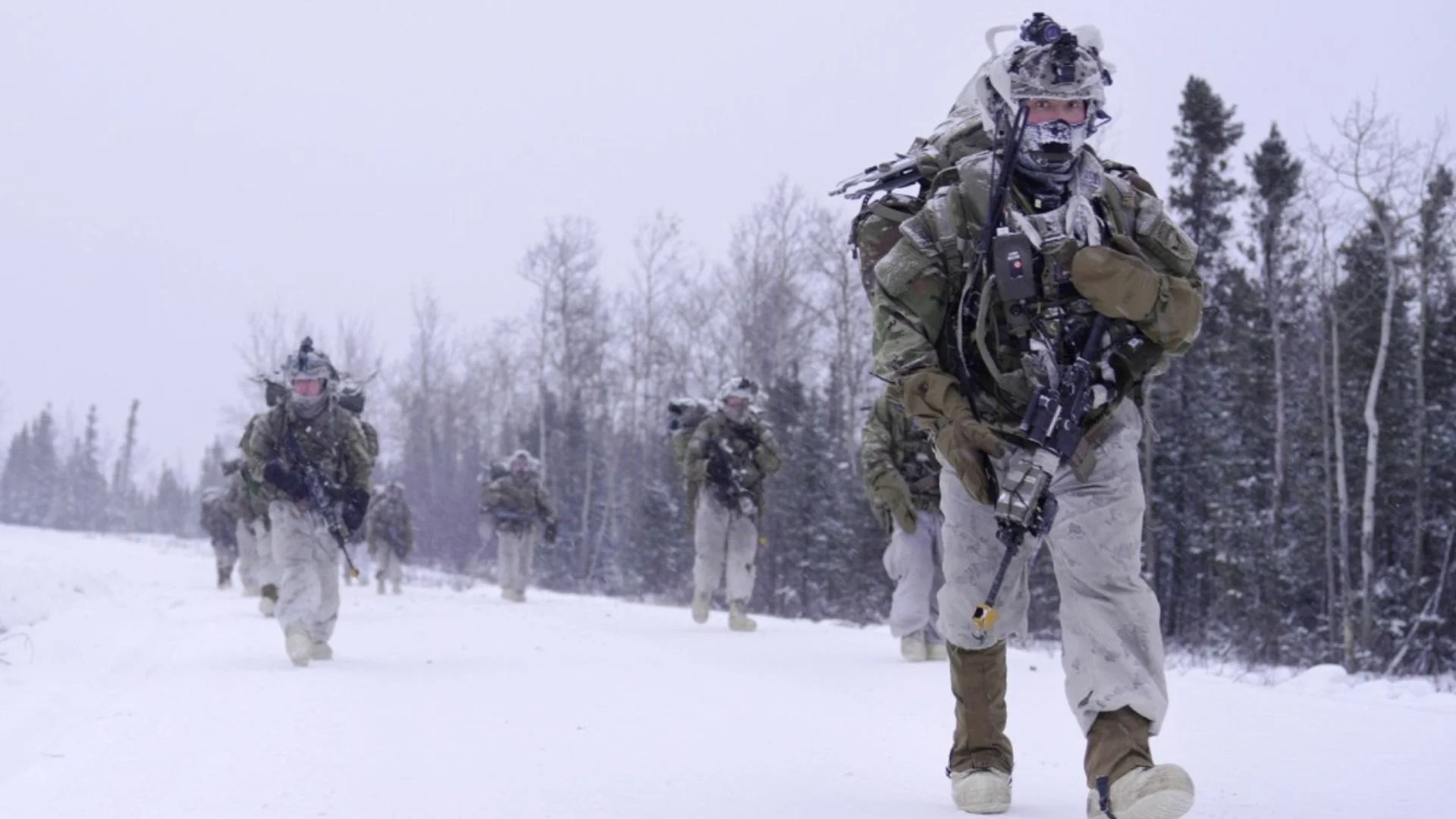
The change was demonstrated during Exercise Red Flag-Alaska 26-2 at Joint Base Elmendorf-Richardson in Alaska. The exercise highlighted the unit’s new focus on airborne assault and expeditionary operations.
The unit currently operates as the 1st Squadron, 40th Cavalry Regiment. Next month, it will officially become the 1st Battalion, 511th Parachute Infantry Regiment. The redesignation marks a significant shift in mission, training, and operational responsibilities.
Exercise Red Flag-Alaska 26-2 was the cavalry squadron’s final major training event before the official transition. Soldiers trained alongside the US Air Force and multinational partners in a complex joint environment.
The exercise focused on preparing troops for airborne operations. Soldiers conducted mission planning, rehearsals, operational wargaming, and leadership briefings. They also worked closely with Army aviation units operating from Bryant Army Airfield.
An airborne infantry battalion has a different mission from a traditional cavalry squadron. Cavalry units mainly perform reconnaissance, security, and screening tasks. Airborne infantry units are trained to enter contested areas quickly and establish a combat presence on the ground.
The future battalion will specialize in airborne forcible-entry operations. These missions involve parachuting troops into strategic locations before larger forces arrive. Soldiers can secure airfields, seize critical terrain, and create safe entry points for follow-on units.
READ ALSO: China’s Giant Helicopter Coil Array Is Rewriting the Rules of Underground and Underwater Detection
Alaska’s Strategic Arctic Edge
This capability is becoming increasingly important for the US military. Military planners expect future conflicts to involve long distances and limited infrastructure. In such situations, airborne forces can reach key locations without depending on ports, roads, or existing logistics networks.
The transition is especially important for Alaska-based forces. Alaska sits at a strategic location between North America, the Arctic, and the Indo-Pacific region. Its geography makes it a valuable base for responding quickly to developments across multiple theaters.
The Arctic has become important to the military in recent years. Melting sea ice is opening new shipping routes and increasing access to natural resources. Several countries are expanding their activities in the region, making military readiness a growing priority.
At the same time, the Indo-Pacific remains one of the most strategically important regions in the world. The vast distances involved require forces that can deploy rapidly and operate independently. Airborne units are designed to meet those requirements.
Red Flag-Alaska also strengthened cooperation between different branches of the US military. Modern airborne operations require close coordination among transport aircraft, ground forces, command networks, and aviation support units. The exercise tested these connections under realistic operational conditions.
Military leaders view joint operations as essential for future missions. Success often depends on how quickly different services can work together. Exercises like Red Flag-Alaska help identify challenges before real-world deployments occur.
READ ALSO: New Sound Waves Scattering Rule Unlocks Smarter Soundproofing Across Wider Frequencies
The transition also revives one of the Army’s historic airborne formations. The 511th Parachute Infantry Regiment earned distinction during World War II operations in the Pacific Theater. Its soldiers participated in several major campaigns and helped build the unit’s enduring reputation.
The redesignation reconnects the formation with that legacy. Army leaders increasingly use historic unit identities to strengthen traditions and morale. At the same time, the restored designation reflects modern operational requirements.
The move also highlights the 11th Airborne Division’s long-standing role in airborne warfare. The division played a key role during the Knollwood Maneuver in December 1943. That exercise helped demonstrate the effectiveness of large-scale airborne operations and secured the future of the US Army’s airborne forces.
More than 80 years later, the division is again helping shape the future of airborne warfare. New technologies, changing threats, and strategic competition are driving the evolution of military operations. Airborne forces remain a key tool for delivering combat power quickly when time is limited.
The conversion of a cavalry squadron into a parachute infantry battalion represents a major increase in expeditionary capability. The new battalion will give commanders a force that can rapidly enter contested environments and establish control of key locations. That flexibility is especially valuable during the early stages of a crisis.
WATCH ALSO: Called Ascentia, the platform is developed by American company Collins Aerospace
Training during Red Flag-Alaska showed that the transformation is already well underway. Soldiers are increasingly planning and operating as an airborne infantry formation rather than a reconnaissance unit. The official reflagging ceremony will formalize a transition already evident in day-to-day operations.
As the US military places greater focus on the Arctic and Indo-Pacific, the new 1st Battalion, 511th Parachute Infantry Regiment is expected to play an important role. Its ability to deploy rapidly, integrate with joint forces, and operate in challenging environments supports the Army’s broader strategic goals. The unit’s evolution reflects the Army’s adaptation of its forces to future military demands.