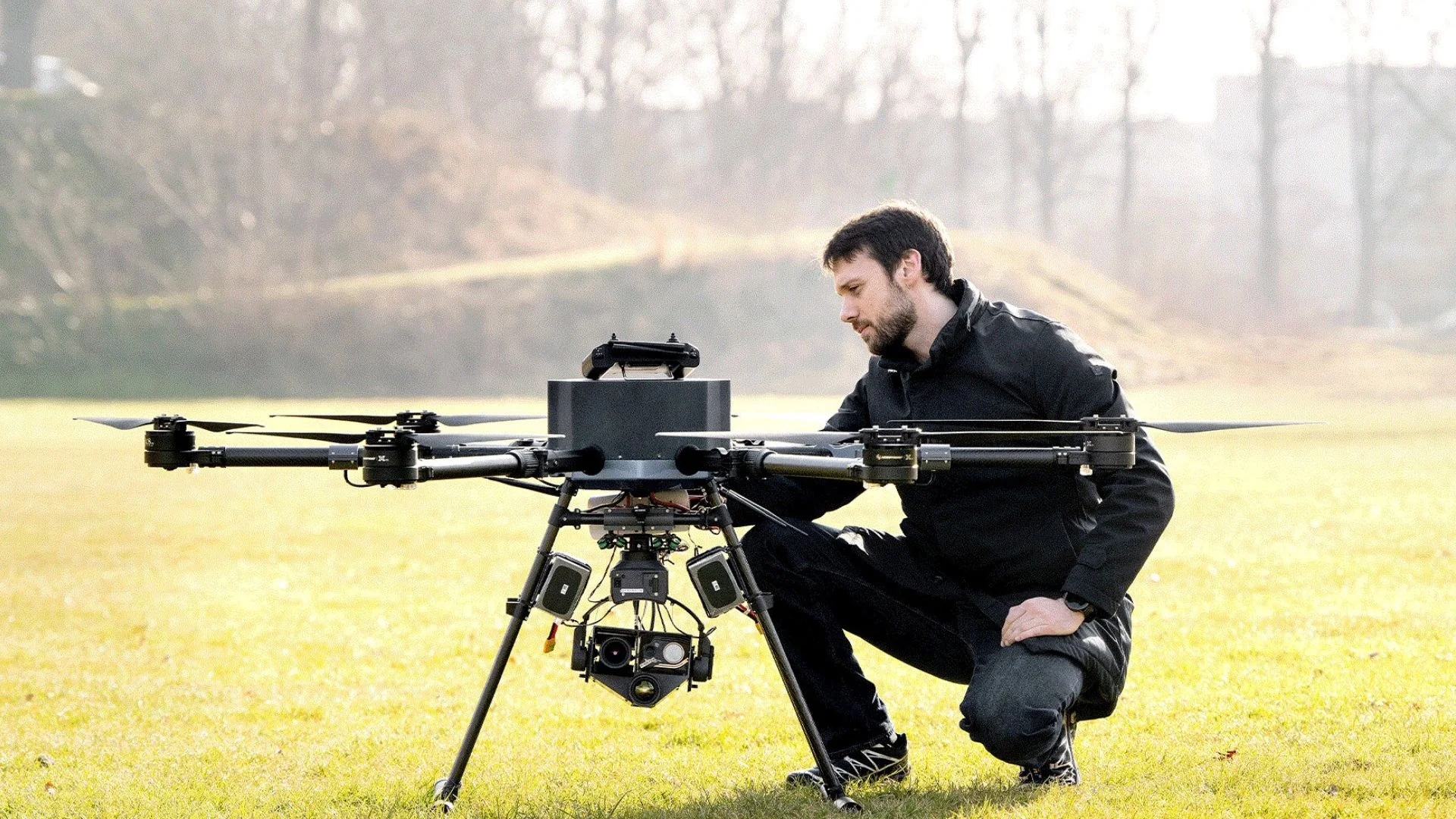
Researchers at the Technical University of Denmark (DTU) are developing an autonomous rescue drone designed to improve the chances of saving people who fall overboard from ships.
The system is built to launch automatically from a moving vessel and begin searching within moments of a confirmed emergency. Its main goal is to reduce the critical time between an accident and the arrival of lifesaving assistance.
Falling overboard remains one of the most dangerous incidents at sea. Rescue crews often face significant challenges because ships cannot stop instantly. By the time a rescue boat is deployed, the person may have drifted a considerable distance due to wind, waves, and ocean currents.
Industry data highlights the seriousness of the problem. According to figures from Cruise Lines International Association, more than 70 percent of people who fell overboard between 2009 and 2019 did not survive. Search efforts become extremely difficult as every minute passes after the incident.
The DTU drone is designed to respond much faster than traditional rescue methods. Instead of waiting for a rescue boat, the aircraft can immediately begin scanning the surrounding area. This rapid response gives rescuers a better chance of locating a person before conditions worsen.
The drone carries an inflatable life jacket as part of its rescue equipment. Once delivered, the life jacket provides flotation support and transmits a GPS signal. This helps keep the person afloat while also giving rescue teams a precise location to follow.
READ ALSO: Yale and Microsoft Use AI to Fast-Track Redox Flow Battery Material Discovery for Clean Energy
The life jacket serves two important purposes. First, it extends the amount of time a person can survive in cold water. Second, it allows rescue vessels to reach the exact location more quickly and efficiently.
According to information cited by researchers, a life jacket can dramatically increase survival time in water temperatures between 4 and 10 degrees Celsius. Without flotation support, survival may last only 30 to 60 minutes. With a life jacket, that time can increase to as much as three hours depending on weather conditions and individual circumstances.
Rescue Drone Improves Search
A major challenge in maritime rescue operations is predicting where a person has drifted after entering the water. Traditional search missions often rely on boats following predefined patterns across large areas. These methods can take valuable time and may not always cover the most likely locations first.
The DTU team has developed advanced algorithms that help the drone determine the best search route. The software analyzes real-time information from the vessel, including wind conditions and ocean currents. It also considers how much time has passed since the person went overboard.
The system combines multiple computer-based search methods into a single decision-making process. This approach helps estimate the person’s probable location more accurately. It also prevents the drone from repeatedly searching the same areas.
Researchers report that this position estimation system delivers a significantly higher success rate than conventional methods. The drone can quickly adjust its search pattern as new information becomes available. This flexibility is important in rapidly changing maritime environments.
READ ALSO: China Study Reveals Detailed PLA Strategy to Target US Carriers at 3,000km Range
Advanced Cameras and Fast Operations
The drone is equipped with three different camera systems. These include a standard RGB camera, an infrared camera, and a thermal imaging camera. Together, they help the aircraft detect people both during daylight and at night.
Thermal imaging allows the drone to identify body heat even in low-visibility conditions. This feature is especially useful during nighttime emergencies or poor weather. The combination of sensors improves the likelihood of finding a person before rescue teams arrive.
The current prototype weighs about 24.8 kilograms and measures approximately 2.4 meters in diameter. It can carry up to 20 kilograms of additional cargo. Depending on weather conditions and payload weight, it can remain airborne for around 30 minutes.
During a mission, the drone can search an area of up to one square kilometer. Its elevated position gives it a significant advantage over rescue boats. Crew members searching from the surface often have a much narrower field of view.
Testing conducted so far has produced encouraging results. Researchers report that the drone successfully located more than 80 percent of people in distress during evaluations. Some of these tests involved searching for a heated mannequin in waters off the Kattegat Sea.
The team is also improving how the drone lands on moving ships. Traditional autonomous landings require drones to hover and calculate the vessel’s motion before touching down. This process can consume several minutes and drain valuable battery power.
READ ALSO: Thales and KNDS France Unveil RAPIDFire Land: New Ground-Based Variant of 40mm Naval Defence System
Researchers are now developing a vision-based landing system. Instead of relying on extensive calibration, the drone uses live camera data to guide itself onto the ship. Early testing shows that landing time can be reduced from several minutes to roughly three seconds.
The project remains under active development and testing. Researchers are refining both the hardware and software while validating the drone’s performance in real-world conditions. The long-term goal is to make autonomous rescue drones a standard safety feature on passenger vessels.
The maritime industry is heavily regulated, so widespread adoption will require extensive testing and certification. However, researchers also see immediate opportunities for the Coast Guard and emergency response organizations. Faster delivery of flotation devices and location tracking could significantly improve survival rates during emergencies at sea.
However, autonomous rescue drones are emerging as a practical tool that combines artificial intelligence, advanced sensors, and rapid response capabilities. By reaching people in distress within minutes, this technology has the potential to reshape maritime search-and-rescue operations and make sea travel safer worldwide.