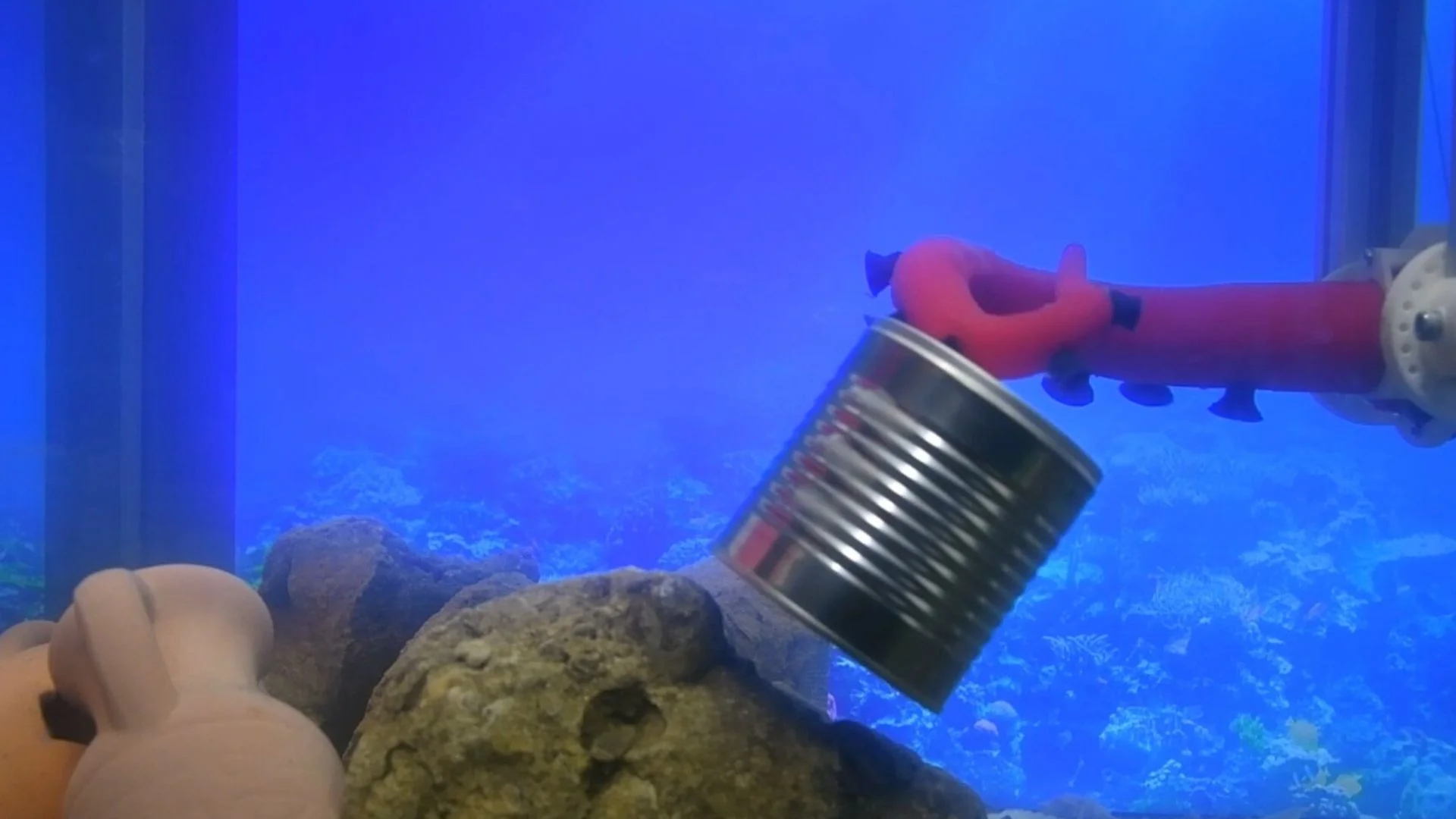
Researchers at the Italian Institute of Technology (IIT) have created a new robotic arm inspired by the remarkable abilities of an octopus.
The soft robotic system can detect touch, measure force, and grasp objects autonomously. It is designed to operate in challenging environments, including underwater locations where traditional robotic systems often struggle.
The research was published in the journal Nature Machine Intelligence.
The project was led by IIT’s Bioinspired Soft Robotics research unit, coordinated by Barbara Mazzolai, the institute’s associate director for robotics. The development represents an important step toward creating robots that can interact with objects more naturally and safely.
Soft robotics focuses on building robots from flexible, deformable materials rather than rigid components. These materials allow robots to adapt to their surroundings and interact more safely with humans and delicate objects. Such systems are particularly useful in environments where conventional hard robots struggle to operate.
The new robotic arm takes inspiration from the octopus, one of nature’s most skilled manipulators. Octopuses use flexible arms covered with sensitive suction cups to explore and handle objects. They also rely on a distributed nervous system, which allows their arms to process information and react quickly without depending entirely on the brain.
READ ALSO: Boeing Lands $2.8B Deal to Boost U.S. Strategic Satellite Communications
Researchers aimed to recreate some of these biological abilities in a robotic system. Their goal was to combine touch sensing and movement control throughout the robotic arm. This design allows the machine to react to its environment in a more efficient and adaptive way.
How the Robotic Arm Works
The robotic arm is made from soft materials and includes artificial suction cups built from silicone. Inside each suction cup are miniaturized optical sensors and small light-emitting diodes, commonly known as LEDs. These components work together to detect physical contact with nearby objects.
When a suction cup touches an object, its structure changes shape slightly. This deformation alters how light reflects inside the suction cup. By measuring these changes, the sensors can determine both the strength of the contact and the direction of the applied force.
The information collected by the sensors is immediately processed by the control system. Individual suction cups can respond independently by activating adhesion when needed. At the same time, the arm adjusts its overall shape by bending, twisting, or wrapping around an object.
This combination of local sensing and coordinated movement helps the robot grasp objects more effectively. The system can respond even to very weak touch signals. Researchers also confirmed that the technology works both in air and underwater environments.
READ ALSO: US’ defence giant hits big milestone, delivers crucial F-35 fighter jet part every 30 hours
According to first author Emanuela Del Dottore, integrating sensing and processing directly into the suction cups allows the arm to react quickly without relying on a fully centralized control system. This approach improves responsiveness and reliability. It also supports operation in complex environments where rapid decisions are important.
Building on Years of Soft Robotics Research
The new robotic arm is part of a larger research effort focused on octopus-inspired robotics. Over several years, IIT researchers have explored different ways to replicate the movements and capabilities of octopus arms. Each stage of the project has added new functionality to the system.
Earlier work involved developing computational tools to identify the best arrangement of cables inside soft robotic arms. These cable configurations helped reproduce natural octopus-like movements while minimizing the number of motors and actuators required. Fewer actuators can reduce complexity, weight, and energy consumption.
Researchers also developed advanced 3D-printed soft endoskeletons. These structures allow complex internal pathways to be built inside the robot while preserving flexibility. The design supports natural movement without sacrificing manufacturing simplicity.
The latest study adds another important capability: tactile sensing integrated directly into the suction cups. Instead of depending mainly on cameras or external sensors, the robot gathers information through touch. This approach mirrors how octopuses interact with their surroundings.
The system follows a decentralized design philosophy. Rather than sending every piece of information to a central processor, sensing and reaction occur across different parts of the arm. This arrangement helps the robot react faster and adapt more effectively to unexpected situations.
Future Applications for Underwater Robotics
One of the most important features of the robotic arm is its modular design. Researchers can easily change the number and arrangement of suction cups depending on specific tasks. This flexibility allows the system to be customized for different industries and environments.
The technology has several potential applications in underwater operations. It could assist in handling delicate marine organisms, collecting scientific samples, and performing environmental monitoring tasks. Traditional robotic grippers often risk damaging fragile objects, while soft robotic systems provide a gentler alternative.
READ ALSO: Mercedes-Benz expands its modular and scalable Van Architecture
Industrial sectors may also benefit from the technology. The robotic arm could support inspection and maintenance work in offshore facilities, underwater infrastructure, and hazardous environments. Its ability to adapt to different shapes makes it suitable for tasks involving irregular objects.
Beyond underwater use, the technology may support medical, agricultural, and manufacturing applications. Soft robotic systems are increasingly being explored for jobs that require precision and safe interaction with sensitive materials. Touch-sensitive manipulation remains one of the most valuable capabilities in these fields.
Barbara Mazzolai said the team designed the system so that perception and action are distributed throughout the robotic body. This allows the robot to interpret contact and adjust its grip naturally. The approach closely reflects biological strategies observed in octopuses.
Researchers now plan to expand the variety of objects the robotic arm can handle. They also aim to increase its payload capacity to carry heavier items. These improvements could help the technology move closer to real-world deployment across multiple industries.
As soft robotics continues to evolve, systems that combine flexible structures with intelligent sensing are attracting growing attention. The new octopus-inspired robotic arm demonstrates how lessons from nature can improve robotic performance. Future versions could help robots operate more effectively in places that remain difficult or dangerous for humans to reach.