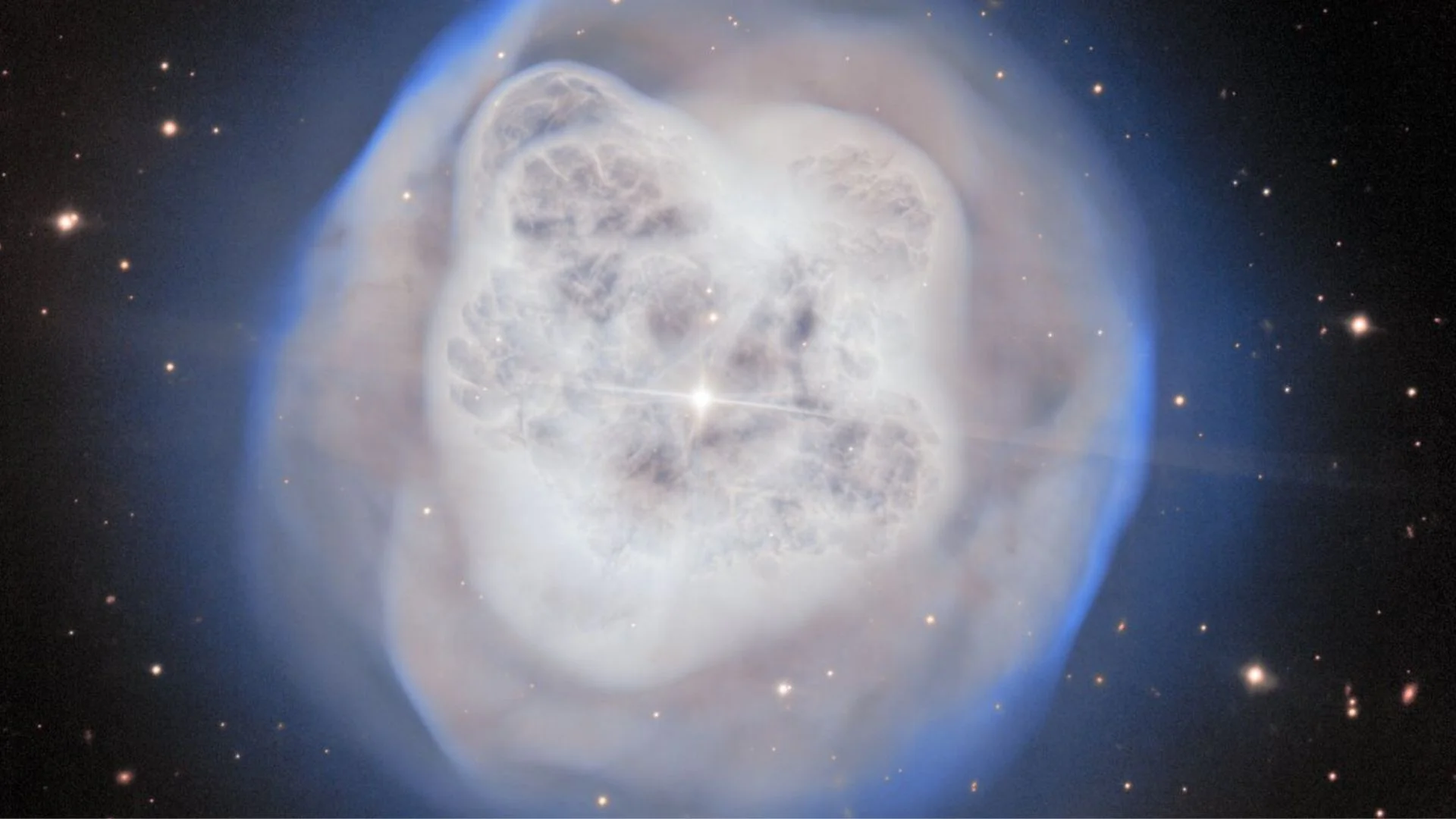
A newly released image of the Crystal Ball Nebula is giving astronomers and the public a closer look at one of the most fascinating stages in a star’s life.
The colorful object, officially known as NGC 1514, was photographed using the Gemini Multi-Object Spectrograph attached to the Gemini North telescope in Hawaii.
The nebula is located about 1,500 light-years away from Earth in the constellation Taurus. Because light takes time to travel through space, the image shows the nebula as it appeared around 1,500 years ago.
The image was captured by a team from the National Science Foundation’s National Optical-Infrared Astronomy Research Laboratory(NOIRLab). Unlike many observations that focus on specific scientific goals, this target was selected because of its striking appearance and its ability to inspire public interest in astronomy.
NGC 1514 is a planetary nebula, a type of object formed when a dying star sheds its outer layers into space. These layers expand outward and create large clouds of gas and dust around the star’s remaining core.
Despite the name, planetary nebulae have nothing to do with planets. Early astronomers gave them this name because they appeared similar to planets when viewed through small telescopes.
At the center of the Crystal Ball Nebula lies a binary star system. A binary system consists of two stars that formed together and continue to orbit around each other.
Astronomers say this two-star arrangement plays a major role in shaping the nebula. As one star reaches the end of its life and releases material into space, the gravitational influence of its companion affects the flow of gas and dust.
READ ALSO: AI-Powered Robotics at NTU Singapore Give Rise to Search-and-Rescue Cyborg Insects
This interaction creates complex structures that would not form around a single star. Scientists believe the companion star helps produce the nebula’s unusual cloud-like appearance and symmetrical patterns.
One of the stars takes about nine years to complete an orbit around its partner. This relatively long orbital period influences how the expanding material spreads through space.
Researchers compare the process to spinning cotton candy. As the companion star moves through the material released by the dying star, it stirs and shapes the gas into intricate structures.
Gemini North Reveals Nebula
The newly released image highlights these details with exceptional clarity. Special filters in the spectrograph isolate specific wavelengths of light, allowing astronomers to identify different gases within the nebula.
The vivid red regions visible in the image are produced by hot hydrogen gas. Bright blue areas are created by glowing oxygen gas, two of the most common elements found in planetary nebulae.
The Crystal Ball Nebula has attracted astronomers’ attention for more than two centuries. German-British astronomer William Herschel first observed the object in 1790 during his studies of deep-space objects.
Herschel is also credited with popularizing the term planetary nebula. His observations helped establish an entirely new category of astronomical objects that scientists continue to study today.
Modern telescopes now provide far more detail than instruments available in Herschel’s era. Advances in imaging technology allow researchers to examine the structure, composition, and evolution of nebulae with much greater precision.
READ ALSO: Tracing 8,000 Years of History in Great Salt Lake Sediments
Scientists study planetary nebulae because they offer a direct view of what happens when stars similar to the Sun approach the end of their lives. These objects also help researchers understand how stars return matter to the galaxy.
The material expelled by dying stars eventually becomes part of new stars, planets, and other cosmic structures. This recycling process plays an important role in the ongoing evolution of galaxies.
Astronomers also observe planetary nebulae at different wavelengths of light. Visible-light images reveal one set of features, while infrared observations can expose hidden structures and cooler material.
The James Webb Space Telescope, for example, can show details that appear completely different from those seen in optical images. Comparing observations from multiple telescopes helps researchers build a more complete picture of these complex objects.
Planetary nebulae exist for only about 10,000 years, which is a relatively short period in astronomical terms. This brief lifespan allows astronomers to track noticeable changes over decades rather than millions of years.
READ ALSO: GA-ASI Achieves Milestone with YFQ-42A Collaborative Combat Aircraft Flight Tests
By monitoring objects like NGC 1514, researchers can measure how quickly stars lose mass and how their temperatures change over time. They can also observe how the expanding clouds move outward into interstellar space.
The latest image of the Crystal Ball Nebula demonstrates how modern observatories continue to reveal new details about familiar cosmic objects. As telescope technology improves, astronomers expect to uncover even more information about the processes that shape stars and the future evolution of planetary nebulae.