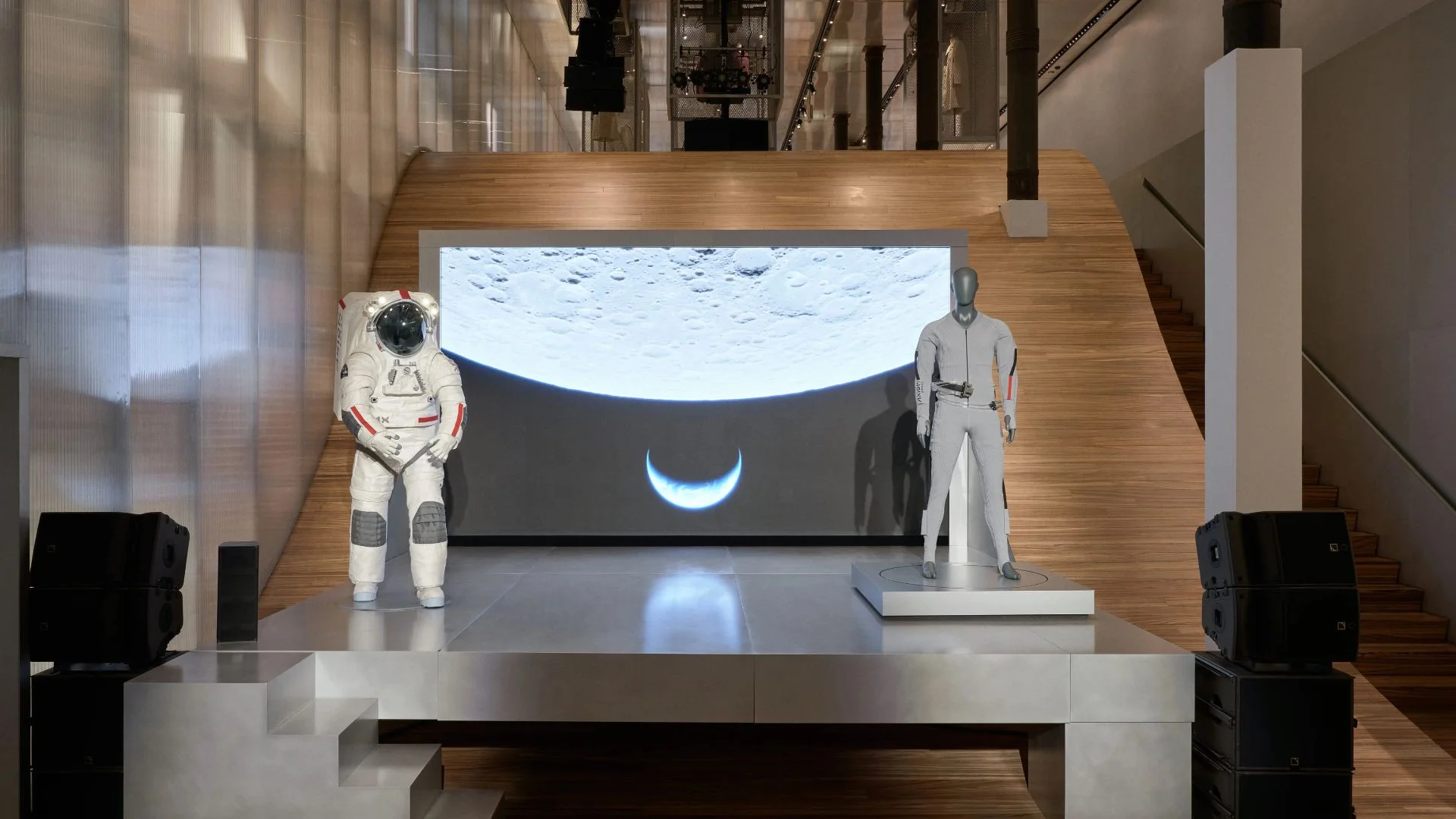
Prada and Axiom Space have revealed a key component of the next-generation spacesuit that NASA astronauts will use during future Artemis missions to the Moon.
The newly unveiled Liquid Cooling and Ventilation Garment(LCVG) is designed to be worn underneath the AxEMU lunar spacesuit and plays a major role in keeping astronauts safe and comfortable during lunar exploration.
The garment was introduced during a special event in New York. Developed through a partnership between Italian luxury fashion brand Prada and US aerospace company Axiom Space, the LCVG represents one of the latest advancements in spacesuit technology for NASA’s planned return to the lunar surface.
The unveiling offered the public its first detailed look at the garment. While spacesuits often attract attention for their outer appearance, the LCVG performs one of the most important functions inside the suit. It helps regulate body temperature, delivers breathable air, and supports astronauts as they work in some of the harshest environments humans have ever explored.
Artemis Spacesuit for Lunar Exploration
The LCVG forms part of Axiom Space’s AxEMU spacesuit system. NASA selected Axiom Space to develop the next-generation lunar spacesuits for Artemis missions. These missions aim to return astronauts to the Moon for the first time since the Apollo era and establish a long-term human presence on the lunar surface.
The garment resembles advanced athletic clothing. It includes features such as a V-neck design, thumbhole sleeves, and stirrup-style pants. Integrated tubing runs throughout the garment, creating a system that manages heat and airflow while astronauts operate inside their pressurized spacesuits.
READ ALSO: Valkyrie Test Flights Propel Air Force’s Human-Machine Teaming Efforts Forward
The cooling system uses small tubes filled with circulating liquid. As the liquid moves through the garment, it absorbs body heat, helping maintain a stable temperature for the wearer. This is especially important because lunar temperatures can change dramatically depending on exposure to sunlight or shadow.
Engineers redesigned the tubing system to improve manufacturing efficiency. Earlier cooling garments often required tubes to be manually threaded through mesh material, a process that took considerable time and effort. The new design incorporates built-in channels that hold the tubes in place more effectively.
Alongside the liquid-cooling network, the garment also features larger air-circulation tubes. These tubes move air across the astronaut’s face and body. The airflow helps remove carbon dioxide exhaled by the astronaut while delivering fresh oxygen for breathing.
The combination of cooling and ventilation systems creates a safer and more comfortable environment inside the spacesuit. This allows astronauts to focus on scientific work and exploration tasks without being distracted by extreme temperatures.
Built for Moon’s Harsh South Pole
The AxEMU suit is being developed specifically for the challenging conditions expected during Artemis lunar missions. One of the primary destinations for future astronauts is the Moon’s South Pole, a region with environmental conditions very different from those encountered during Apollo missions.
Unlike the equatorial regions visited by Apollo astronauts, the South Pole contains areas that spend long periods in shadow. Some craters near the pole rarely receive direct sunlight. These conditions create large temperature differences across relatively short distances.
According to Axiom Space, temperatures can vary by more than 400 degrees Fahrenheit between sunlit and shadowed areas. Such extreme changes require advanced thermal protection systems capable of adapting to rapidly changing environments.
The LCVG serves as a critical part of that protection. By continuously regulating body temperature, it helps astronauts remain comfortable and safe whether they are working in direct sunlight or near permanently shadowed regions.
The new spacesuit system also reflects decades of technological progress since NASA’s Apollo program. The last Apollo mission landed on the Moon in 1972. More than fifty years later, engineers have access to improved materials, manufacturing techniques, testing methods, and digital design tools.
As a result, the AxEMU suit incorporates greater mobility, enhanced durability, and better environmental protection than earlier lunar suits. These improvements are intended to support longer missions and more demanding scientific activities on the lunar surface.
Prada’s Role in Next-Gen Spacesuits
Prada’s involvement in the project has attracted significant public attention. While the partnership between a luxury fashion company and a space technology firm may appear unusual, both organizations say the collaboration is based on shared expertise in materials, manufacturing, and design.
WATCH ALSO: China’s new massive battle tank takes part in live-fire test
Prada contributed knowledge in advanced textiles and production methods. The company worked closely with Axiom engineers to develop materials capable of withstanding the demanding lunar environment.
One notable contribution involves the protective outer layers of the spacesuit. These materials help prevent damage from the Moon’s abrasive dust, sharp surfaces, and challenging environmental conditions. Maintaining the suit’s structural integrity is essential for astronaut safety during lunar missions.
The partnership also focuses on improving fit and comfort. Traditional spacesuits often require extensive customization and can be difficult to adapt for different users. Axiom and Prada are developing a more modular approach that allows components to be adjusted, replaced, or resized without redesigning the entire suit.
This strategy offers both operational and economic advantages. Individual suit components can be tailored to specific astronauts, reducing the costs of manufacturing completely new suits for each user.
The development team hopes these improvements will support the future growth of human spaceflight. As commercial space activity expands and more people travel beyond Earth, scalable spacesuit production and customization will become increasingly important.
The LCVG and AxEMU suits have already undergone extensive testing. Engineers have evaluated the systems under different temperature conditions, gravity simulations, and environmental scenarios. Additional testing is expected at NASA facilities, including the Neutral Buoyancy Laboratory, where astronauts train for spacewalks underwater.
Axiom Space has also indicated that portions of the system could be tested aboard the International Space Station before being used on lunar missions. Such testing would provide valuable operational data before astronauts wear the suits on the Moon.
NASA’s Artemis program represents one of the most ambitious space exploration efforts of the modern era. The success of these missions depends not only on rockets and spacecraft but also on the equipment that protects astronauts during exploration activities.
WATCH ALSO: Humanoid robot folds towel autonomously after observing human
The new cooling and ventilation garment demonstrates how industries outside traditional aerospace are contributing to the future of spaceflight. By combining engineering expertise with advanced materials and manufacturing techniques, Prada and Axiom Space have created a system designed for the next generation of lunar explorers.
As NASA moves closer to returning astronauts to the Moon, technologies such as the LCVG will play a central role in enabling safe and productive missions. The garment highlights how modern spacesuit design is evolving to support longer stays, more challenging environments, and a future where human activity in space becomes increasingly common.