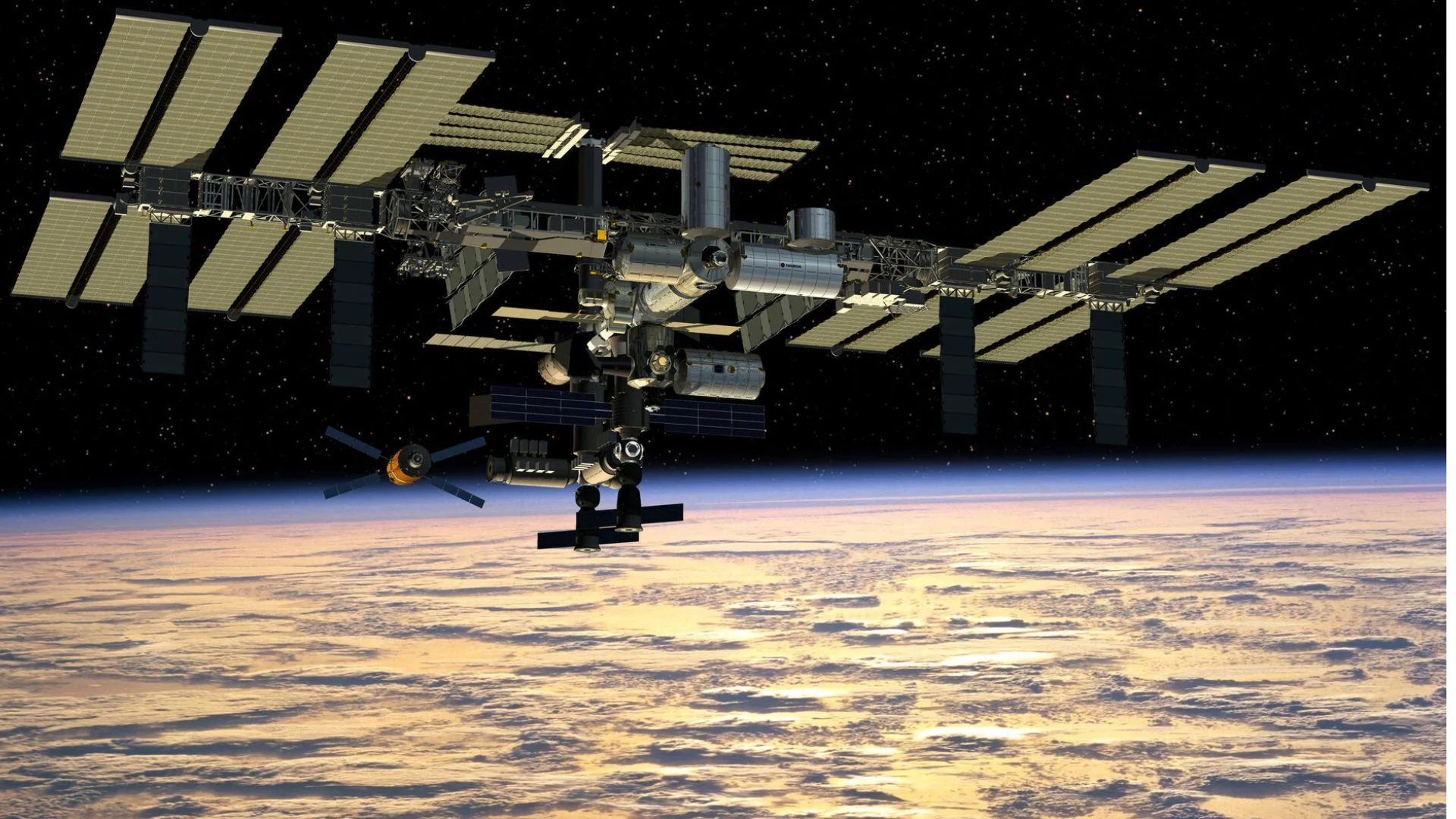
Astronauts aboard the International Space Station(ISS) experience one of the strangest daily routines ever created by humans.
The orbiting laboratory circles Earth every 92 minutes, giving the crew 16 sunrises and 16 sunsets every day. This unusual environment has forced space agencies to redesign how people sleep, work, eat, and even celebrate birthdays in space.
Why ISS Astronauts See 16 Sunrises
The International Space Station travels around Earth at about 28,000 kilometers per hour. At that speed, the station completes a full orbit every 1.5 hours. This creates repeated cycles of daylight and darkness throughout a single day.
Astronauts often describe watching the Sun disappear behind Earth in a matter of seconds. Darkness quickly fills the station before sunlight returns less than an hour later. The dramatic change happens far faster than any sunset seen on Earth.
These constant light changes are visually stunning but physically difficult for humans. The human body naturally follows a 24-hour cycle linked to daylight. On the ISS, that natural rhythm can easily become confused.
To solve this problem, the station does not follow local time zones. Instead, astronauts use Coordinated Universal Time(UTC). This system keeps every crew member working on the same schedule regardless of where they launched from.
Crew members follow tightly planned daily routines. Their day includes science experiments, exercise, equipment repairs, meals, meetings, and personal time. Strict schedules help reduce stress on the body and mind.
READ ALSO: Robotics Push: Hyundai Plans 25,000 Atlas Robots Across US Factories by 2028
Space agencies learned early that irregular sleep in orbit affects performance. Poor sleep can reduce concentration, slow reaction times, and increase mistakes. These risks become serious during spacewalks or spacecraft docking operations.
How Space Agencies Control Sleep in Space
Astronauts do not sleep in ordinary beds inside the ISS. Each crew member sleeps in a small private cabin about the size of a phone booth. The sleeping bag is attached to a wall so the astronaut does not float away during sleep.
Microgravity creates unusual problems that people never face on Earth. Without gravity, air does not circulate naturally around the body. Carbon dioxide from breathing can collect around an astronaut’s face if airflow is poor.
To prevent this, every sleep station includes ventilation fans. These systems keep fresh air moving through the cabin at all times. The airflow protects astronauts while they sleep.
Lighting inside the station also plays a major role in health. NASA and its international partners use advanced LED lighting systems that change brightness and color during the day. Bright blue light helps astronauts stay alert, while warmer light helps prepare the body for sleep.
Scientists describe this system as a form of light therapy. The lighting mimics the patterns of sunrise and sunset on Earth. This helps the brain maintain a more stable body clock.
READ ALSO: University of Utah and DARPA Launch SMART Hub for Critical Minerals Expansion
Researchers continue studying how space changes human sleep patterns. Some astronauts use carefully timed melatonin supplements to help regulate sleep cycles. Scientists are also developing faster hormone tests to monitor how well astronauts adapt to life in orbit.
Studies show astronauts often sleep less than the recommended seven to nine hours per night. Sleep loss builds over time during long missions. Even experienced astronauts can struggle with fatigue after several weeks in orbit.
Life in Orbit Changes Everyday Human Habits
The unusual environment aboard the ISS affects more than sleep alone. Everyday activities such as eating meals, exercising, and tracking time require careful planning. Even birthdays and holidays need coordination because the crew constantly moves between daylight and darkness.
Religious practices in space have also created unique questions for astronauts. Prayer schedules in some faiths depend on the times of sunrise and sunset on Earth. Space agencies and religious leaders have worked together to adapt these traditions for orbital missions.
Exercise is another important part of life aboard the station. Astronauts spend about 2 hours a day using special equipment to help prevent muscle and bone weakening in microgravity. Without regular exercise, long-term health problems can develop quickly.
Mental health also remains a major focus for mission planners. Living in a small station far from Earth creates isolation and stress. Structured routines and communication with family help astronauts maintain emotional stability.
WATCH ALSO: Britain delivers laser-guided Air defense missiles to Ukraine six months ahead of schedule
The challenges faced on the ISS are becoming more important as space missions grow longer. Future missions to the Moon and Mars will expose astronauts to even more extreme conditions. Understanding sleep, mental health, and body rhythms in orbit is now a critical part of space exploration.
Space agencies see the ISS as a testing ground for human survival beyond Earth. Lessons learned aboard the station already influence spacecraft design, lighting systems, and astronaut training programs. These findings may also improve sleep research and workplace health on Earth.
The experience of seeing 16 sunrises a day sounds extraordinary from the ground. For astronauts, however, it is part of a carefully managed system built to keep humans healthy in one of the harshest environments ever explored.