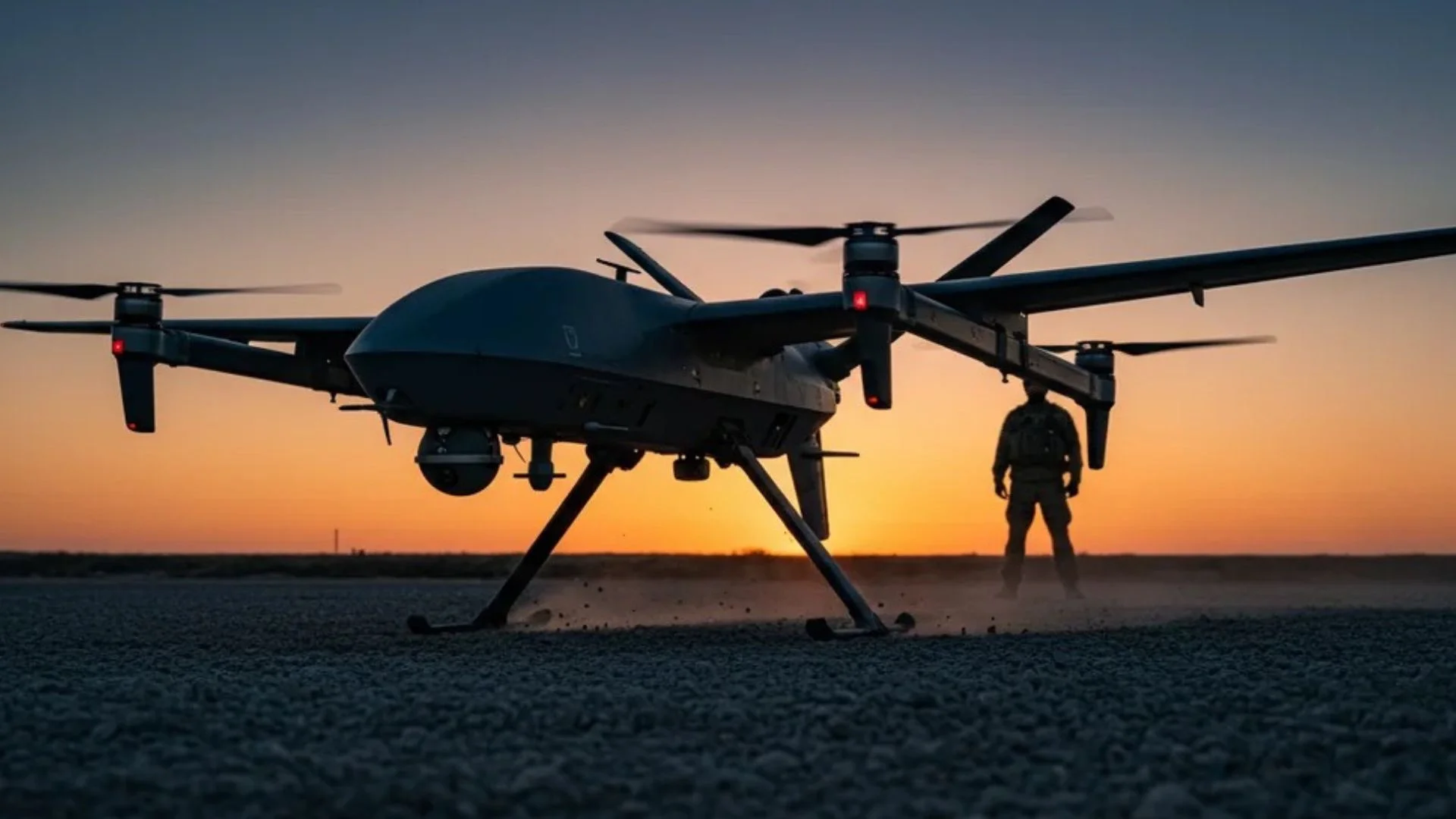
AIRO Group Holdings has announced the RQ-70 Dainn, a new unmanned aircraft system developed for intelligence, surveillance, reconnaissance, and target acquisition operations.
The company said the drone was designed to meet the demands of modern warfare, where military units need faster decision-making and longer operational reach.
The aircraft will make its public debut during the Eurosatory defense event in Paris from June 15 to June 19, 2026.
AIRO’s RQ-70 Dainn
The RQ-70 builds on operational experience gained from the earlier Sky-Watch RQ-35 drone platform.
According to the company, the RQ-35 has undergone continuous battlefield refinement for more than four years during operations in Ukraine. AIRO used feedback from frontline operators to shape the new aircraft’s design and mission systems.
Modern conflicts are driven by rapid data sharing, autonomous systems, and electronic warfare. Traditional defense systems often require long development timelines and large support structures before deployment.
AIRO said the RQ-70 was created to offer a more flexible and faster-response solution for these evolving combat conditions.
The company stated that the drone supports long-range intelligence gathering and persistent surveillance missions. It can remain airborne for up to eight hours during operations. The aircraft also has an operational range exceeding 62 miles (100 kilometers), allowing missions far beyond frontline areas.
The RQ-70 uses vertical takeoff and landing (VTOL) technology. This allows the aircraft to launch and land without requiring a runway, making deployment easier in remote or damaged locations. AIRO said a single operator can manage the entire system, including autonomous mission control and recovery functions.
AI-Driven Drone Designed for Contested Environments
AIRO described the RQ-70 as more than a standard surveillance drone. The company said the platform combines aircraft systems, sensors, software, and user interfaces into a single, connected, AI-driven architecture. This setup is intended to improve the speed at which military units receive and process battlefield information.
The aircraft is designed to operate in GPS- and GNSS-denied environments. These are combat situations where satellite navigation signals are blocked or disrupted by electronic warfare systems. AIRO said resilience in such environments has become increasingly important as modern militaries rely heavily on jamming and signal interference tactics.
WATCH ALSO: Two Humanoid Bots Tackle 32-Box Job With Zero Human Help
The drone also supports modular payload systems. This means operators can swap mission equipment depending on operational requirements. Payloads can include surveillance cameras, sensors, targeting systems, or communication tools for different battlefield roles.
John Uczekaj, Chief Operating Officer at AIRO Group Holdings, said the RQ-70 was developed directly from lessons learned in active operations.
He explained that the company relied on continuous feedback from the RQ-35 platform to guide the drone’s development. He also said production will be supported through facilities in both Denmark and the US.
AIRO plans to use a parallel production approach across its international facilities. The company said this strategy is intended to improve manufacturing speed, reliability, and supply chain resilience.
Defense companies are focusing on distributed production models after recent global supply disruptions and rising military demand.
Ukraine War Lessons Shape Future Drone Development
The war in Ukraine has changed how many countries view unmanned systems and battlefield intelligence. Small and medium-sized drones are now widely used for surveillance, artillery targeting, and strike coordination.
Defense companies across Europe and North America are rapidly investing in systems that combine autonomy, artificial intelligence, and electronic warfare resistance.
AIRO said the RQ-70 reflects this wider industry shift toward adaptive military technology. Instead of building static systems designed around fixed mission requirements, defense firms are focusing on platforms that evolve through real-world operational feedback.
The company believes rapid software updates and continuous field testing are now essential parts of modern military development.
Joe Burns, Chief Executive Officer of AIRO Group Holdings, said the RQ-70 is intended to support more distributed and longer-duration surveillance missions.
READ ALSO: Chinese Academy of Sciences Fossil Discovery Uncovers Pangaea’s Ancient Animal Superhighway
He added that the system is designed to help military forces make faster and clearer operational decisions. According to Burns, AI-driven autonomy remains a priority for the company’s long-term strategy.
The company plans to begin full-scale production of the RQ-70 in January 2027. Initial deliveries are scheduled for later in 2027, depending on market demand and program execution timelines.
AIRO believes growing global demand for autonomous ISR systems will continue to shape future defense procurement priorities.
The launch of the RQ-70 highlights the increasing role of AI-enabled unmanned systems in modern combat operations. Military organizations are now prioritizing systems that can operate independently, survive electronic attacks, and rapidly deliver actionable intelligence.