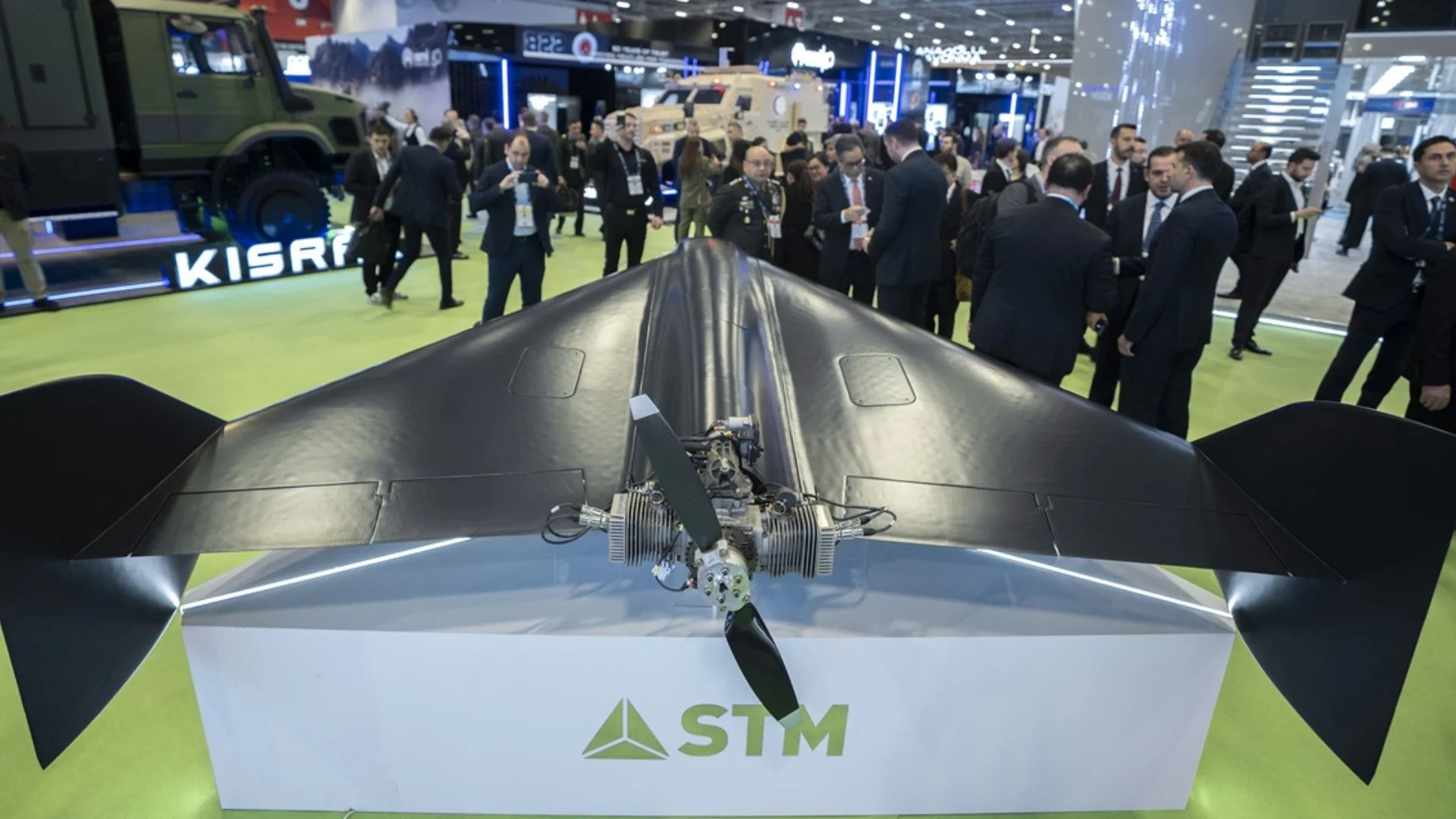
Turkey officially unveiled the Kuzgun loitering munition during the SAHA Expo 2026 in Istanbul.
The system was presented by the Turkish defense company STM as a long-range, autonomous attack drone designed for precision strikes and high-volume deployment.
Its introduction marks Turkey’s entry into a rapidly expanding segment of modern drone warfare.
Kuzgun is designed as a runway-independent strike drone with a reported range of up to 1,000 kilometers. According to STM’s specifications, the drone carries a 40-kilogram high-explosive fragmentation warhead and can remain airborne for six hours. The aircraft cruises at around 180 kilometers per hour during missions.
The drone launches from a ground-based rocket-assisted platform rather than a traditional runway. This allows rapid deployment from mobile positions and remote operational zones. The design supports flexible battlefield use during long-range strike missions.
READ ALSO: Baggage Bots: Japan Airports Deploy Chinese Humanoid Robots Amid Labour Shortages
STM describes Kuzgun as a ‘Long-Range Loitering Munition UAV’ built for autonomous attacks against pre-selected targets. The system uses satellite-based GNSS navigation and reportedly includes resistance against electronic jamming. This feature is important because modern battlefields increasingly rely on electronic warfare systems to disrupt drones.
The drone also includes coordinated terminal dive-attack capability. This means the UAV can descend directly onto a target during the final phase of an attack. Similar tactics have been widely used in recent conflicts involving long-range kamikaze drones.
Kuzgun Draws Comparisons With Shahed-136 and LUCAS
Kuzgun’s appearance and mission profile have drawn comparisons with Iran’s Shahed-136 drone. The Shahed series became internationally known after Russia used large numbers of the drones during strikes against Ukrainian infrastructure beginning in 2022. These drones gained attention because they offered long-range strike capability at a lower cost than cruise missiles.
Like the Shahed-136, Kuzgun uses a delta-wing airframe designed for endurance and simple manufacturing. This design improves flight efficiency while reducing production costs. Such drones are intended for mass deployment rather than survivability in heavily defended airspace.
The drone also shares similarities with the American LUCAS unmanned system developed by SpektreWorks. LUCAS, short for Low-Cost Uncrewed Combat Attack System, was publicly introduced in 2024 as a low-cost strike drone for US and allied forces. The project reflected growing Western interest in affordable long-range autonomous weapons.
WATCH ALSO: Poland and Portugal Gain New Space Capabilities After ICEYE Launch
Unlike advanced cruise missiles, these drones are built around cost efficiency and large-scale deployment. Military planners increasingly see attritable systems as important because they can overwhelm air defenses through numbers. A defender may be forced to use expensive interceptor missiles against significantly cheaper drones.
This cost imbalance has become one of the major lessons from the war in Ukraine. Relatively inexpensive loitering munitions have repeatedly forced defenders to spend large amounts of resources protecting infrastructure and military sites. As a result, countries around the world are accelerating investment in similar systems.
Kuzgun appears positioned between the Shahed-136 and LUCAS in terms of capability and industrial sophistication. It combines the low-cost operational philosophy of Iranian drones with the NATO-aligned manufacturing approach seen in Western systems. The result is a scalable strike platform designed for sustained production and operational affordability.
Why Kuzgun Matters for Turkey
The unveiling of Kuzgun highlights Turkey’s continued expansion of its already large unmanned systems industry. Turkish companies have gained global recognition through platforms such as the Bayraktar TB2, Bayraktar Akinci, and Bayraktar Kizilelma. Until now, however, Turkey had not publicly introduced a direct equivalent to long-range expendable strike drones like the Shahed series.
Kuzgun fills that gap in Turkey’s defense portfolio. Its reported maximum takeoff weight of 200 kilograms and 40-kilogram warhead make it suitable for attacks on radar systems, logistics hubs, command centers, and ammunition depots. The drone is intended to provide sustained operational pressure through repeated low-cost attacks.
The system may also strengthen Turkey’s position in the international defense export market. Turkish drones have already attracted buyers across Africa, the Middle East, Central Asia, and Eastern Europe. Countries seeking affordable long-range strike systems may view Kuzgun as an alternative to more expensive missile platforms.
READ ALSO: AeroKoi Used a 3D Printer to Recreate Classic Steam Locomotive Whistle Sounds
Another important aspect is industrial scalability. Modern conflicts increasingly depend on the ability to rapidly produce affordable weapons in large numbers. Loitering munitions like Kuzgun fit this requirement because they are cheaper and faster to manufacture than many traditional missile systems.
Turkey’s latest drone project also reflects broader changes in military thinking worldwide. Long-range one-way attack drones are now viewed as a separate and essential category of modern warfare systems. Their ability to combine range, affordability, and autonomous operation has made them central to future battlefield planning.
The introduction of Kuzgun signals that competition in the global drone market is entering a new phase. More countries are investing in expendable long-range strike UAVs designed for persistent attacks and air-defense saturation missions. As these systems continue to spread, they are expected to reshape military strategy, defense spending, and future conflict dynamics.