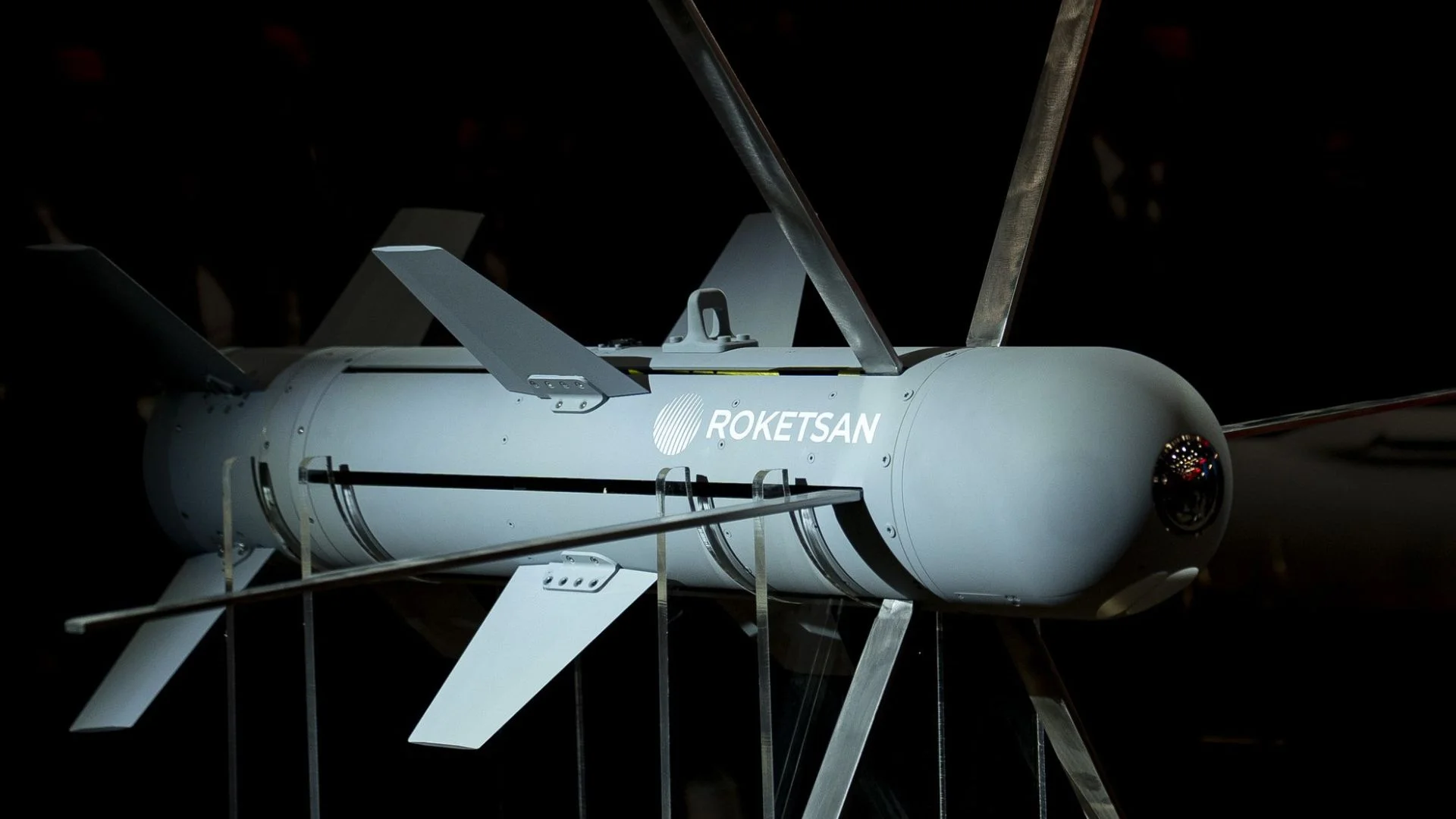
Turkey has introduced a new precision-guided munition called Nester, a blade-equipped missile designed for highly targeted strikes with minimal collateral damage.
The weapon was unveiled by Turkish defense company Roketsan during the SAHA 2026 International Defense and Aerospace Exhibition in Istanbul.
The new system closely resembles the secretive AGM-114R9X Hellfire missile used by the US in counterterrorism operations.
Nester, which means scalpel in Turkish, is based on Roketsan’s existing MAM-L lightweight smart munition. Unlike conventional missiles, the new weapon does not use an explosive warhead. Instead, it deploys six large blades moments before impact to strike a target with precision while limiting damage to nearby people and structures.
READ ALSO: NATO Eyes Cheap Drone Interceptors as Ukraine Challenges US Defense Market Strategy
Turkey’s Nester Blade Missile Focuses on Precision
The Nester is designed mainly for assassination-style strikes against high-value targets. The weapon uses pop-out blades similar to those seen on the AGM-114R9X Hellfire, often nicknamed the ‘Flying Ginsu’ or ‘Ninja missile.’ That US missile became publicly known after reports emerged in 2017 showing vehicles sliced open without signs of explosions.
Roketsan says the new weapon is intended for operations where avoiding civilian casualties is important. Instead of relying on blast effects, the blades deliver kinetic damage directly to the target. This allows operators to hit a specific person inside a vehicle or a confined area with far greater precision than standard missiles.
The company has not yet released full technical details about Nester. However, the weapon appears closely linked to the MAM-L smart munition already used extensively by Turkish drones. The missile’s compact size makes it suitable for unmanned aerial vehicles, light attack aircraft, and possibly helicopters.
The original MAM-L is around 3.3 feet long and weighs nearly 48 pounds. It has a diameter of 6.3 inches and a range of about 9.3 miles. In comparison, the American Hellfire missile is larger, measuring more than 5 feet long and weighing close to 100 pounds.
WATCH ALSO: DRDO Reveals Advanced Armoured Platform, Boosting India’s Defence Power
Designed for Turkish Drone Warfare Operations
Turkey’s defense industry has rapidly expanded its drone and precision weapons programs over the past decade. The Bayraktar TB2 drone, which commonly carries the MAM-L munition, has become one of the country’s most recognized military exports. Turkish drones have been used in conflicts in Syria, Libya, Ukraine, and the fighting between Armenia and Azerbaijan.
The Nester is expected to become part of this growing drone ecosystem. Its lightweight design allows smaller drones to carry multiple weapons during a mission. This gives operators the ability to conduct selective strikes without deploying larger missiles or airstrikes.
The MAM-L family already includes several warhead types, including armor-piercing, thermobaric, and high-explosive versions. Nester is different because it removes the explosive payload entirely. Its entire purpose is to deliver highly focused damage with reduced risk to surrounding civilians.
Analysts believe the weapon aligns closely with Turkey’s ongoing counterinsurgency operations. Turkish forces frequently conduct operations against the Kurdistan Workers’ Party, also known as the PKK, in Turkey, Iraq, and Syria. Precision weapons that reduce collateral damage have become increasingly important in such missions.
Turkey ended a ceasefire with the PKK in 2015 and has since intensified military operations. Drone strikes now play a major role in these campaigns. A weapon like Nester offers a way to target individuals while lowering the chance of wider destruction in urban or populated areas.
READ ALSO: Archaeologists Uncover 5,000-Year-Old Wooden Secret Beneath Stone Island in Scotland
Guidance System and Global Export Potential
One major question surrounding Nester involves its guidance system. Both the MAM-L and standard Hellfire missiles use laser guidance to track targets. However, the American AGM-114R9X reportedly includes advanced targeting features that help it hit extremely precise points on a vehicle.
Experts believe Nester may include similar technologies. One possibility is an imaging infrared guidance system that automatically locks onto a specific section of a vehicle. Another option is a human-in-the-loop system, where an operator adjusts the missile’s path during the final seconds before impact.
Such systems require secure communication links between the missile and the operator. Roketsan has confirmed that Nester includes a proximity sensor that activates the blades just before impact. Before deployment, the six blades remain hidden in slots along the missile’s body.
The lack of an explosive warhead creates additional engineering challenges. Without blast effects, the missile depends heavily on speed and impact force to destroy the target. If the system is unpowered like the MAM-L, its kinetic effect may be lower than that of the larger Hellfire R9X.
Despite these challenges, the weapon has strong export potential. Turkish defense products are increasingly popular because they are often cheaper and more accessible than Western systems. Unlike American weapons, Turkish-made munitions are generally not subject to US International Traffic in Arms Regulations (ITAR).
WATCH ALSO: India Tests Powerful Naval Anti-Ship Missile
That flexibility gives Turkey an advantage in international defense markets. Countries that cannot access certain American systems may look to Turkish alternatives instead. The Nester may attract interest from nations seeking precise strike capabilities without the political and export limitations attached to US weapons.
The unveiling of Nester also highlights how modern warfare continues to shift toward highly targeted operations using drones and precision-guided munitions.
As conflicts increasingly move into urban environments, militaries are placing greater emphasis on weapons that can strike individuals while minimizing civilian harm. Turkey’s latest weapon shows how its defense industry is adapting to those changing battlefield demands.