Blue Origin has reached a major step forward in rocket reusability, but the achievement came with an unexpected setback in space.
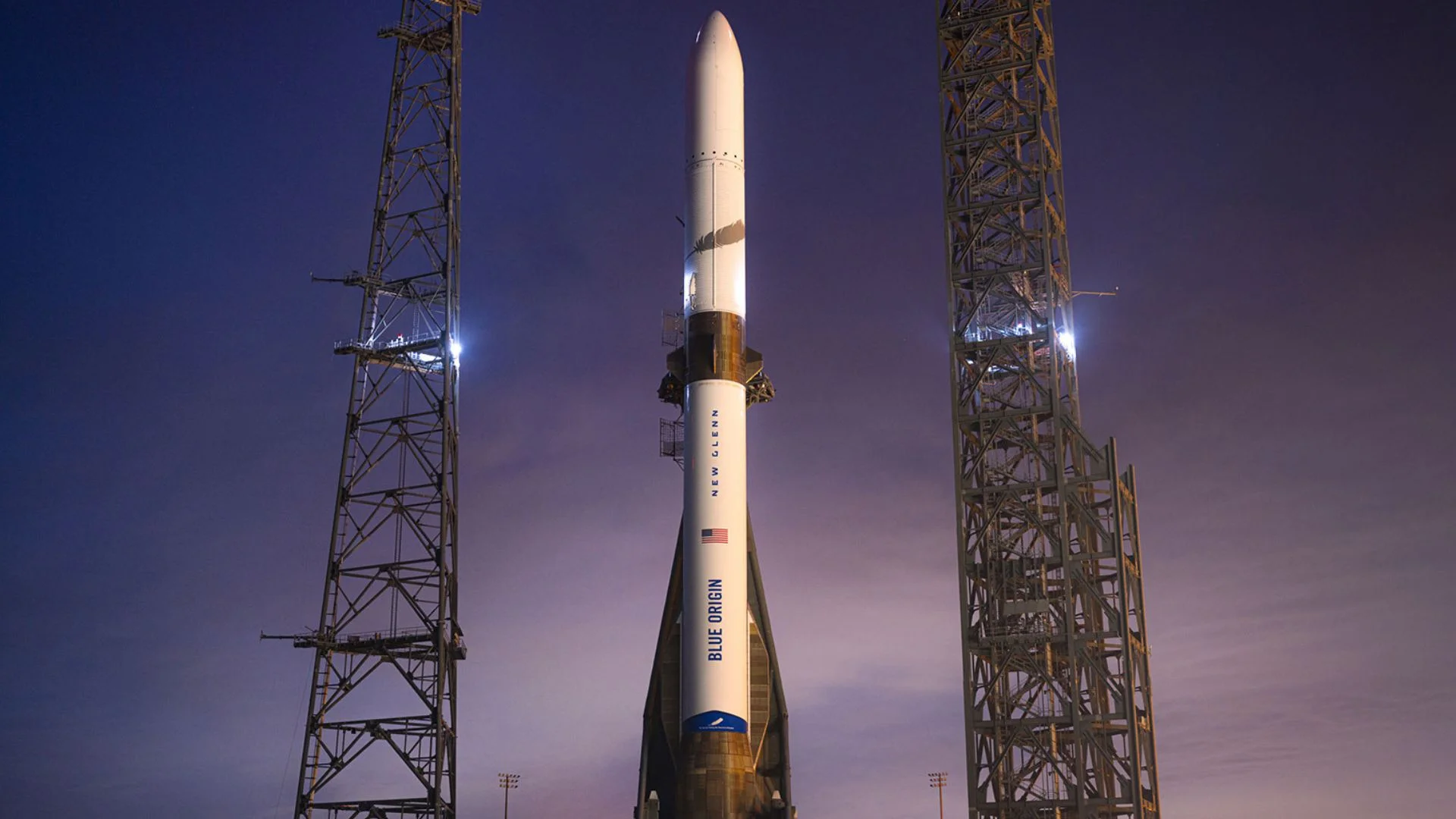
The company’s powerful New Glenn rocket flew using previously launched hardware for the first time, successfully landing its booster at sea.
However, the mission failed to place its satellite into the correct orbit, raising concerns about performance at a critical moment for the company.
The launch took place early Sunday morning from Cape Canaveral in Florida. The mission, known as NG-3, marked only the third flight of the heavy-lift rocket. It carried a large communications satellite called BlueBird 7, built by AST SpaceMobile, into low Earth orbit.
READ ALSO: China’s Robotic Diving Suit Cuts Oxygen Use by 40%: What’s Powering It Underwater?
The rocket lifted off at 7:25 a.m. EDT after a short delay in the countdown. Engineers paused the launch clock with less than four minutes remaining for reasons they did not disclose. After resuming, the rocket climbed smoothly into the sky, marking a promising start.
This mission stood out because Blue Origin reused its first-stage booster for the first time. The same booster had flown earlier on the NG-2 mission, though it was fitted with new engines for this launch. Reusability is a key goal for modern spaceflight. It helps reduce costs and allows companies to launch more frequently.
The first stage performed well during ascent. About three and a half minutes into the flight, it shut down its engines and separated from the upper stage as planned. Moments later, it began its journey back to Earth.
Roughly six minutes after liftoff, the booster made a precise landing on Blue Origin’s droneship, named Jacklyn, in the Atlantic Ocean. Teams across the company celebrated the moment, calling out the booster’s nickname, ‘Never Tell Me The Odds,’ as it touched down successfully.
READ ALSO: Mosquito Reaches Iceland, Signaling a Hidden Ecological Shift Across the Arctic
This marked an important milestone. Only one previous New Glenn mission, NG-2, had achieved a successful booster landing. The rocket’s debut flight in January 2025 reached orbit but failed to recover the first stage.
Blue Origin engineers had made several improvements before this flight. They upgraded the thermal protection system at the base of the rocket to better handle the extreme heat during reentry. They also refined the guidance system to improve stability and control as the booster returned through the atmosphere.
Jordan Charles, vice president of New Glenn at Blue Origin, explained the changes during live commentary. He said engineers wanted to better understand how heat affects the rocket during reentry. He added that the team made adjustments to ensure all systems perform as expected during flight.
While the booster landing was successful, the mission’s main objective was to deploy BlueBird 7 into its planned orbit. That is where the mission ran into trouble.
BlueBird 7 is part of a new generation of satellites designed to provide direct-to-cellphone internet service. It belongs to the Block 2 series, which are much larger than earlier versions. The satellite carries a massive antenna spanning about 2,400 square feet, making it one of the largest communication satellites ever built.
WATCH ALSO: An unmanned boat has completed a long 1,100-nautical-mile voyage
Its predecessor, BlueBird 6, launched in December 2025 aboard the LVM3 rocket. Earlier satellites in the series, known as Block 1, were significantly smaller.
According to the mission plan, BlueBird 7 was supposed to separate from the rocket’s upper stage about 75 minutes after launch. Initially, everything appeared to go as expected. Blue Origin confirmed that the satellite had separated and powered on successfully.
But about two hours after liftoff, the company reported a problem. The satellite had been placed into an off-nominal orbit, meaning it did not reach the correct altitude or trajectory.
Soon after, AST SpaceMobile provided more details. The company said the satellite’s orbit was too low to maintain operations using its onboard propulsion system. As a result, BlueBird 7 would not be able to carry out its mission.
The company announced that the satellite would be deorbited. This means it will reenter Earth’s atmosphere and burn up. While the loss is significant, AST SpaceMobile said the financial cost is expected to be covered by insurance.
The outcome casts a shadow over what was otherwise a strong demonstration of reusability. It also raises questions about New Glenn’s reliability as Blue Origin prepares for more complex missions.
READ ALSO: 25 Years Later, Gene Therapy Wins Oscars of Science for Restoring Vision
New Glenn is a massive rocket, standing 322 feet tall. It is comparable in size to NASA’s Space Launch System and significantly taller than SpaceX’s Falcon 9. The rocket’s first stage is powered by seven BE-4 engines, which use a mix of liquid oxygen and methane fuel.
This same type of fuel, known as methalox, is also used by SpaceX in its Starship system. Both companies are racing to prove the reliability of their reusable launch systems.
Blue Origin plans to use New Glenn for several important missions in the coming years. One of the most significant is the launch of the Blue Moon lunar lander, which NASA has selected as part of its Artemis program.
NASA originally chose SpaceX’s Starship as its primary lander for returning astronauts to the Moon. However, delays in development have led the agency to support multiple options, including Blue Origin’s Blue Moon.
The uncrewed Mark 1 version of Blue Moon is expected to launch later this year. The spacecraft has already completed environmental testing at NASA’s Johnson Space Center and is undergoing final preparations in Florida.
However, the issue seen during the NG-3 mission could affect that timeline. NASA wants to test key technologies, including docking in Earth orbit and transferring cryogenic fuel, before approving any lander for crewed missions.
The agency aims to send astronauts to the Moon around mid-2027 under the Artemis program. It has indicated that it will proceed with whichever lander is ready first.
Meanwhile, SpaceX continues to test its Starship system. The company is preparing for another test flight of its Super Heavy booster and upper stage in the near future.
As competition intensifies, each launch becomes more important. Blue Origin’s latest mission shows both progress and challenges. The successful booster landing proves that reusability is within reach. But the failure to place the satellite into the correct orbit highlights the risks that still remain.
For now, Blue Origin celebrates a key milestone while working to understand what went wrong. The company’s next steps will be closely watched as it moves toward more ambitious missions in space.