China has carried out two major rocket launches within days, quietly accelerating its push to build massive satellite internet networks in space.
The missions added fresh batches of satellites to two key projects, Thousand Sails and Guowang, both seen as central to the country’s long-term space ambitions.
The first launch took place on April 7. A Long March 8 rocket lifted off from the Hainan Commercial Space Launch Site at 9:32 a.m. Eastern time (1332 UTC). The mission was handled by the China Aerospace Science and Technology Corporation (CASC), which later confirmed that the payload was for the Thousand Sails constellation.
READ ALSO: KAIST Robot That Sees Terrain And Chooses Its Own Path Conquers Obstacles With Ease
Reports indicate that the rocket carried 18 satellites. These were placed into a near-polar orbit, as suggested by airspace closure notices issued before the launch. The satellites were built by the Innovation Academy for Microsatellites under the Chinese Academy of Sciences (IAMCAS).
This was the first Thousand Sails launch since October 2025. That earlier mission had followed a gap in activity after a March 2025 launch. Some of the early satellites reportedly faced issues, as they failed to reach their intended orbits. Despite those setbacks, the latest mission marks steady progress.
With this launch, the Thousand Sails constellation, also known as Qianfan, now has 126 satellites in orbit. The project is led by Shanghai Spacecom Satellite Technology (SSST), also called Spacesail. It is one of China’s key efforts to build a large-scale satellite internet system.
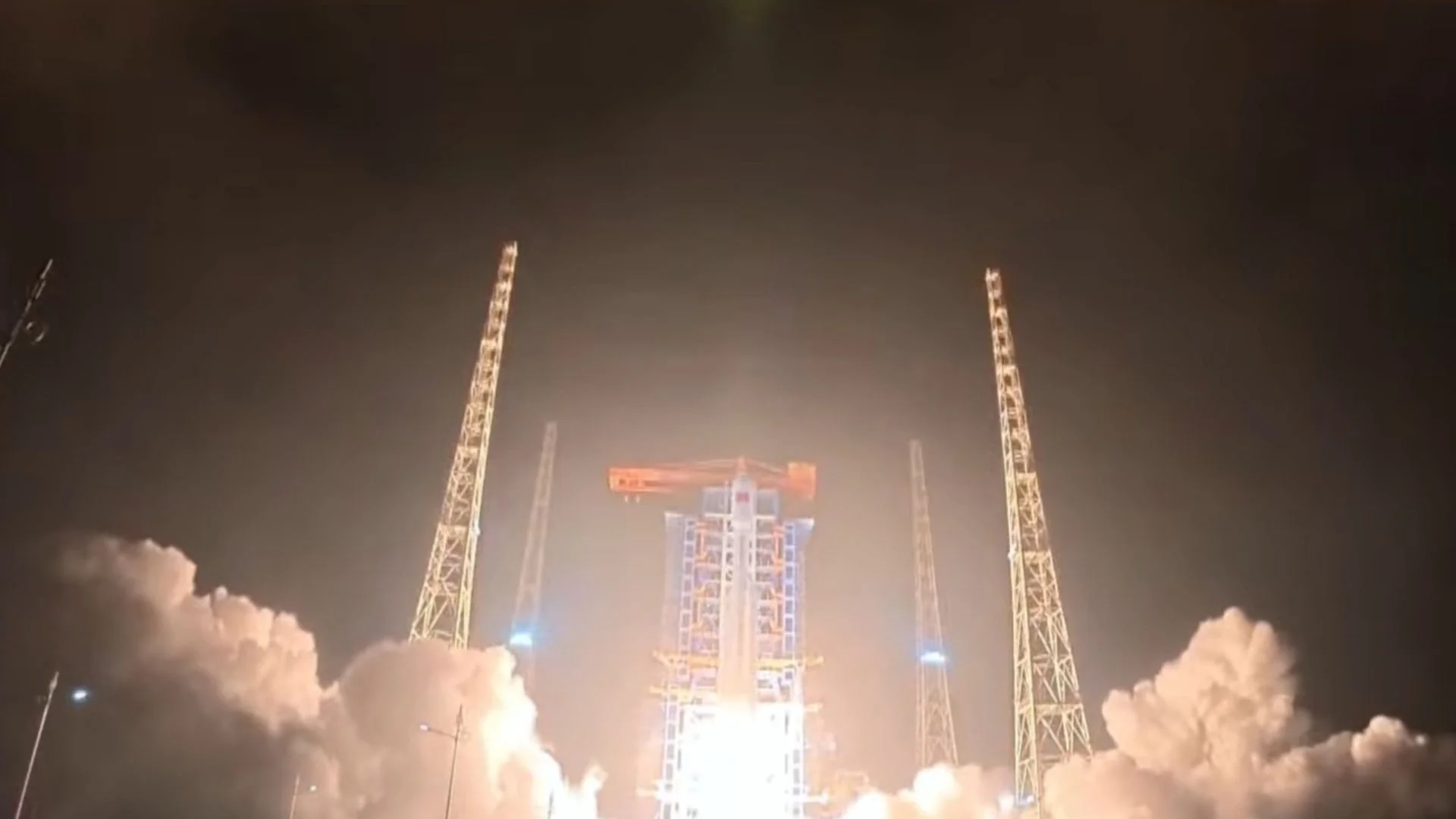
Just a day later, China launched another rocket. On April 8, a Long March 6A lifted off from the Taiyuan Satellite Launch Center in north China at 3:38 p.m. Eastern time (1938 UTC). The rocket climbed into the night sky, carrying the 21st group of satellites for the Guowang constellation.
WATCH ALSO: Humanoid Robots Engage in Unscripted Chat for Hours
CASC also confirmed the success of this mission. Typically, Long March 6A launches for Guowang carry five satellites, and this mission followed the same pattern. Like the Thousand Sails satellites, these were also manufactured by IAMCAS.
The Guowang constellation has now reached 168 operational satellites. There are also additional satellites believed to be used for testing and development.
However, detailed information about the Guowang spacecraft remains limited. Some of the satellites are known to have been built or overseen by the China Academy of Space Technology (CAST), a major state-run space agency.
Official filings with the International Telecommunication Union (ITU) reveal the scale of the Guowang project. China plans to expand it into a 13,000-satellite constellation. In the near term, the goal is to place around 400 satellites in orbit by 2027.
READ ALSO: This Raytheon Camera Sees Heat Changes First, Targets Can’t Stay Hidden
Guowang is widely seen as China’s answer to global satellite internet systems like Starlink. The project reflects a broader strategy to compete in low Earth orbit, where countries and companies are racing to build large constellations for communication, data, and connectivity.
To support these ambitions, China is rapidly increasing its launch capacity. This includes developing reusable rocket technology and expanding launch infrastructure. The country’s latest Five-Year Plan for 2026 to 2030 clearly highlights satellite internet and reusable launch systems as top priorities.
The recent launches were China’s 20th and 21st attempts of 2026. They came shortly after a setback on April 3, when the debut flight of the commercial Tianlong-3 rocket failed. Despite that, the overall launch pace remains strong.
WATCH ALSO: US firm successfully demonstrates ship-based Sea Launcher for autonomous underwater vehicle ops
China is aiming to launch as many as 140 this year. This would include major missions related to the Moon and human spaceflight, as well as satellite deployments. The growing number of launches shows how quickly the country is scaling its space operations.
Both Thousand Sails and Guowang are expected to drive much of this surge. They represent China’s most ambitious effort yet to build a global satellite internet network, one that could reshape connectivity and competition in space.