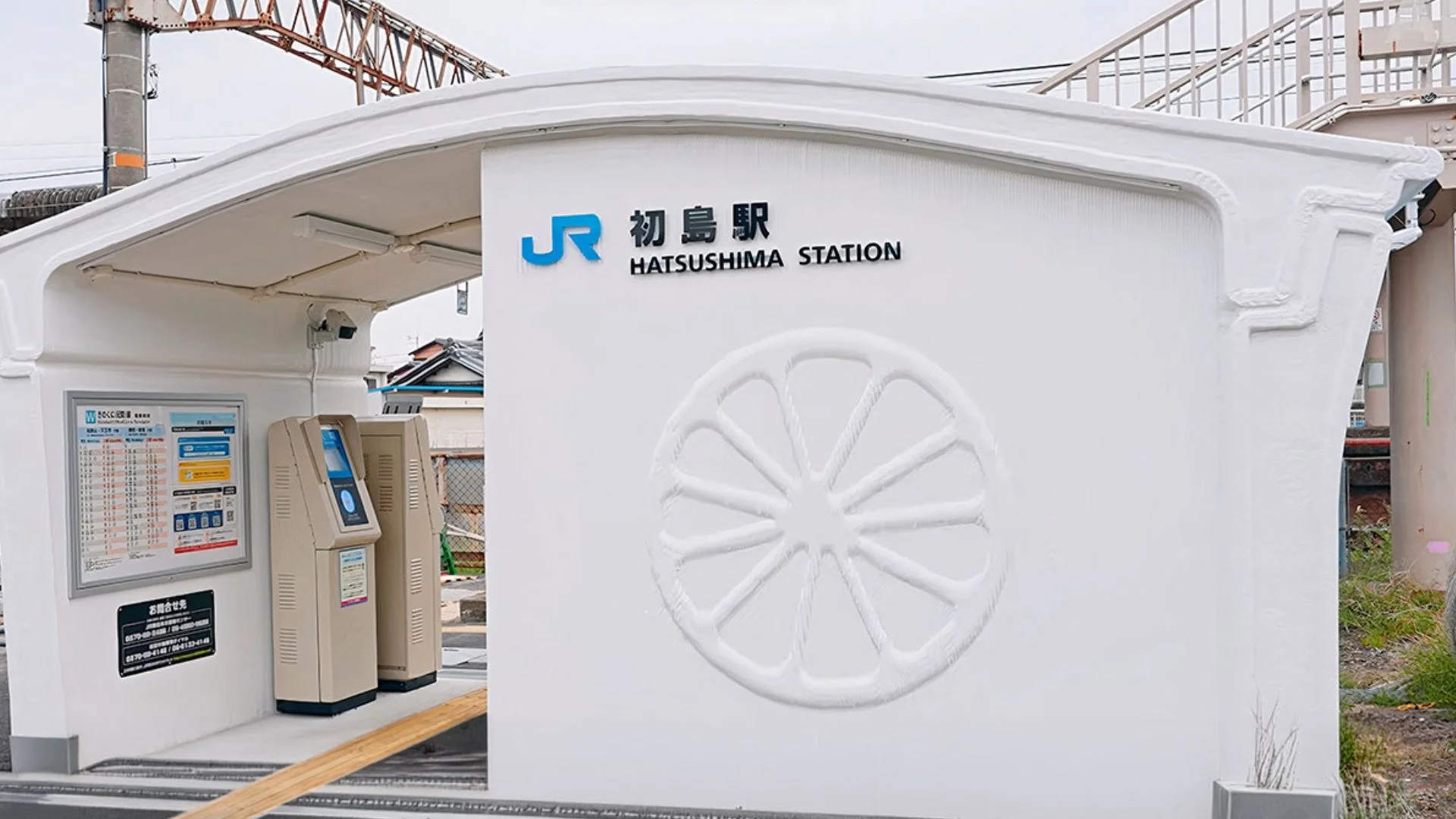
ABB, a Swiss-Swedish robotics company, partnered to create Japan’s first 3D-printed railway station. The project halved both construction time and costs, addressing labor shortages and rising wages in Japan’s aging rail network.
The news is about a restored station shelter in Wakayama Prefecture, originally a wooden structure built in 1948. JR West, the railway operator, worked with Serendix, a Japanese construction tech company, and ABB to print and assemble the new station.
Serendix collaborated with ABB to bring the project to life. The robot used was an ABB IRB 6700 arm, a heavy-duty industrial robot typically used in factories.
READ ALSO: US Firm’s 2-Second Drone Launch Leaves No Time to React on the Battlefield
Old railway stations wear down from years of weather and use. Finding competent contractors is difficult, and construction costs are rising. Traditional rebuilding would have shut down the station for months and cost twice as much.
The robot used a Vertico nozzle, which is four times more accurate than standard nozzles. It also reduced mortar waste by half. The team modified the arm to have seven degrees of freedom, enabling it to print curved, detailed surfaces.
Printing the concrete components took about one week inside a factory. The team then brought the pieces to the site. Between the last train at night and the first train the next morning, they assembled everything in just six hours. The new station has an arched ceiling and decorative touches.
The main benefit is dramatic savings. JR West said the traditional method would have required months of station closures and would have cost twice as much. This approach also used far less concrete and steel, reducing waste.
WATCH ALSO: Chinese humanoid robot learns to stitch detailed embroidery patterns autonomously
The station is small and serves only about 270 passengers daily in a rural village. Scaling this method to large, busy urban stations has not yet been tested. Also, the printing still happens in a factory, not fully on-site.
Japan has thousands of aging stations needing replacement. Labor shortages are worsening. 3D printing with robots could solve both problems. A Serendix employee said they believe they can automate even more of the process for future jobs. This project proves that faster, cheaper, and greener station construction is possible.