Researchers at Arizona State University(ASU) have developed bio-inspired robotic muscles that can lift up to 100 times their own weight while remaining soft, flexible, and energy-efficient.
The work is led by doctoral student Eric Weissman from ASU’s Robotic Actuators and Dynamics Lab.
His research, published in Proceedings of the National Academy of Sciences, introduces a new approach to building artificial muscles that behave much like real biological ones but with greater strength and versatility.
Weissman explains the idea simply. “We created a new artificial muscle that mimics how real muscles work,” he says. “Earlier versions existed, but ours are lighter, stronger, and more adaptable.”
Today’s robots, especially four-legged ones, often rely on electric motors. These motors make them heavy and limit their mobility. They are also less flexible and struggle in complex environments. This is where the new design stands out.
READ ALSO: A Heat-Safe Battery Debuts on NYC Rooftops: Here’s What Makes It Different
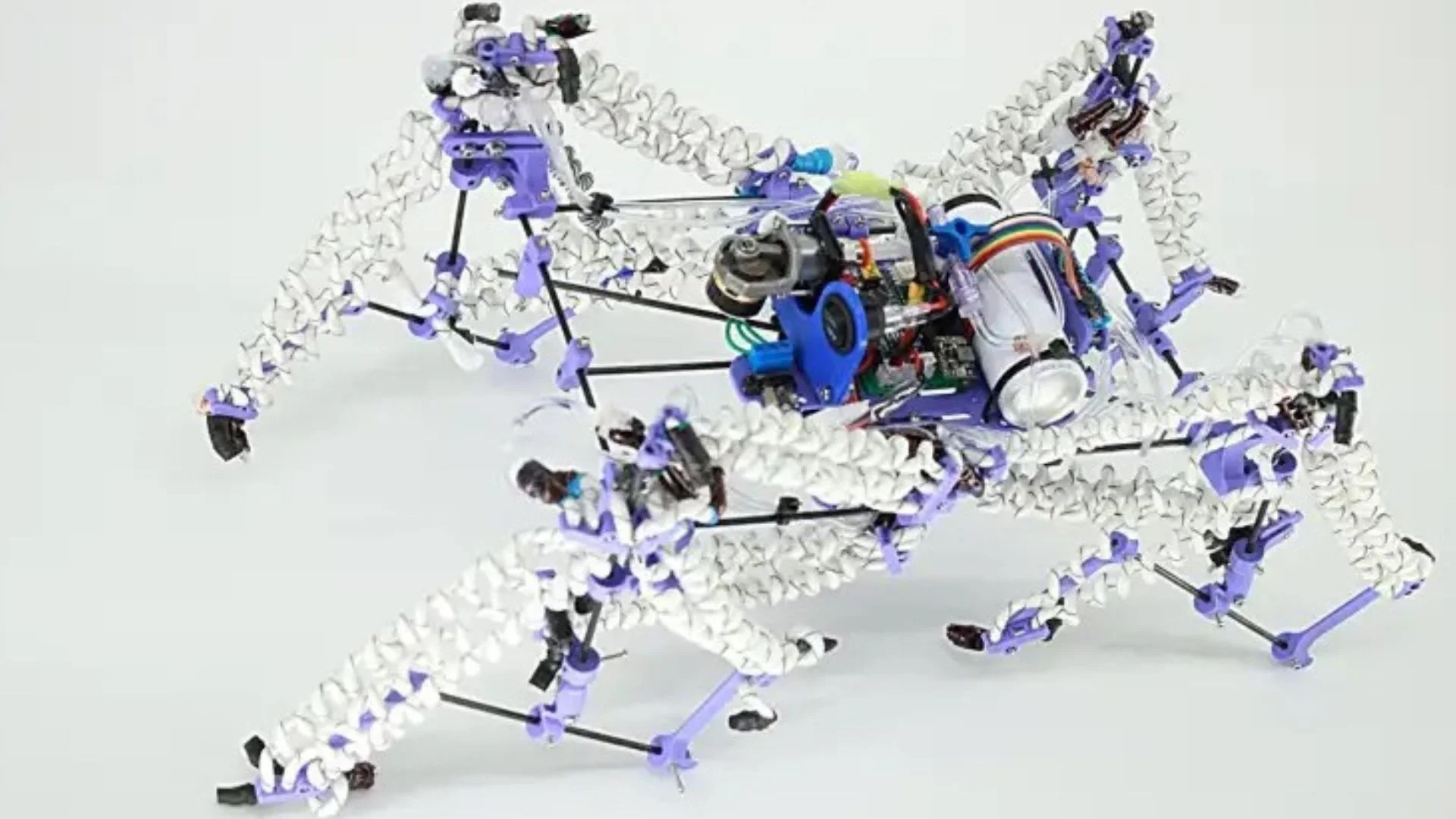
The team developed what they call helical anisotropically reinforced polymer actuators, or HARP actuators. These are soft, tube-like structures shaped like a spiral pasta. When air is pumped into them, they expand and contract, just like natural muscles.
Weissman describes them vividly. “They look like small coiled tubes,” he says. “When we add a bit of air, they move, expanding and contracting like real muscle fibers.”
Because of this design, the actuators require less pressure to operate. This enables robots to carry their own air supply and move independently without an external power source. In simple terms, these robots can operate independently while remaining lightweight and efficient.
The advantages go beyond strength. These artificial muscles are flexible, quiet, and durable. They can handle extreme conditions, including high heat and rough surfaces. This opens the door to many real-world uses.
In disaster zones, soft robots powered by these muscles could move through debris and collapsed buildings. Their flexible bodies would allow them to squeeze into tight spaces without further damaging themselves while searching for survivors.
WATCH ALSO: United Launch Alliance’s Atlas V rocket delivers success for Amazon Leo
At home, such robots could assist elderly people with daily tasks. They could reach shelves, carry objects, and perform simple chores safely thanks to their soft, compliant structure.
The muscles are also suitable for harsh environments. They can operate in boiling water and near underwater thermal vents where temperatures are extremely high. This makes them useful for marine exploration and industrial cleaning processes.
The research team has also created a flexible framework. This means the technology can be adjusted for different uses without having to start from scratch each time. It could lead to lower costs and wider adoption across industries.
Another innovation from the same lab takes inspiration from nature in a different way. Doctoral student Jiahe Wang has designed a ‘bionic elephant arm,’ modeled after the trunk of an elephant.
This soft robotic arm can bend, twist, and move around obstacles with ease. It can reach over, under, and around objects, making it ideal for inspection work in complex industrial environments.
Wang highlights its importance. “In factories and chemical plants, equipment is often hard to access,” he says. “Even simple inspections can require stopping operations, which costs time and money.”
READ ALSO: US Joby Aviation Flies First FAA-Conforming Electric Air Taxi
The elephant-inspired arm reduces these challenges. Its soft design lowers the risk of damaging equipment or injuring workers. It can work safely in close contact with humans, which is a major advantage over rigid robotic arms.
In agriculture, a thinner version of this arm could help with pollination. Crops like strawberries and tomatoes have dense leaves, making it difficult for natural pollinators or drones to reach them. A soft robotic arm can move gently through plants without disturbing them.
Unlike drones, which create strong air currents, these soft robots work quietly and carefully. This makes them more suitable for delicate farming tasks.
A thicker version of the arm could even be used in space. It could assist astronauts by handling tools or performing maintenance tasks. Its soft structure makes it safer to use around both humans and sensitive equipment.
The lab is also working on wearable technology. Doctoral student Rohan Khatavkar has developed a back support device designed to reduce strain during heavy lifting.
Traditional devices fall into two categories. Active systems use motors and can be adjusted, but they are bulky and uncomfortable. Passive systems are lightweight but cannot adapt to different tasks.
Khatavkar’s design combines both approaches. It uses an elastic actuator along with a pneumatic artificial muscle to create a system that is both lightweight and adjustable.
“The device is compact and easy to wear,” Khatavkar says. “It can be tuned to provide the right level of support for different tasks.”
Users can adjust the stiffness and assistance levels as needed. When support is not required, the system can simply be turned off instead of removed. This makes it more practical for real-world use.
Professor Jiefeng Sun, who leads the lab, believes these innovations are just the beginning. He sees applications across agriculture, healthcare, industry, and even space exploration.
WATCH ALSO: China’s new massive battle tank takes part in live-fire test
“These soft muscles can be used in many types of robots,” Sun says. “They are lighter, safer, and more flexible than traditional systems.”
He also points out an important safety advantage. Unlike rigid machines, soft robots do not have sharp edges or strong pinch points. This reduces the risk of injury when humans and robots work together.
Looking ahead, the team is exploring the use of space-grade materials. These could further enhance the durability and performance of muscles, especially in extreme environments such as outer space.
The researchers have already secured a provisional patent through ASU’s Skysong Innovations, signaling strong commercial potential.
With their ability to combine strength, flexibility, and independence, air-powered artificial muscles are set to redefine how robots are built and used. From disaster rescue to farming, from factories to space missions, these soft yet powerful systems may soon become a common part of everyday life.