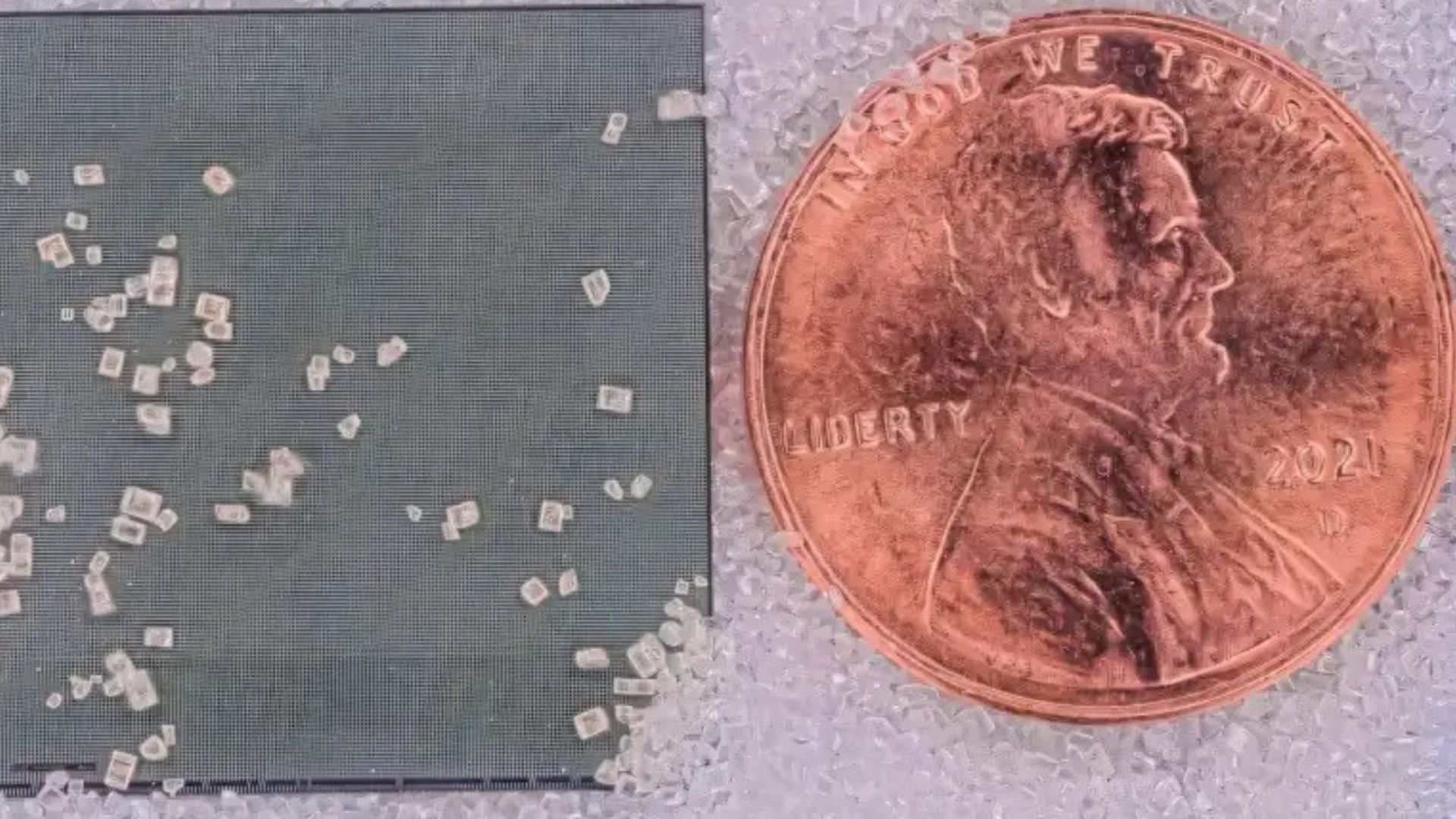
A new smart chip can compress massive X-ray data in real time, helping scientists overcome data overload and speed up discoveries.
Researchers at the Argonne National Laboratory have designed a detector chip that reduces data by 100-200 times in real time. This innovation can make experiments faster, more efficient, and far easier to manage. The results of this research were published in the Journal of Instrumentation.
Modern X-ray detectors are incredibly powerful. They capture detailed signals when X-rays interact with a sample, much as a camera captures light to form an image. These signals are then converted into digital data for analysis.
Even frames that contain little useful information are recorded and stored. Over time, this creates enormous datasets that are difficult to process, transfer, and analyze. Scientists often spend more time managing data than studying it.
READ ALSO: XM8 Is Back: US Army’s New 6.8mm Carbine Aims to Redefine Modern Combat
Physicist Antonino Miceli explained the challenge.“We want to bring computing closer to where data is created,” he said. “We built a chip that performs complex calculations directly inside the detector.”
Instead of sending every bit of raw data to external systems, the new chip processes information instantly. It shrinks each image into a smaller set of numbers while preserving the most important details.
This approach works like compressing a video or music file before sharing it, but much faster and more advanced.
The chip also allows scientists to analyze data without first decompressing it. This saves valuable time and computing power. Researchers can now get results while experiments are still running, instead of waiting hours or even days.
A Chip That Can Learn
What makes this technology even more powerful is its flexibility. Scientists can train the chip before or during an experiment. By uploading specific settings, known as weights, they can tell the chip what kind of information to focus on. This process is similar to how artificial intelligence models are trained.
Researcher Tao Zhou highlighted this feature. “The chip learns what matters most for each experiment,” he said. “It can reduce data on the fly while keeping vital information.”
This means the same chip can be adapted for different experiments, making it highly versatile. Tests show the chip can handle up to a million frames per second. At the same time, it dramatically reduces data size.
READ ALSO: A Supersonic Jet Without the Boom? NASA’s X-59 Just Moved One Step Closer
This approach offers several key advantages. It significantly reduces the amount of data that needs to be stored and transferred, making systems more efficient.
It also lowers energy consumption, which is crucial for large-scale experiments. In addition, the need for complex hardware and extensive cabling is minimized.
Most importantly, it enables faster analysis and real-time feedback, enabling scientists to make quicker, more informed decisions during experiments.
With real-time insights, scientists can adjust their experiments in real time. This speeds up the entire research process and improves accuracy.
Unlocking the Full Power of X-Ray Facilities
The chip is especially valuable for advanced research facilities like the Advanced Photon Source, one of the most powerful X-ray sources in the world. At such facilities, detectors are often the limiting factor, not the X-ray source. This new technology removes that bottleneck.
“Detectors have been holding us back,” Miceli said. “To fully use these powerful sources, we need smarter technology like this.”
WATCH ALSO: China’s new humanoid robot can perform combat moves
The research team has already tested the chip using real experimental data. The next step is to move from prototype to large-scale production.
Once widely deployed, this technology could transform how scientists handle massive datasets, not just in X-ray research, but in many other fields that rely on high-speed data collection.
This breakthrough shows how combining advanced hardware with intelligent data processing can reshape scientific research. By compressing data at the source and enabling real-time analysis, the new chip allows scientists to focus on what truly matters, making discoveries faster than ever before.