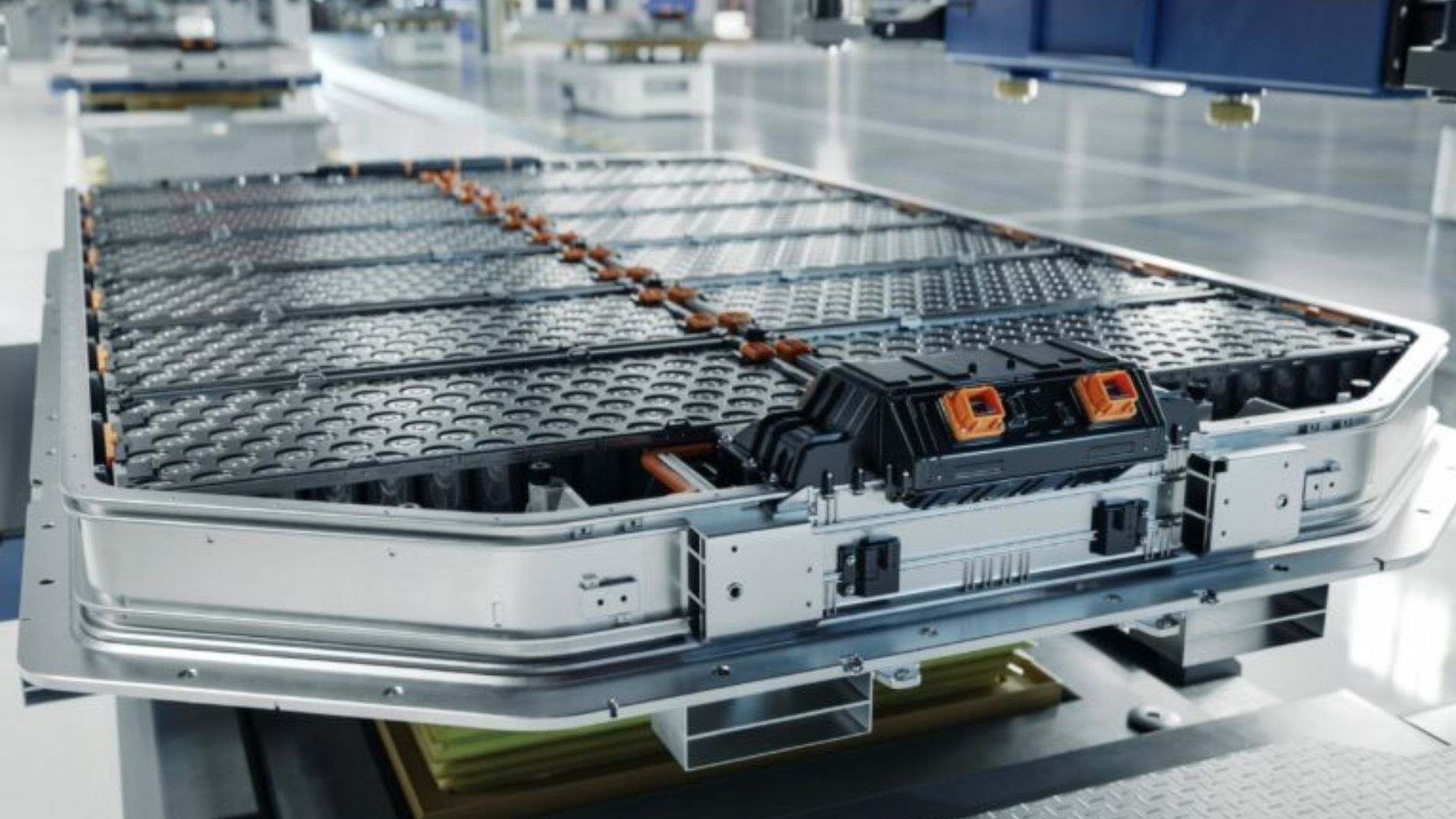
China-based battery maker Eve Energy, a supplier to Tesla, has unveiled two new solid-state battery (SSB) cells, marking a step toward next-generation energy storage.
The company announced that its Longquan No. 3 and Longquan No. 4 batteries have rolled off the production line at its Chengdu facility.
The move signals early production readiness in its multi-path solid-state program.
The two battery variants are designed for different uses. The Longquan No.3 targets consumer electronics, while the Longquan No.4 is built for electric vehicles (EVs). Both reflect ongoing efforts to overcome key technical barriers in solid-state battery design.
The Longquan No.3 focuses on compact devices. It operates under low stack pressure, below 2 MPa. This is important because solid-state batteries require consistent contact between solid layers inside the cell.
READ ALSO: E-2D Hawkeye: Pentagon Sends ‘Eyes in the Sky’ as Gulf Threats Escalate
Maintaining this contact usually requires high pressure. Eve Energy says its design reduces this requirement while still ensuring stability. The company also highlights high volumetric energy density, although it has not shared exact figures.
The Longquan No.4, on the other hand, is aimed at EV traction systems. It features a 60 Ah cell capacity, which is relevant for automotive applications.
The battery can operate at up to 5 MPa, demonstrating progress toward real-world vehicle conditions. Lower pressure levels are critical for integrating solid-state batteries into EV platforms, as they simplify design and improve safety.
READ ALSO: Iran Strike Hits Qatar LNG Hub,17% Supply at Risk; Global Gas Crisis Fears Rise
Eve Energy has not disclosed details about the battery chemistry. It has only confirmed that both are fully solid-state systems. Key performance metrics, such as charging speed, total energy density, and battery pack capacity, remain undisclosed.
These new batteries follow the earlier Longquan No.2 model. That version targeted emerging sectors like robotics, low-altitude aircraft, and AI hardware. The company is using a step-by-step development strategy across different industries to refine its technology.
The Chengdu facility, launched in September 2025, serves as a pilot base for solid-state battery production. It plays a key role in testing manufacturing processes and scaling up future production.
The broader industry is also pushing toward solid-state technology. Automakers and suppliers are working to reduce stack pressure while maintaining stable internal interfaces. This is one of the biggest challenges in making SSBs commercially viable.
WATCH ALSO: Humanoid robot plays table tennis like human beings
Eve Energy already supplies batteries to global automakers such as Tesla, BMW, and Mercedes-Benz. It is also part of a commercial vehicle battery joint venture with Daimler Truck, Cummins, and Paccar, strengthening its position in both passenger and heavy-duty EV markets.
Meanwhile, other companies are advancing similar efforts. Farasis Energy, backed by Mercedes-Benz, introduced a sulfide-based solid-state battery with an energy density of 400 Wh/kg in 2025. Gotion, supported by Volkswagen, has also completed a 2 GWh solid-state production line in 2026.
WATCH ALSO: Drum-shaped antenna reflector on NASA-ISRO NISAR satellite deployed
Despite the progress, Eve Energy has not announced a timeline for mass production or commercial deployment. Pricing details are also unavailable. The current announcement focuses on early-stage validation rather than large-scale rollout.
Key questions remain around scalability, cost, and integration into EV platforms. However, the new batteries highlight steady progress in making solid-state technology practical for future use.