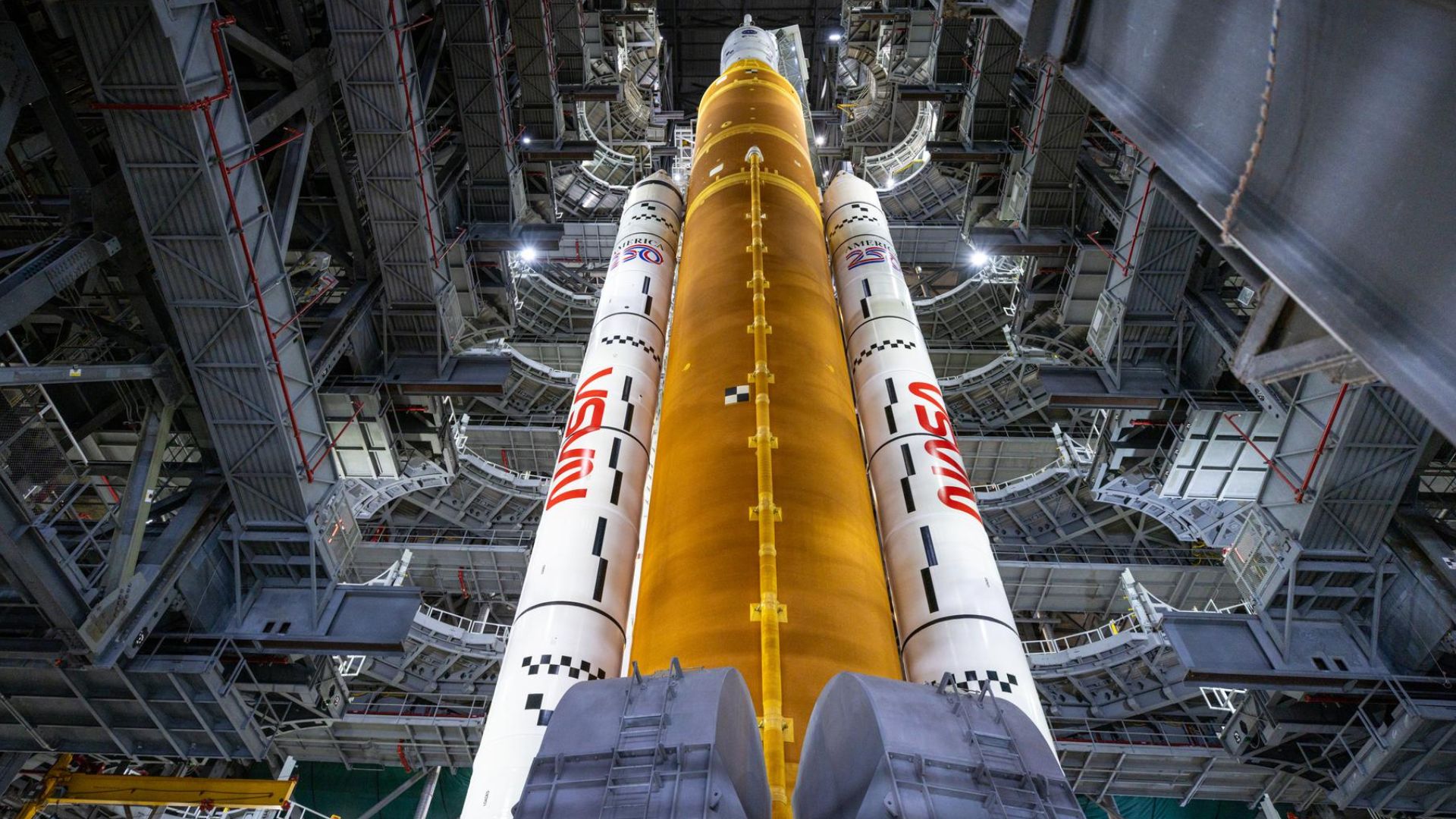
NASA’s Artemis II rocket returned to the launch pad in Florida ahead of the next crewed lunar mission.
The powerful Space Launch System (SLS), along with the Orion spacecraft, began its slow rollout to Launch Pad 39B in the early hours of Friday.
The operation started at 12:20 a.m. EDT from the Kennedy Space Center after a brief delay caused by strong winds.
The rollout marks an important milestone ahead of the mission that will carry astronauts around the Moon for the first time in decades.
The journey to the launch pad took nearly 10 hours. The rocket was transported atop a massive crawler transporter. It moved at a very slow speed of about 1 mile per hour to ensure safety.
The crawler carried the fully assembled rocket and its mobile launcher across a 4-mile path. This path, known as the crawlerway, is specifically designed to handle the system’s enormous weight.
Standing 322 feet tall, the SLS rocket is one of the most powerful ever built. It weighs around 5.75 million pounds when fully fueled. Engineers ensured that every movement during transport was carefully monitored.
Why Artemis II Rocket Returned to Assembly Building
This was not the first Artemis II rollout. The rocket had earlier reached the launch pad in January. However, it had to be rolled back to the Vehicle Assembly Building after tests revealed a technical issue.
Engineers detected a problem with helium flow in the rocket’s upper stage. This issue prevented proper pressurization, a vital factor for safe flight operations.
READ ALSO: Pentagon Moves Toward Swarm Warfare With Cheap Drones Built for Scale and Speed
To fix this, the rocket was moved back to the assembly building on February 25. Teams spent weeks repairing and testing the affected systems before approving another rollout.
Key Repairs and System Upgrades Completed
While inside the assembly building, engineers carried out several important upgrades. They replaced multiple batteries across the rocket, including those in the core stage, upper stage, and solid rocket boosters.
A new set of batteries for the flight termination system was also installed. This system ensures safety by allowing the rocket to be destroyed if it goes off course.
Engineers also replaced a seal in the liquid oxygen feed line. They reassembled and tested the oxygen interface systems to ensure there were no leaks.
WATCH ALSO: 6-ton tiltrotor aircraft completes first flight in China
The Orion spacecraft also received attention. Its launch abort system batteries were fully charged and checked to ensure they were ready.
These improvements were necessary to prepare the rocket for the next phase of launch operations.
Artemis II will be the first crewed mission of NASA’s Artemis program. The mission will send four astronauts on a journey around the Moon and back to Earth.
The crew includes Reid Wiseman as commander. He will be joined by pilot Victor Glover and mission specialist Christina Koch. Jeremy Hansen from the Canadian Space Agency will also fly as a mission specialist.
The astronauts are expected to spend about 10 days in space. Their journey will include a single loop around the Moon before returning to Earth.
WATCH ALSO: China sets world record, maglev train reaches 700km/h speed in 2 seconds
This mission will test the spacecraft’s life-support systems in deep space. It will also help NASA prepare for future missions that aim to land humans on the Moon again.
Launch Window and Final Preparations
With the rocket now back at the launch pad, the countdown toward launch has begun. NASA is targeting the next launch window, which opens on April 1.
If the launch is delayed, backup opportunities are available through April 6. Another window is expected later in the month.
Before launch, teams will conduct final checks of both the rocket and ground systems. The astronauts have already entered quarantine at NASA’s Johnson Space Center in Houston. This step helps protect them from illness before the mission.
READ ALSO: War in Skies, Yet Flights Continue: The Invisible System Keeping Passengers Safe
Artemis II is a key mission in NASA’s broader plan to return humans to the Moon. The program aims to establish a long-term human presence on the lunar surface.
Future missions will build on this progress. Artemis III is expected to include a lunar landing. NASA is working with private partners like SpaceX and Blue Origin to develop lunar landers.
These missions will test new technologies and help prepare for future human exploration of Mars.
For now, all eyes are on Artemis II. Its success will mark a major milestone in space exploration and a return to human missions beyond low Earth orbit.