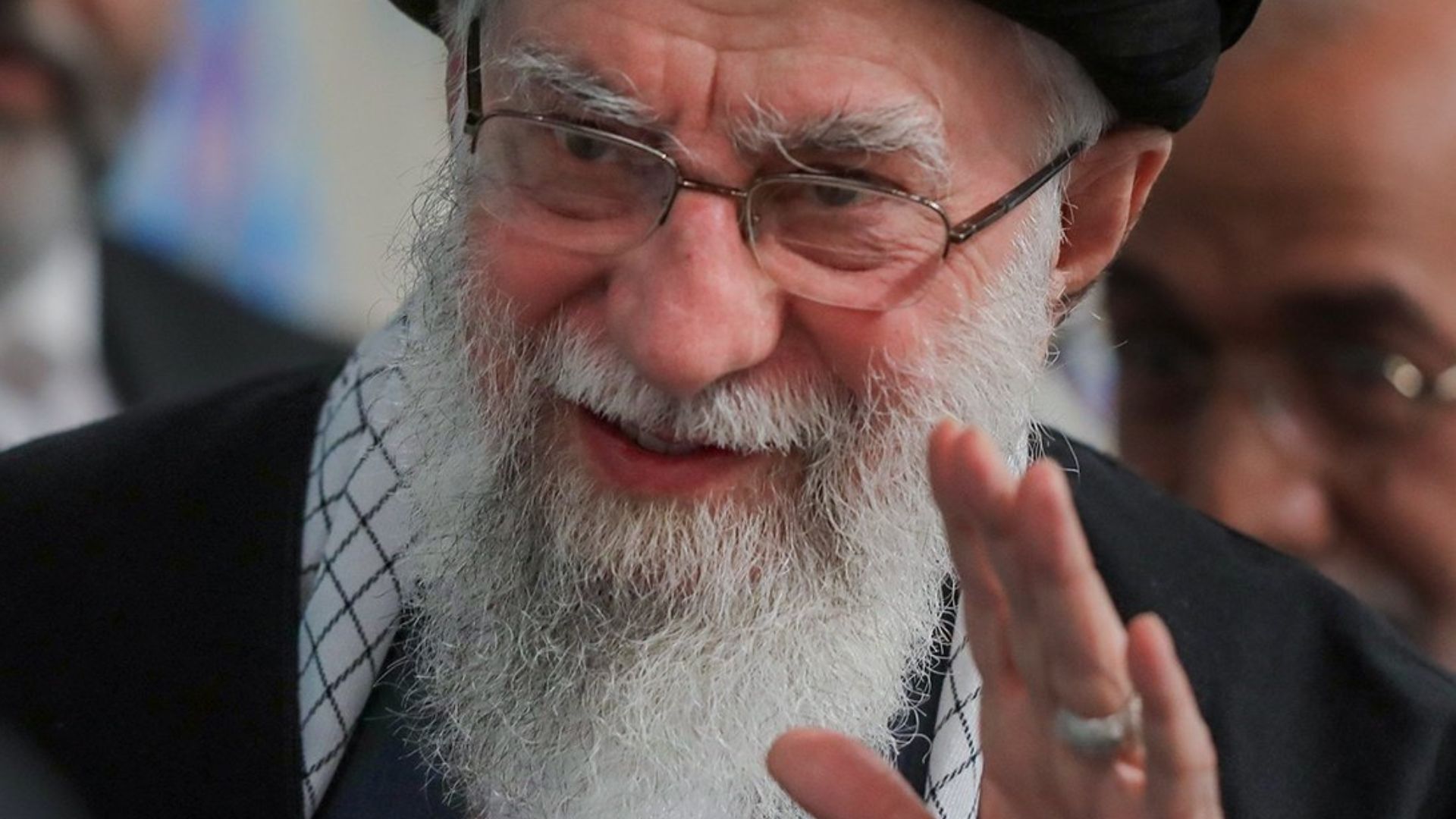
Iran’s Supreme Leader Ayatollah Ali Khamenei was killed in a massive joint US-Israel military operation that targeted his compound in central Tehran.
Iranian state media confirmed his death early Sunday. The strike has shaken the Islamic Republic and triggered fears of wider war in the Middle East.
Officials said the operation was planned for months. The timing was deliberate. It aimed to reduce confusion among attackers and exploit predictable security patterns.
According to US officials, intelligence agencies used advanced satellite imagery, signal interception, and real-time surveillance to track Khamenei’s movements. US President Donald Trump said Khamenei could not escape highly sophisticated tracking systems.
Airbus satellite photos later showed heavy damage at the compound site. The attack relied on a combination of stealth aircraft, long-range cruise missiles, and precision-guided bunker-buster bombs designed to destroy fortified structures.
Operation “Epic Fury” began with one of its first strikes carried out near the office complex of Iran’s Supreme Leader, Ayatollah Ali Khamenei, in Tehran. The strike marked the opening phase of what officials describe as a more extensive and carefully coordinated military campaign.
READ ALSO: https://modernmechanics24.com/post/solar-battery-generates-green-hydrogen/
In recent weeks, the US has significantly increased its military presence in the Middle East. It has deployed aircraft carriers, fighter jets, guided-missile destroyers, and other advanced military systems. Among the major assets sent to the region are two of the US Navy’s largest warships: the USS Gerald R. Ford and the USS Abraham Lincoln.
According to reports, the strikes are being conducted from both air and sea. An Israeli defence official said the operation was planned for months in coordination with Washington. The final decision on when to launch the attack was reportedly made weeks ago.
Reportedly, the initial phase of the joint offensive is expected to continue for at least four days.
WATCH: https://modernmechanics24.com/post/humanoid-robots-unscripted-conversation/
Iran’s geography makes it strategically important. The country sits along the northern coast of the Strait of Hormuz. It is an important route for global oil and liquefied natural gas shipments. Any conflict in this area can affect global energy markets.
Iran also borders the Caspian Sea, the world’s largest inland body of water, which it shares with Russia and several Central Asian nations.
Since tensions with Tehran continue, the US has positioned forces around Iran through more than 30 military bases and key naval locations.
In the air domain, several US assets have been deployed across the region. At Crete in Greece, the RC-135V reconnaissance aircraft has been stationed. In Azraq, Jordan, the US has deployed F-15E fighter jets, EA-18G Growler electronic warfare aircraft, and A-10 Thunderbolt II attack aircraft.
READ ALSO: https://modernmechanics24.com/post/drones-f-16s-us-arms-afghan-pak-war/
At Al Kharj in Saudi Arabia, assets include F-16 Fighting Falcon jets, E-11A BACN communication aircraft, P-8A Poseidon reconnaissance planes, and E-3 early warning aircraft.
In Bahrain, P-8A Poseidon aircraft are operating from Awali. In the UAE’s Al Dhafrah base, the MQ-4C Triton high-altitude unmanned aircraft has been deployed.
At sea, US naval forces are spread across key waterways. In the Red Sea, the guided-missile destroyer USS Delbert D. Black is on deployment.
In the Persian Gulf, the littoral combat ships USS Tulsa and USS Canberra are operating.
The Lincoln Carrier Strike Group is positioned in the Northern Arabian Sea. It is led by the aircraft carrier USS Abraham Lincoln and supported by several destroyers. Its air wing includes F/A-18E Super Hornets, EA-18G Growlers, E-2C Hawkeyes, MH-60 helicopters, and F-35C fighter jets.
WATCH: https://modernmechanics24.com/post/china-military-modern-exercise/
In the Strait of Hormuz, the destroyer USS Mitscher is deployed along with USS Santa Barbara and USS Michael Murphy.
Meanwhile, the advanced Ford Carrier Strike Group, led by USS Gerald R. Ford, has moved closer to Israel from near Greece. It includes multiple destroyers and an air wing equipped with fighter jets, electronic warfare aircraft, early warning planes, helicopters, and cargo aircraft.
These deployments show a large-scale military build-up by the US and its allies around Iran. It is showing heightened readiness amid ongoing regional tensions.
Weapons Used in Strike
Experts believe stealth aircraft such as the F-35 were likely used to penetrate Iranian airspace. Long-range cruise missiles may have been launched from warships in the Gulf. These weapons can fly at low altitude and avoid radar detection.
The strike also targeted Iran’s air defense systems before hitting the main compound. By neutralizing radar installations and missile batteries, US and Israeli forces cleared a path for precision bombing.
READ ALSO: https://modernmechanics24.com/post/robots-replace-scientists-catalyst-labs/
US Central Command later confirmed that Revolutionary Guard command centers, missile launch sites, drone bases, and air defense facilities were among the targets.
How Defenses Were Bypassed
Iran maintains layered air defenses, including surface-to-air missile systems and radar networks. But the US-Israel joint operation bypassed these systems.
First, electronic warfare units likely disrupted communications and radar signals. This created blind spots in Iran’s defensive shield.
Second, waves of precision strikes destroyed key air defense nodes in central Iran.
Third, the use of stealth aircraft reduced detection. These jets are designed to evade radar and strike with pinpoint accuracy.
By the time the final wave targeted Khamenei’s compound, much of the surrounding air defense system had already been damaged.
Trump said Khamenei was unable to avoid our intelligence and tracking systems. Israeli officials echoed the claim, saying the operation involved close coordination between the two countries.
Around 200 Israeli Air Force jets carried out a large-scale offensive targeting the Islamic Revolutionary Guard Corps’ missile infrastructure and air defense networks across western and central Iran.
More than 500 sites were struck in a coordinated, near-simultaneous assault, including missile launchers and advanced air defense systems positioned at multiple locations nationwide.
Executed after detailed planning and supported by high-grade intelligence, the operation synchronized hundreds of fighter aircraft in a complex combat maneuver, considerably extending the IAF’s aerial dominance over Iranian airspace.
Wider Targets Across Iran
The strike was not limited to the Supreme Leader’s compound. Israel confirmed that the commander of the Revolutionary Guard Corps and Iran’s defense minister were also killed. The secretary of the Iranian Security Council reportedly died in the operation as well.
Explosions were heard near the Intelligence Ministry building in Tehran. Witnesses said air defenses were firing into the sky, but many incoming projectiles went unintercepted.
WATCH: https://modernmechanics24.com/post/unsw-fire-resistant-cotton-spray/
In southern Iran, reports said a girls’ school was struck during the wider bombing campaign. Iranian officials claimed over 100 people were killed in that incident. The US said it was reviewing reports of civilian casualties.
The Israeli military stated that hundreds of targets were hit across Iran. These included military airfields, drone facilities, and missile storage depots.
Iran’s Retaliation
Iran responded quickly. Missiles and drones were launched toward Israel and US bases in Bahrain, Kuwait, and Qatar.
The Israeli military said dozens of missiles were fired, with many intercepted. However, at least one civilian was killed in the Tel Aviv area.
Bahrain confirmed damage near the US Navy’s Fifth Fleet headquarters in Manama. Smoke was seen rising from the area. The US military said there were no American casualties and only limited damage despite hundreds of incoming projectiles.
The paramilitary Revolutionary Guard vowed retaliation. Iran’s Cabinet warned that the great crime will never go unanswered.
A Leadership Vacuum
Khamenei, 86, had ruled Iran since 1989 after succeeding Ayatollah Ruhollah Khomeini. He held ultimate authority over foreign policy, the military, and the nuclear program.
His death leaves a power vacuum. There is no publicly confirmed successor. Iran’s clerical establishment and Revolutionary Guard now face a critical test of unity.
READ ALSO: https://modernmechanics24.com/post/china-quantum-computing-os-download/
Trump described the strike as an opportunity for Iranians to take back their country. Critics in the US questioned whether congressional approval was required before launching such an operation.
Nuclear Tensions at Core
The US justified the strike as necessary to stop Iran from rebuilding its nuclear program. A senior US official said intelligence showed Iran had developed the capability to produce advanced centrifuges. These machines enrich uranium to levels that could be used for weapons.
Iran has long insisted that its nuclear program is for peaceful purposes. It retains the right to enrich uranium under international agreements.
The strike marks one of the most direct confrontations between Washington and Tehran in decades. It signals a shift from proxy conflict to open military engagement.
What Comes Next
Military analysts warn that further retaliation could trigger a more extensive regional war. Iran still possesses missile capabilities and allied groups across the region.
The US has augmented its naval presence. Israel remains on high alert.
The killing of Ayatollah Ali Khamenei represents a dramatic turning point. It removes the central figure of Iran’s political system. But it also prompts questions.
Who will lead Iran next? Will retaliation expand into full-scale war? And can diplomacy survive this escalation? But for now, the region stands on edge.