Science

3D‑printed heart model

US University Builds Beating 3D-Printed Heart Model for Surgery Training

Washington State University researchers have built a beating 3D-printed model of the left side of the heart. Made from soft materials using patient scans, it allows surgeons to practice valve repairs with real tools and imaging. The model successfully simulated a mitral valve repair, showing potential for better surgical training without relying on animals or cadavers.

Read More...
magnesium-air battery

Japan’s University of Tsukuba Builds Reusable Magnesium-Air Battery

Researchers at the University of Tsukuba have built a reusable magnesium-air battery using a nitrogen-doped graphene cathode and solid electrolyte. The design resists chloride damage, performs better than platinum-based versions, and stays safe even when bent. It offers a low-cost alternative to lithium batteries for future electric vehicles.

Read More...
Researcher holding a small pouch-cell battery in a laboratory setting

US and South Korea Team Up to Improve Sulfur-Based EV Batteries

Researchers from the University of Chicago, UC San Diego and LG Energy Solution have improved sulfur-based solid-state batteries by changing how materials are mixed. The new cathode delivers about 1500 mAh per gram, close to sulfur’s theoretical limit, and works in a scalable pouch-cell format. The low-cost design could help electric vehicles travel longer distances.

Read More...
Harris's hawk flying toward a gap with wings partially tucked in a research facility

UK and US Researchers Study Hawk Flight to Improve Drones

Oxford and UC Davis researchers have studied how a Harris’s hawk tucks its wings to fly through narrow spaces. Using motion capture and wind tunnel models, they found the bird shifts between unstable and stable flight states. The findings could lead to more agile drones that navigate complex environments.

Read More...
Change typhoon intensity and path

China Proposes Using Space Solar Beams to Tame Typhoons

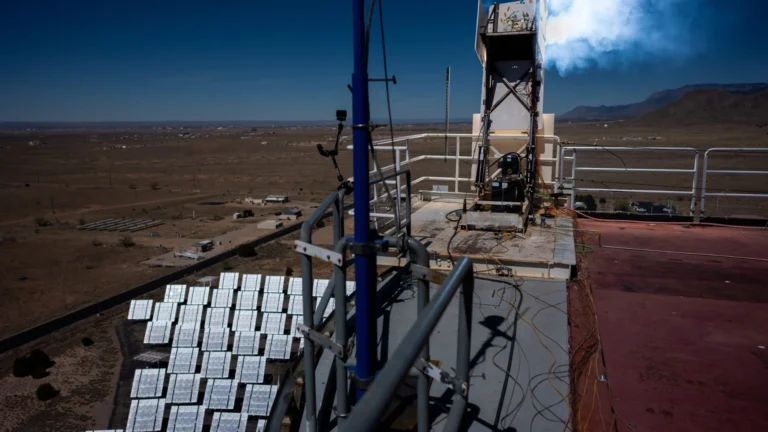
Chinese scientist Duan Baoyan proposes using space solar beams to tame typhoons by heating storm moisture. His Zhuri project aims for a megawatt-class orbital demonstration by 2030. The station could also charge satellites and lunar bases. A 75-metre test tower already simulates the process on Earth, but safety and scale concerns remain before full construction begins.

Read More...
Glue-Free Paper

Germany’s Fraunhofer Develops Laser Method for Glue-Free Paper Sealing

Germany’s Fraunhofer institutes have developed a laser method that seals paper packaging without glue or plastic. The process uses a CO laser to turn paper fibers into natural adhesives, creating seams that can hold 20 kilograms. The technology makes paper packaging fully recyclable and will be demonstrated at Interpack 2026.

Read More...
Electron microscopy

Cornell Researchers Find ‘Mouse Bite’ Defects in Semiconductors With 3D Imaging

Cornell University researchers used high-resolution 3D imaging to detect atomic-scale “mouse bite” defects inside computer chips for the first time. Working with TSMC and ASM, the team captured images of transistor channels just 15 to 18 atoms wide. The breakthrough helps chipmakers spot manufacturing flaws during development and could improve everything from phones to quantum computers.

Read More...
X‑ray spectroscopy

US Lab Argonne Uses AI to Speed Up X-Ray Analysis by Five Times

Scientists at Argonne National Laboratory built an AI-guided method that makes X‑ray spectroscopy five times faster. The system cuts measurements by 80 percent while reducing human error and sample damage. It helps researchers study batteries and catalysts in real time, bringing X‑ray science closer to fully autonomous experiments.

Read More...