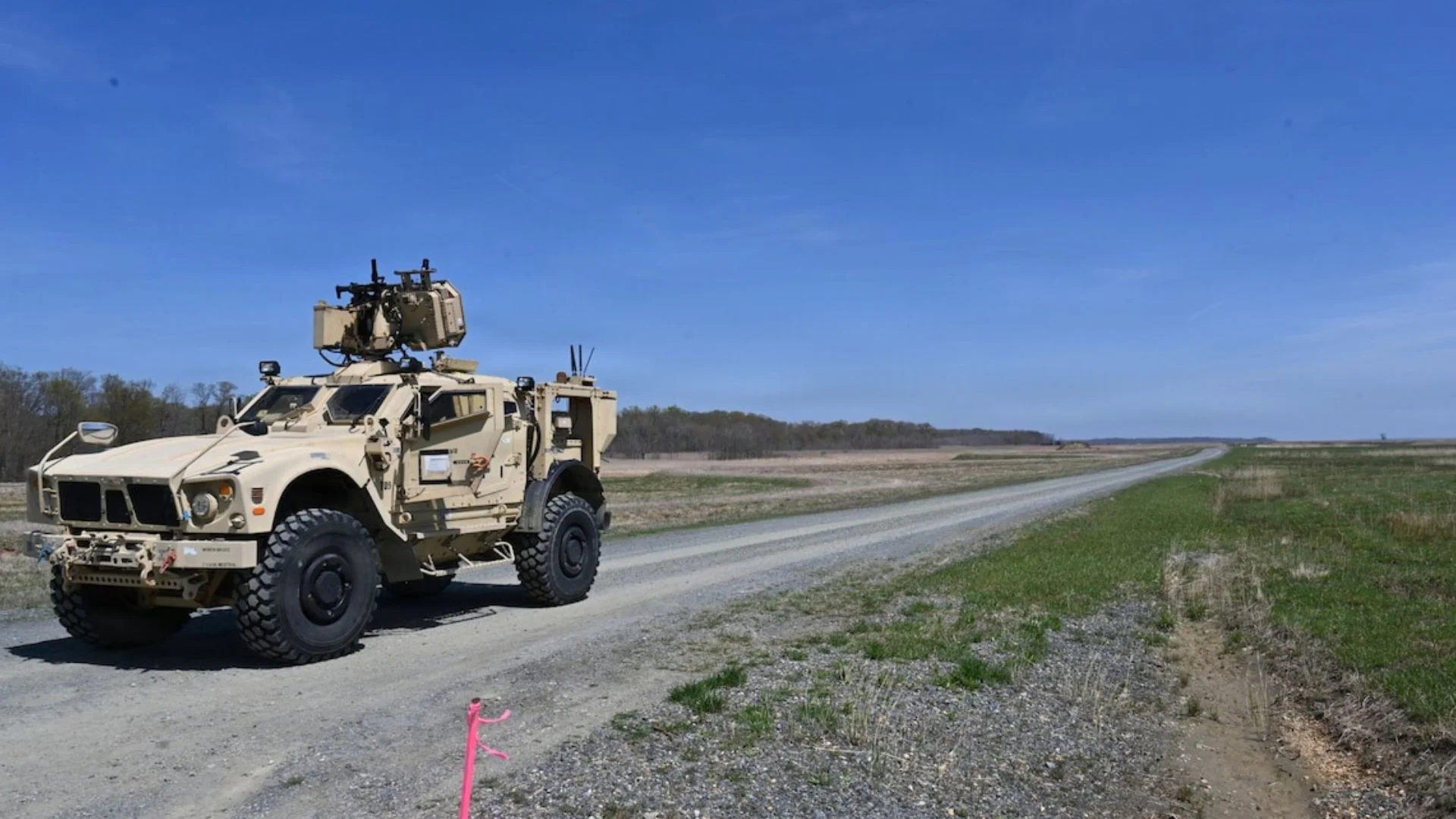
The US Army has successfully tested a new counter-drone capability designed to engage and destroy small unmanned aerial systems while military vehicles are moving.
Developed by the US Army Combat Capabilities Development Command (DEVCOM) Armaments Center, the technology combines advanced fire control software with remotely operated weapon stations.
The goal is to improve accuracy against drone threats while reducing the number of rounds needed to neutralize them.
US Army Advances Counter-Drone Tech
The new capability was demonstrated during testing in April at Aberdeen Proving Ground in Maryland. The effort is led by the Armaments Center’s Science and Technology Integration Office as part of a project focused on advanced counter-drone fire control. The system allows operators to track, aim at, and engage drones even when the host vehicle is moving.
The project was launched in response to the growing threat posed by small drones on modern battlefields. Army leadership directed the team to develop a more effective way to defeat these increasingly common aerial threats. Small drones are now widely used for surveillance, target spotting, and attack missions in conflicts around the world.
READ ALSO: Ukraine Opens TrophyLab to Share Captured Russian Weapons Intelligence With Allies
At the heart of the system is the Armaments Center’s Gunslinger fire control technology. The software was originally created for the Army’s Future Attack Reconnaissance Aircraft program before being adapted for ground-based air defense missions. Engineers modified the technology to accurately track and engage airborne targets while moving.
How the New Fire Control System Works
The system connects the Gunslinger software with a remotely operated weapon station and multiple vehicle sensors. These sensors provide real-time information about both the vehicle’s movement and the drone’s position. The software then calculates the correct aiming solution and keeps the weapon aligned with the target.
Hitting a small drone while moving is significantly more difficult than engaging a stationary target. Both the vehicle and the drone are constantly changing position, creating a complex targeting problem. The new fire control system is designed to automatically address this challenge and improve hit probability.
READ ALSO: Modified Clay Could Slow Fruit Ripening and Cut Food Waste During Shipping
Developers also built the software using a modular open-system architecture. This approach allows the Army to share the technology across different platforms and integrate future upgrades more easily. It also helps reduce development costs and speeds up the adoption of new capabilities.
Testing Results and Future Development
According to project officials, the April tests produced encouraging results. The team successfully engaged and destroyed drones during the demonstration, validating the performance of the advanced targeting algorithms. The tests marked an important step toward refining the capability for operational use.
READ ALSO: NASA Trials Innovative Supersonic Parachute Delivery Technology
Developers now plan to conduct additional testing with faster-moving vehicles and drones. These future evaluations will help improve tracking performance, accuracy, and overall system reliability. Engineers will use data from each test to further enhance the software.
Project officer Nick Cascia said the successful drone engagements showed that months of preparation and development efforts were paying off.
Deputy project lead James Little added that the team plans to build on the early results and continue improving the system. Their focus remains on delivering a practical, effective solution to emerging drone threats.
WATCH ALSO: Humanoid robot plays table tennis like human beings
The development highlights the Army’s growing focus on countering unmanned aerial systems, which have become a major challenge in modern warfare.
As drone use continues to expand across military operations worldwide, advanced fire control technologies like this one are expected to play an important role in protecting forces and improving battlefield effectiveness.