

Rice University researchers have developed a new way to make bulk diamond composites without using the extremely high pressures normally needed to process diamond. The team also found that high-speed impacts can turn diamond into graphite within microseconds, revealing a new way the material can absorb energy.
The study was published Aug. 6 in Materials Today. The findings could help researchers develop tougher materials for aerospace, defense and other technologies that face extreme conditions.
The researchers created a strong composite by combining small diamond grains with cubic boron nitride and cobalt. The process produced a solid material in which diamond particles were spread through a boron nitride matrix.
The team then tested the composite under high-speed impacts. One test showed that the material stayed together after being hit by a small metal projectile traveling at more than seven times the speed of sound.
READ ALSO: https://modernmechanics24.com/post/mit-arm-controller-excavator-training/
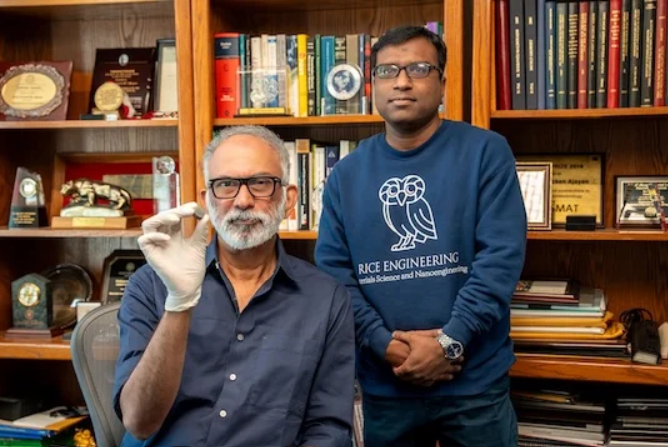
The research was led by Pulickel Ajayan, Benjamin M. and Mary Greenwood Anderson Professor of Engineering at Rice University. Abhijit Biswas, a research scientist in Rice’s materials science and nanoengineering department, was the first author.
Researchers from Texas A&M University, the Karlsruhe Institute of Technology, the University of Brasília, the University of Toronto, the University of Houston and other institutions also contributed to the study.
Diamond is extremely hard and conducts heat well, making it useful for technologies that must operate under harsh conditions. But making larger pieces of diamond is difficult because the high temperatures used during processing can cause diamond to turn into graphite.
High-pressure methods can make polycrystalline diamond, but they require extreme pressure. This can make the process more difficult and limit the size of the material that can be produced.
The researchers mixed microscopic diamond grains with cubic boron nitride and cobalt. They then used a technique called spark plasma sintering, which quickly applies heat and pressure to turn the powder mixture into a solid composite.
The resulting material contains diamond particles inside a boron nitride structure, with cobalt helping bind and stabilize the mixture. According to the researchers, the composite is very tough and difficult to machine.
WATCH ALSO: https://modernmechanics24.com/post/cartoon-robot-learns-kitchen-chores-2/
The team fired metal projectiles measuring 1–4 millimeters at the composite at hypersonic speeds. When one projectile traveled faster than seven times the speed of sound, the material remained intact.
A larger projectile moving even faster caused the composite to break apart. During the impacts, however, nearly all of the diamond involved in the transformation changed into graphite within microseconds.
Diamond and graphite are both made from carbon, but their atoms are arranged differently. Under the extreme shock of the collision, the diamond structure rearranged and changed into graphite.
The researchers used molecular dynamics simulations to study how the atoms moved during this process. They found that the transformation to graphite absorbed part of the impact energy, offering clues about how structural changes can help materials handle extreme force.
The findings come from controlled laboratory experiments and simulations. The research does not yet show how the composite would perform in long-term real-world aerospace or defense applications.
More testing will be needed to understand how the material behaves under different temperatures, impact conditions and repeated stresses.
The study gives researchers a new way to think about diamond-based materials. Instead of only relying on diamond’s hardness, the material’s ability to change structure under extreme force may also help it absorb energy.
This could guide the development of tougher materials for aerospace, defense and other systems that need to withstand severe impacts. The new manufacturing method may also make larger diamond-based composites more practical to produce.
















One Response