

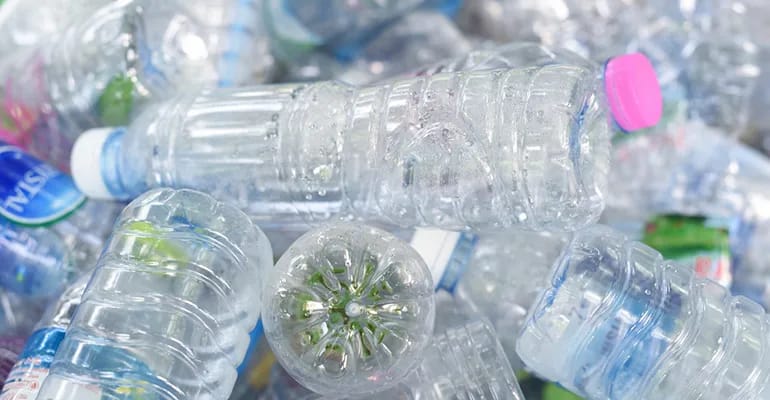
Researchers at The Australian National University (ANU) have found that changing a single atom in a plastic-degrading enzyme can sharply improve its performance without sacrificing stability.
The study focuses on enzymes that break down polyethylene terephthalate (PET), a plastic widely used in bottles, food packaging and synthetic fibres.
Published in Angewandte Chemie International Edition, the research also introduces a faster way to test new enzyme designs.
The work addresses a long-standing problem in enzyme engineering. Scientists often improve an enzyme’s activity through repeated changes to its structure, but those changes can eventually reduce its stability. The ANU team found that a much smaller chemical adjustment can improve performance while keeping the enzyme’s overall structure largely intact.
READ ALSO: https://modernmechanics24.com/post/china-new-beihai-jiu151-rescue-vessel/
The research centred on PET hydrolases, commonly called PETases. These enzymes break PET into smaller chemical components that can then be used in recycling processes.
PETases have already been studied extensively, with researchers using computer modelling and protein engineering to improve their ability to act on plastic. The ANU researchers took a different approach by changing the chemistry at only one location within the enzyme.
They introduced a group of noncanonical amino acids known as azatryptophans. These compounds closely resemble tryptophan, one of the 20 amino acids normally found in proteins, but replace a carbon-hydrogen group with a nitrogen atom.
The change was extremely small at the molecular level. Yet PET-degrading enzymes carrying the altered amino acid at one specific site broke down PET at almost twice the efficiency of the original versions.
Importantly, the modified enzymes retained their thermal stability. This matters because an enzyme that works faster but loses its structural stability may be difficult to use in practical processes.
Dr Elwy Abdelkader of ANU’s Research School of Chemistry, the lead author of the study, said enzyme engineering often reaches a point where improving activity affects stability. The team’s results show that a highly targeted chemical change can alter how an enzyme functions without requiring extensive redesign.
Faster Testing For PET
The study also presents a screening method designed to speed up research on plastic-degrading enzymes. The researchers developed a fluorescence-based test called PETra, which can measure enzyme activity within minutes.
Traditional tests can take hours or even days. This makes large-scale testing of enzyme variants slower, especially when researchers need to compare many different designs.
PET creates another challenge because it does not dissolve easily in water and has a complex solid structure. PETra addresses this by using a soluble fluorescent material that acts as a chemical stand-in for PET.
The researchers then compared PETra measurements with tests using actual solid PET. They found a strong relationship between the results, indicating that the faster test can help researchers identify promising enzyme variants before carrying out longer experiments.
That screening step is important for enzyme engineering. A faster test allows scientists to examine more variants in less time and focus detailed experiments on the designs that show useful activity.
WATCH ALSO: https://modernmechanics24.com/post/pla-mobile-anti-aircraft-fire-drill/
Beyond Plastic Recycling
Professor Thomas Huber, a co-author of the study, said the research builds on the use of noncanonical amino acids to make precise changes to proteins. Natural proteins are generally built from 20 standard amino acids, which limits the chemical options available when scientists redesign them.
Adding carefully selected noncanonical amino acids expands those options. In this case, the researchers used the technique to make a very small change that altered the behaviour of a PET-degrading enzyme.
The findings are relevant to efforts to develop biological methods for handling plastic waste. PET is one of the most widely used plastics, and enzymes that break it down are being studied as part of research into more selective recycling processes.
The approach is not limited to PETases. The researchers said similar single-atom changes may be useful when designing enzymes for sustainable manufacturing, biotechnology and medical applications.
The study therefore combines two separate advances in enzyme research: a precise chemical method for changing protein behaviour and a rapid system for measuring the results. Together, they provide researchers with a way to test whether extremely small molecular adjustments can improve engineered enzymes without undermining their stability.
The next stage will involve applying the method to other enzymes and identifying where similarly precise chemical changes can produce useful effects. If the approach works across a wider range of proteins, it may give scientists a faster and more controlled way to fine-tune enzymes for industrial and biological applications.











One Response