

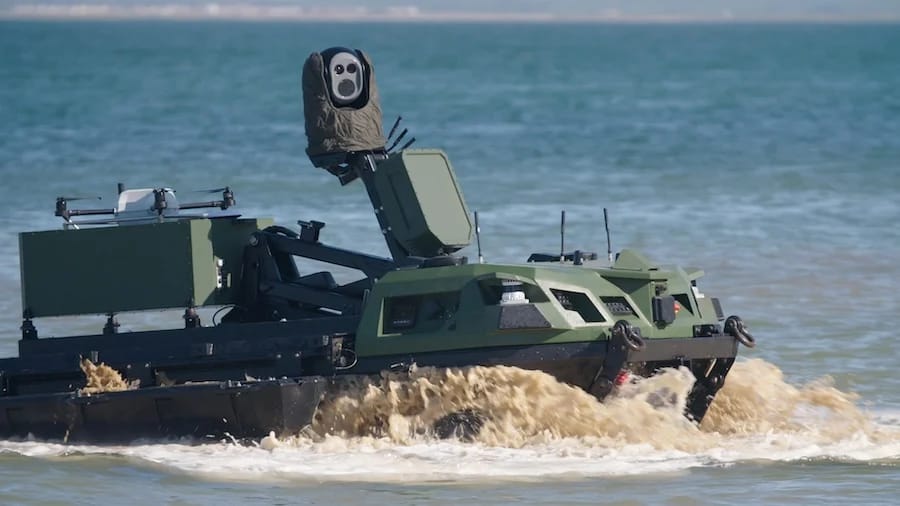
Rheinmetall is testing a networked maritime security system with the German Navy during REPMUS26 in Portugal.
The setup links unmanned platforms, underwater sensors and a mobile command centre to build a broader operational picture around ports and coastal areas. The trials are also examining how systems from different manufacturers can work together through a common digital architecture.
Robotic Experimentation and Prototyping with Maritime Unmanned Systems (REPMUS26) is being held from 31 August to 25 September 2026.
The exercise is taking place on Portugal’s Troia Peninsula and in nearby waters, bringing together naval forces, research organisations and defence companies. Participants are testing unmanned technologies in air, surface, underwater and wider networked operating environments.
READ ALSO: https://modernmechanics24.com/post/3d-titanium-lattice-survives-damage/
Rheinmetall has been involved in the large-scale experimentation programme since 2024. Its role focuses on integrating different maritime technologies into a connected operational system rather than testing each platform in isolation. The company said the 2026 trials are centred on realistic scenarios and practical cooperation with naval and government users.
The German Navy is using Rheinmetall’s containerised setup as a relocatable command and control centre during the exercise. The system is designed to support port-security operations and provide information from both underwater and surface environments. Its mobile design also allows the command element to be moved to different locations when required.
One Interface, Multiple Systems
A major part of the demonstration is Rheinmetall’s Battlesuite middleware. The software acts as a connecting layer between sensors, unmanned platforms and other mission equipment supplied by different technology companies. This approach is intended to reduce the need for operators to manage each system through a separate interface.
The Battlesuite architecture is based on Tactical Core middleware from German technology company Blackned.
Rheinmetall describes the architecture as an open environment for integrating sensors, effectors and mission modules from multiple partners. In practical terms, this gives operators a common framework for combining equipment that was not necessarily designed by the same manufacturer.
This interoperability is important for multinational maritime operations. Naval forces frequently use equipment from different suppliers and countries, which can create challenges when systems use different software, data formats or control methods. A common integration layer can help bring those systems into a single operational picture without requiring every platform to be replaced.
Underwater Sensors Take Focus
Unmanned underwater sensing is receiving particular attention during the 2026 trials. Rheinmetall is working with industry partners to test underwater sensors that can contribute information over sustained periods. These systems are intended to improve awareness of activity beneath the water as well as around the surface.
The wider objective is to create a persistent operational picture. Such a picture combines information from several sources so that operators can understand what is happening across different parts of a maritime area. The approach is relevant to port protection, coastal surveillance and monitoring of critical maritime infrastructure.
The system is also designed to let operators manage multiple unmanned systems through one user interface. Those systems can differ in type and can come from different manufacturers. This feature is significant because future maritime security networks are likely to involve a mixture of autonomous and remotely operated vehicles rather than a single unmanned platform.
WATCH ALSO: https://modernmechanics24.com/post/space-force-gps-ground-system-upgrade/
NATO Interoperability Gains Importance
The REPMUS26 trials also provide a test environment for collaborative operating concepts among NATO partners. Rheinmetall said the aim is to validate how connected maritime systems can work together under realistic conditions. The company links this work to the protection of ports, coastal waters and international maritime supply routes.
Gregor Mannherz, head of the Rheinmetall delegation, said the exercise allows the company to test prototype development in realistic scenarios.
He said cooperation with operational experts from naval customers and government agencies helps Rheinmetall refine its products and direct development more efficiently.
The trials also show how maritime security is moving toward distributed sensing and networked operations. Instead of relying on one ship, sensor or control station, operators can combine information from several systems across different domains. For ports and other critical infrastructure, that architecture can provide a broader basis for detecting and responding to activity in surrounding waters.
REPMUS26 therefore serves as more than a platform demonstration for individual unmanned vehicles. It is testing the digital connections that allow different systems to function as part of a larger maritime security network.
The results will help inform further development of interoperable systems for the German Navy and other NATO partners as unmanned technologies become a larger part of maritime operations.







2 Responses