

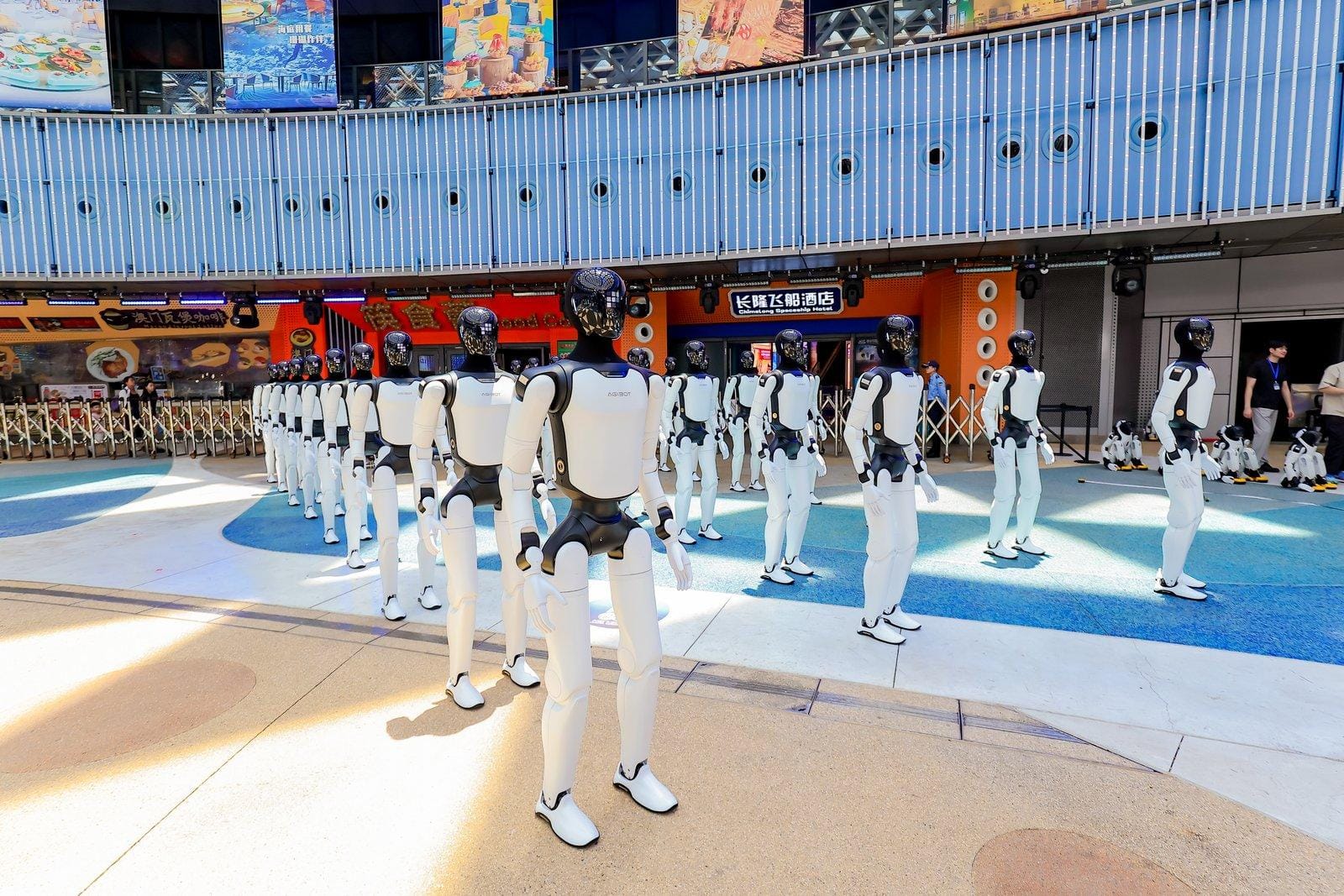
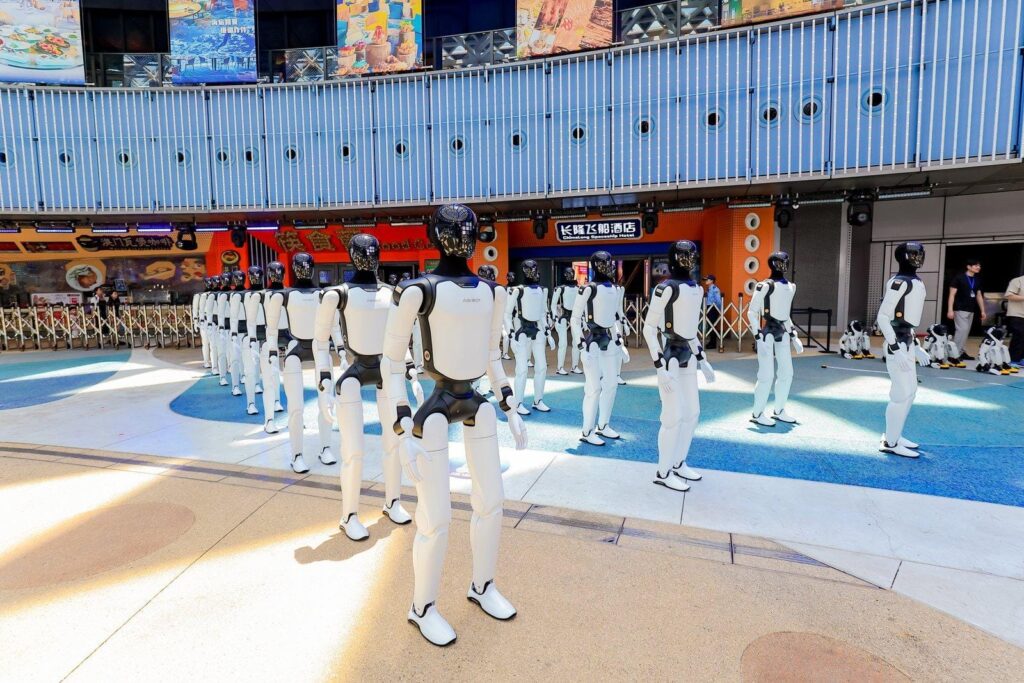
China has opened what it describes as the world’s first large-scale embodied artificial intelligence theme park in Zhuhai, bringing hundreds of robots into a commercial tourism setting.
The project combines robotics, entertainment, education and visitor services at the Chimelong Spaceship Park in Hengqin. It gives embodied AI systems a large public environment where they can interact with people and operate across different tasks.
The park was jointly developed by Chinese embodied AI company AgiBot and cultural tourism group Chimelong. It opened on Sunday at the Chimelong Spaceship Park in Hengqin, Zhuhai, in Guangdong Province. More than 300 robots from AgiBot’s product range were deployed at the site on opening day.
The project includes more than 100 robot interaction points. These are spread across seven main areas, including entertainment, education, tour guidance, retail, visitor assistance, hotels and sports competitions. Visitors can therefore encounter robots in both entertainment roles and everyday service situations during a visit.
READ ALSO: https://modernmechanics24.com/post/rolls-royce-australian-aukus-reactors/V
The opening also featured two claimed industry firsts. One was a large-scale joint dance performance involving humans and robots, while another involved robots performing aerial acrobatics. The performances are designed to combine robotic movement with conventional cultural and tourism programming.
Embodied AI Meets Visitors
Embodied AI refers to artificial intelligence that operates through a physical machine. Instead of existing only as software, these systems use sensors, computing systems, cameras and mechanical components to perceive their surroundings and perform actions in the real world.
A theme park provides a demanding environment for such technology. Robots must respond to people, navigate physical spaces and perform tasks repeatedly while dealing with changing conditions. These interactions can also provide information that developers use to assess how robotic systems perform outside controlled laboratory settings.
AgiBot plans to bring humanoid robots that performed strongly at the World Humanoid Robot Games to the park. Robots of the same models that led the competition in gold medals and overall medals are expected to appear regularly and demonstrate their performances for visitors.
AgiBot said its integrated product and technology system has helped it become the world’s largest embodied AI company by shipments and revenue. The company also ranks among industry leaders in robot hardware consistency and large-scale delivery capabilities, according to the information provided.
Seven Areas For Robots
The park’s seven application areas cover a broad range of human-robot interaction. They include commercial and entertainment performances, science education, study tours, visitor guidance, shopping assistance, service stations, retail outlets, intelligent tour companions, hotel services and sports events.
The Chimelong Spaceship Park itself focuses on immersive space exploration and marine ecology education. It has received more than 10 million visitors since opening, giving the robotics project access to an established tourism environment with a large number of visitors.
The scale of deployment sets the project apart from smaller robotic demonstrations. Chimelong said overseas theme parks have generally used robots in limited pilot programmes rather than operating them across many functions on a regular commercial basis.
The company said China has several conditions that support wider use of embodied AI in tourism. These include a large cultural and tourism market, a developed robotics manufacturing base and extensive digital infrastructure such as high-speed mobile networks.
WATCH ALSO: https://modernmechanics24.com/post/five-luna-robots-synchronized-dance/
China Builds Application Base
One of the technologies used in the project is 5G-A, an advanced version of mobile network technology designed to provide higher speeds, lower latency and greater network capacity than conventional 5G in suitable applications. In a theme park, such connectivity can support communication between robots, cloud systems and other digital services.
Xiang Ligang, a technology and telecommunications policy observer, said the project provides embodied AI with complex and frequent interactions with people. He said developers need more than laboratory models and hardware because real-world applications are also required for data collection and technology testing.
That process is important for embodied AI because physical robots face conditions that are difficult to reproduce fully in a laboratory. A busy theme park can expose systems to different visitors, movements, conversations, obstacles and operating environments. The resulting experience can help developers identify technical problems and refine future systems.
The China Embodied Intelligence Industry Development Report (2026) estimated that China’s embodied intelligence market grew from about 213.3 billion yuan ($31.85 billion) in 2018 to an estimated 1.09 trillion yuan in 2026. The report put the compound annual growth rate at about 22% to 23%.
Xiang said China’s large consumer market, robotics supply chain and wide range of manufacturing and service applications can support an application-data-technology iteration cycle. More commercial settings similar to the Zhuhai theme park are expected to emerge as companies seek real-world environments for embodied AI systems.
The opening of the park therefore marks a shift from individual robot demonstrations toward broader commercial deployment. Its performance will depend on how reliably the machines operate across entertainment, education, hospitality and visitor services. The experience gained in Zhuhai will provide another source of real-world data as China expands the use of embodied AI beyond factories and research laboratories.










One Response