

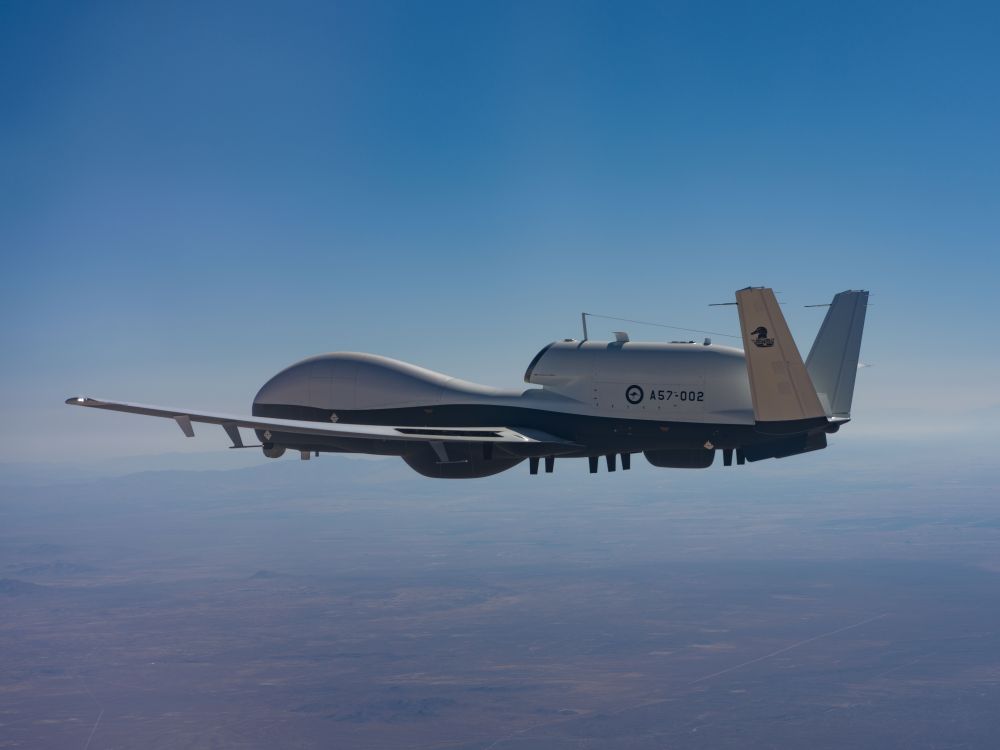
Australia has declared Initial Operational Capability (IOC) for its MQ-4C Triton unmanned aircraft and MC-55A Peregrine intelligence, surveillance, reconnaissance and electronic warfare aircraft.
The milestone follows extensive operational testing and evaluation by the Australian Defence Force. It gives the Royal Australian Air Force (RAAF) an initial operational force for long-range surveillance and airborne electronic warfare missions across the Indo-Pacific.
The Australian Department of Defence announced the IOC milestone for both aircraft fleets.
The MQ-4C Triton is a High Altitude, Long Endurance (HALE) unmanned aircraft designed to conduct persistent intelligence, surveillance and reconnaissance missions. The MC-55A Peregrine is built to combine intelligence, surveillance, reconnaissance and electronic warfare functions in a single aircraft.
IOC does not mean that the complete fleet is operational. In Australia’s defence framework, it means that an initial group of aircraft and supporting elements has reached the required level of readiness for operational deployment. Further aircraft, support equipment, training and other elements can be added as the programs move toward their full operational capability.
READ ALSO: https://modernmechanics24.com/post/first-embodied-ai-theme-park-robots/
The RAAF has ordered four MQ-4C Tritons and four MC-55A Peregrines. Three aircraft of each type have now been delivered to Australia. The fourth MC-55A is scheduled to arrive in Australia later this year.
Triton Extends Surveillance Reach
The MQ-4C Triton is designed to remain airborne for long periods while collecting surveillance information from high altitude.
Its role is to provide commanders with a persistent view of large areas, reducing the need to rely only on shorter-range or crewed aircraft for continuous monitoring. This is particularly relevant to Australia because of the size of its surrounding maritime and airspace areas.
The Australian Defence Department said the Triton IOC has strengthened the RAAF’s ability to deliver persistent intelligence, surveillance and reconnaissance effects across the country’s primary area of military interest. The aircraft is intended to operate over wide areas in and around the Indo-Pacific. Its high-altitude operation also allows it to cover large distances while supporting surveillance missions from remote locations.
Northrop Grumman, the aircraft’s manufacturer, described the IOC milestone as an important step for Australia’s ISR capability.
Jane Bishop, vice president and general manager of Northrop Grumman’s Global Surveillance Division, said Triton can provide surveillance data to support joint decision-makers. She also pointed to the aircraft’s ability to operate in harsh and remote environments.
Peregrine Adds Electronic Warfare
The MC-55A Peregrine adds a different capability to Australia’s airborne surveillance fleet. The aircraft is designed to conduct intelligence, surveillance and reconnaissance while also supporting electronic warfare missions.
In simple terms, this allows the aircraft to gather information from the electromagnetic environment and support operations involving electronic systems.
Australia received its first MC-55A in February. The aircraft have already begun overseas deployments as the RAAF builds experience with the platform. In July, one MC-55A deployed to Clark Airbase in the Philippines and flew several missions over the South China Sea.
The deployment provides an early example of how Australia is using the aircraft outside its home territory.
The South China Sea is an important operating area for regional military forces, making airborne intelligence and electronic warfare capabilities relevant to missions there. The MC-55A can therefore complement other Australian aircraft involved in surveillance and wider defence operations.
WATCH ALSO: https://modernmechanics24.com/post/long-march-12returns-internet-satellites/
Part Of Wider Air Upgrade
The Triton and Peregrine milestones are part of a wider expansion of Australia’s airborne intelligence and surveillance capabilities. The RAAF also operates Boeing P-8A Poseidon aircraft for maritime patrol and other missions. These aircraft are now receiving further upgrades to improve their software, systems and sensors.
The Australian Defence announcement also confirmed that the first of two P-8As being upgraded by Boeing in the US has returned to Australia.
Boeing received a contract in 2024 to upgrade all 14 Australian P-8As to the Increment 3 Block 2 standard. The first two aircraft are being upgraded in Jacksonville, Florida, while the remaining aircraft will receive the work in Australia.
The P-8A, MQ-4C and MC-55A perform different functions, but their capabilities can support the same wider operational picture.
The P-8A provides a crewed maritime patrol capability, while the Triton is intended for long-duration high-altitude surveillance and the Peregrine focuses on ISR and electronic warfare. These aircraft give Australia several ways to collect information and support operations across its large maritime area.
The latest IOC declarations also mark a transition from acquisition and testing toward regular operational use. Australia now has an initial operational fleet of MQ-4Cs and MC-55As, with additional aircraft still due to arrive and other air platforms undergoing upgrades.
However, the RAAF will have a larger mix of aircraft available for surveillance, intelligence gathering, maritime missions and electronic warfare across the Indo-Pacific.






One Response