NVIDIA has announced the Isaac GR00T Reference Humanoid Robot, a new open humanoid robot platform designed to help researchers accelerate the development of advanced robotics systems.
The platform combines humanoid hardware, artificial intelligence computing, software tools, and development workflows into a single integrated system. It is aimed at universities, research laboratories, and robotics developers working on the future of general-purpose humanoid robots.
The announcement comes as interest in humanoid robots continues to grow across industries. Researchers and companies are developing robots capable of performing tasks that require human-like movement, perception, and decision-making.
However, building these systems often requires integrating multiple hardware and software components from different providers, creating significant development challenges.
NVIDIA says the Isaac GR00T Reference Humanoid Robot addresses this problem by offering a unified platform.
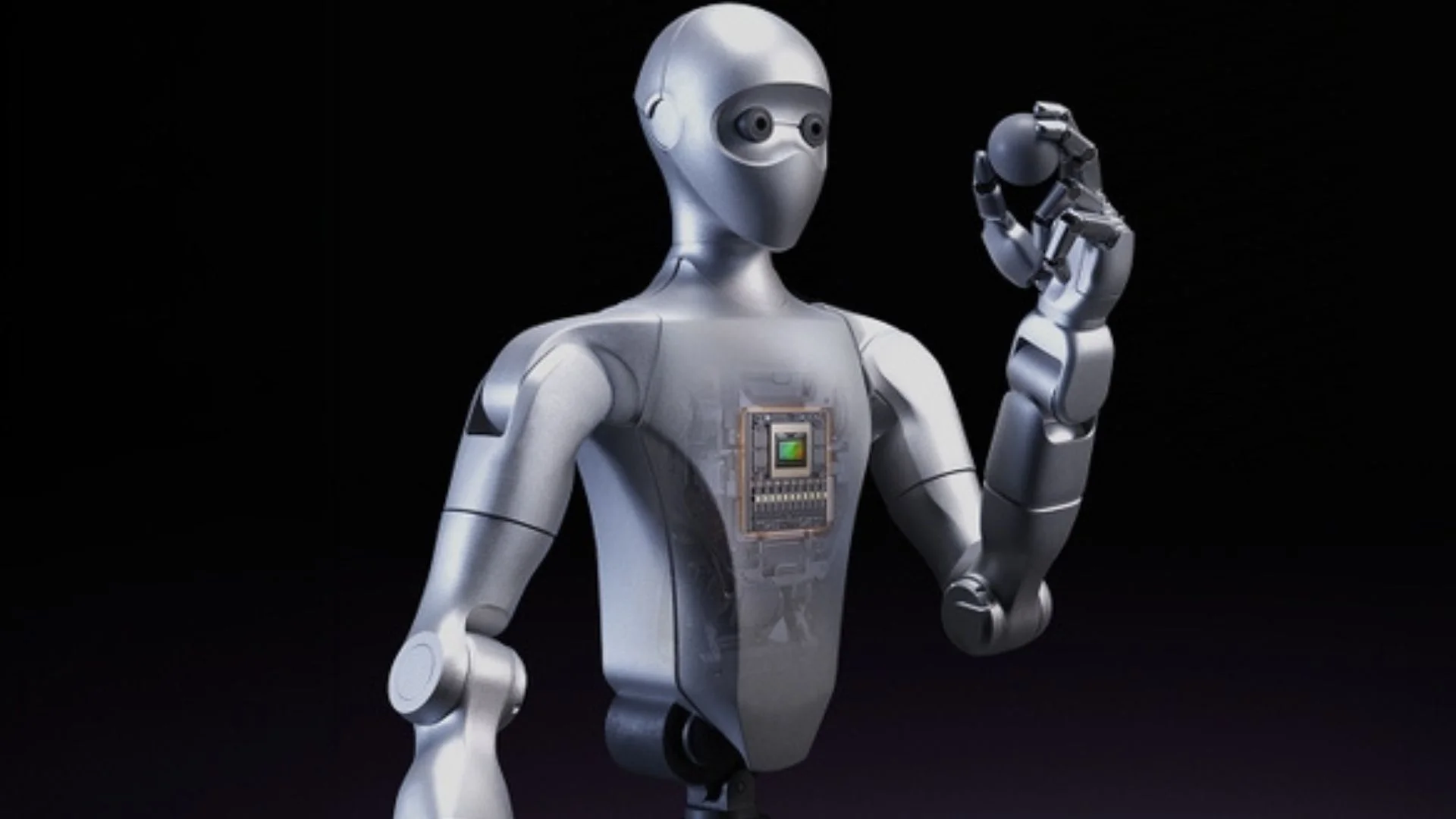
The system combines the Unitree H2 Plus humanoid robot with Sharpa Wave dexterous robotic hands, NVIDIA Jetson Thor onboard computing hardware, and the company’s Isaac GR00T software platform. These components provide researchers with a complete environment for developing and testing humanoid robotics applications.
The robot’s physical structure is based on the Unitree H2 humanoid chassis. Standing nearly six feet tall and weighing around 150 pounds, the robot is designed to operate at a human scale. The chassis provides 31 degrees of freedom, allowing a wide range of body movements needed for locomotion and interaction with real-world environments.
READ ALSO: General Tool Company Expands Facility to Boost US Navy Arleigh Burke Destroyer Production
The system also includes two Sharpa Wave tactile robotic hands. Each hand is equipped with five fingers and advanced sensing capabilities designed for delicate object handling. Combined with the humanoid body, the robot reaches a total of 75 degrees of freedom, enabling complex manipulation tasks that resemble human hand movements.
To help the robot understand and interact with its surroundings, NVIDIA has equipped the platform with several sensors. A stereo camera mounted on the robot’s head provides a wide field of view, helping it perceive depth and identify objects. Additional cameras mounted on the robot’s wrists allow it to observe objects during close-range tasks such as grasping and assembly.
The robot also includes an inertial measurement unit (IMU). This sensor tracks movement, orientation, and balance. Such information is important for maintaining stability while walking, lifting objects, or performing coordinated movements.
One of the platform’s major features is its onboard artificial intelligence computing system. The robot uses the NVIDIA Jetson AGX Thor T5000, powered by the company’s Blackwell GPU architecture. The computing module delivers up to 2,070 FP4 teraflops of AI performance and includes a 14-core Arm processor and 128GB of unified memory.
This onboard computing power allows the robot to process sensor data and make decisions in real time. Instead of relying heavily on cloud-based systems, the robot can perform many AI tasks directly on the machine. This improves responsiveness and supports deployment in environments where constant internet connectivity is not available.
The robot is also designed for physical work. Its arms can generate a torque of up to 120 Newton-meters, while the legs can reach up to 360 Newton-meters. The platform supports a rated payload of 7 kilograms and can handle a peak payload of up to 15 kilograms, enabling it to carry and manipulate heavier objects.
Connectivity options include Ethernet, Wi-Fi 6, Bluetooth 5.2, and USB interfaces. The robot also features microphones and speakers that support voice-based interactions. A built-in battery with a capacity of 0.972 kilowatt-hours provides approximately three hours of operating time before recharging is required.
READ ALSO: NTU Singapore Scientists Propose Carbon-Neutral Space Data Centres Using Unlimited Solar Power
Safety remains a key consideration in the development of humanoid robotics. To address this, the platform includes a remote emergency stop function. This allows operators to immediately disable the robot if unexpected situations arise during testing or operation.
NVIDIA Isaac GR00T Software Platform
Beyond hardware, NVIDIA positions the Isaac GR00T ecosystem as a full-stack software platform for humanoid robotics. The company has developed a range of tools that support every stage of robot development, from data collection and simulation to deployment and evaluation.
One of these tools is NVIDIA Isaac Teleop. This system allows developers to capture high-quality demonstrations of tasks performed by humans or robots. The collected data can then be used to train AI models that help robots learn new behaviors and skills.
The platform also includes Isaac GR00T foundation models. These AI models are designed to support reasoning, learning, and multitasking execution. Similar to foundation models used in language AI systems, they provide a starting point for developers building more advanced robotic capabilities.
Researchers can also use NVIDIA Isaac Sim and Isaac Lab. These tools create virtual environments where robots can be trained and tested before entering the real world. Simulation reduces costs and helps researchers identify problems early in the development process.
Once models are ready, NVIDIA Isaac ROS middleware helps transfer trained capabilities onto physical robots. Jetson Thor then executes these models in real-world conditions, enabling real-time inference and control.
NVIDIA says researchers maintain ownership and control over their robot data, training datasets, telemetry information, and operational logs. This approach is intended to support open research while giving institutions flexibility in managing their projects.
Research Institutions and Industry Impact
Several leading research organizations have already committed to using the new platform. These include Ai2, ETH Zurich, the Stanford Robotics Center, and the Advanced Robotics and Controls Laboratory at the University of California, San Diego.
WATCH ALSO: India recently tested carried out the successful launch of Intermediate Range Agni-Prime Missile
Researchers at these institutions plan to use the platform to explore areas such as locomotion, manipulation, perception, autonomous decision-making, and human-robot interaction. The shared hardware and software foundation also makes it easier for researchers to compare results and reproduce experiments across different laboratories.
NVIDIA founder and CEO Jensen Huang said humanoid robots represent one of the largest future opportunities for physical AI. He noted that robots capable of understanding and interacting with the physical world have the potential to transform major industries.
The company also announced that the Isaac GR00T development platform will support the Unitree G1 humanoid robot. The G1 is already widely used in research and development projects, allowing more institutions to adopt NVIDIA’s software ecosystem without changing existing hardware investments.
NVIDIA Research plans to use the new reference design internally as well. The company intends to advance future Isaac GR00T models, frameworks, and robotics technologies using the platform.
The launch reflects a broader shift in the robotics industry toward open, collaborative development. By providing a common hardware and software foundation, NVIDIA aims to reduce barriers for research teams and accelerate innovation across the field.
WATCH ALSO: Called Ascentia, the platform is developed by American company Collins Aerospace
The NVIDIA Isaac GR00T Reference Humanoid Robot is scheduled to become available through Unitree in late 2026. NVIDIA also expects to release the Isaac GR00T reference workflow for the Unitree G1 on GitHub and Hugging Face in the near future.
As artificial intelligence and robotics continue to converge, platforms such as Isaac GR00T are expected to play an important role in helping researchers develop more capable humanoid systems that can operate in real-world environments and perform complex tasks.