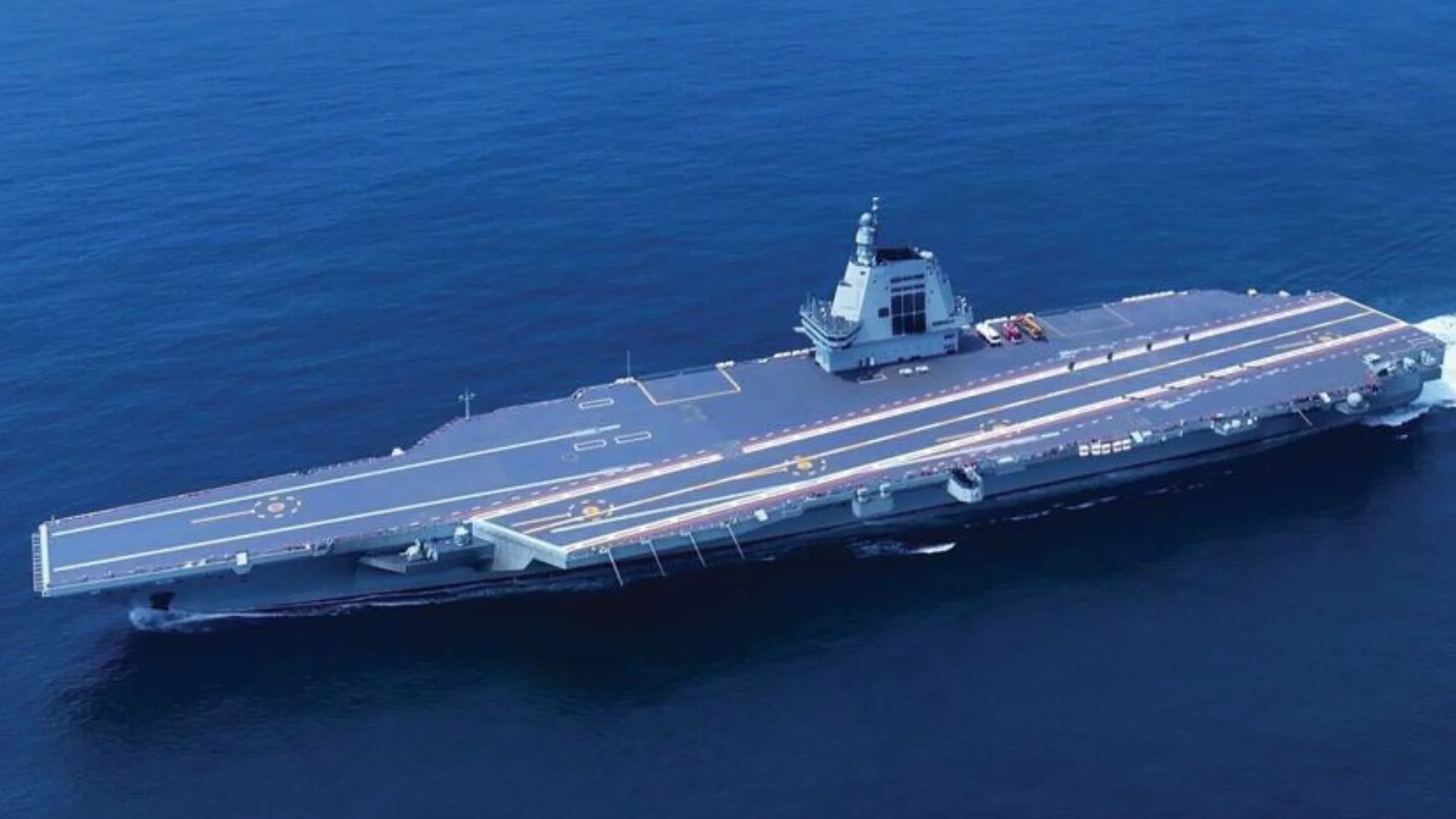
China is moving closer to building its first nuclear-powered supercarrier, the Type 004, a warship expected to become one of the largest aircraft carriers ever constructed.
The massive vessel is designed to expand the reach of the People’s Liberation Army Navy far beyond regional waters.
Its size, nuclear propulsion, and advanced aircraft launch systems are drawing close attention from the United States and Indo-Pacific allies.
Type 004 Supercarrier’s Naval Ambitions
China’s reported Type 004 aircraft carrier marks a major step in the country’s naval modernization plans.
The carrier is expected to displace between 110,000 and 120,000 tons, making it larger than the US Navy’s Gerald R. Ford-class carriers. Analysts believe the vessel is under development at the Dalian shipyard in northeastern China.
READ ALSO: Robotic Hand Achieves 91% Success Grasping Fragile Objects on First Attempt
The carrier is expected to enter service around 2029 or 2030. Open-source satellite imagery has shown large construction modules and possible reactor-related structures at the shipyard. These signs suggest China is moving ahead with a full-scale nuclear-powered carrier project.
The Type 004 is expected to become China’s first nuclear-powered aircraft carrier. China’s current carriers, Liaoning, Shandong, and Fujian, use conventional propulsion systems. Nuclear propulsion would give the new carrier much greater operational range and endurance.
Unlike conventional ships, nuclear carriers do not need regular refueling during deployments. This allows them to stay at sea for months at a time with fewer logistical limitations. The only major limitations are crew endurance, food supplies and ammunition stocks.
The ship is also expected to use electromagnetic aircraft launch systems(EMALS). This technology uses electromagnetic energy instead of steam to launch aircraft from the deck. It allows aircraft to take off with heavier fuel and weapon loads.
China already tested similar catapult systems on its Fujian carrier. However, the Type 004 is expected to use a larger and more advanced version of the technology. Reports suggest the carrier may feature four or even five catapult tracks.
The vessel can measure between 330 and 340 meters in length. The beam is estimated at around 80 to 90 meters and provides a very large flight deck area. A larger deck allows aircraft to move more efficiently during high-tempo operations.
A larger carrier also provides more internal storage space. This includes room for aviation fuel, spare parts, precision-guided weapons, and maintenance facilities. These features are important for long-range deployments far from mainland support bases.
WATCH ALSO: Blue dogs spotted in Chernobyl nuclear disaster site spark concern
Nuclear Power and a Larger Air Wing Increase Capability
The Type 004 is expected to carry between 90 and 105 aircraft. That figure will exceed the normal operational air wing carried by Ford-class carriers. A larger air wing improves strike capability, air defense coverage, and surveillance operations.
The carrier is expected to operate several advanced aircraft types. These include the J-35 stealth fighter, the J-15T carrier fighter, and the KJ-600 airborne early warning aircraft. China is also expected to deploy drones from the carrier.
The J-35 is designed as a low-observable carrier-based fighter. Stealth features reduce radar visibility and improve survivability in contested airspace. Carrier-based stealth fighters would significantly expand China’s maritime strike reach.
The KJ-600 airborne early warning aircraft is another important addition. These aircraft use large radar systems to detect threats at long range. They help coordinate fleet defense, air operations, and missile targeting during combat missions.
Analysts also expect the Type 004 to support unmanned combat and surveillance systems. Drones can extend reconnaissance coverage and reduce risks to pilots during dangerous missions. China has invested heavily in autonomous military technologies in recent years.
The ship’s nuclear reactors are expected to generate enormous electrical power. This power supports electromagnetic catapults, advanced radar systems, and future weapons technologies. Directed-energy weapons such as lasers may eventually require similar levels of power.
Some defense estimates suggest the reactors could generate between 450 and 500 megawatts of power. That level would place the Type 004 among the world’s most powerful naval platforms. High electrical output is important for modern carrier operations.
READ ALSO: Lenovo’s 1000Wh Battery Reveal Signals More Than Just Better Battery Life
The carrier’s larger design can also improve sortie generation rates. Sorties refer to the number of combat flights launched during operations. Estimates suggest the Type 004 could potentially conduct between 150 and 190 sorties per day during intense combat conditions.
Higher sortie rates improve combat endurance during prolonged conflicts. Aircraft can maintain continuous patrols, launch strikes, and support fleet defense without long delays. This becomes important during high-intensity maritime operations.
Indo-Pacific Security Concerns Continue to Grow
The emergence of Type 004 draws attention across the Indo-Pacific region. The US, Japan, India, Australia and the Philippines are all closely monitoring China’s naval expansion. Regional governments see the carrier program as an element of a broader push towards blue-water naval power.
China’s earlier carriers focused mainly on regional operations near its coastline. Type 004 signals a shift in the direction of sustained global deployments. Nuclear-powered carriers allow operations across the Western Pacific, the Indian Ocean and other distant regions.
The carrier may eventually operate alongside Type 055 guided-missile destroyers and nuclear-powered submarines. These escort ships would provide air defense, anti-submarine protection, and long-range strike support. They would form powerful carrier strike groups.
Military planners are also studying how the Type 004 fits into China’s anti-access and area-denial strategy. China already deploys long-range anti-ship missiles, submarines, and advanced surveillance systems. A nuclear supercarrier would add another layer to this growing military network.
The Taiwan Strait remains one of the most sensitive areas in the region. A larger Chinese carrier force could allow air operations from multiple directions during a crisis. This would complicate defense planning for Taiwan and its partners.
The South China Sea and Philippine Sea are also important operational zones. These waters contain key shipping routes and strategic chokepoints. A nuclear-powered carrier can remain active in these regions for long periods without relying on nearby refueling support.
Despite China’s rapid progress, experts note that operating nuclear carriers remains highly complex. The US has decades of experience with nuclear carrier operations, logistics, and carrier aviation training. China is still developing that level of operational expertise.
WATCH ALSO: China sends 3 astronauts, 4 mice to space station for mammal study in orbit
The US Navy also faced major technical challenges during the development of the Ford-class carriers. Electromagnetic launch systems and weapons elevators required years of refinement. China might encounter similar engineering and operational difficulties as the Type 004 program advances.
Even so, the Type 004 represents a major milestone for China’s naval industry. The project highlights the country’s rapidly expanding shipbuilding capacity and its long-term military planning. It also reflects Beijing’s goal of building a navy capable of sustained operations across global sea lanes.
The coming decade can bring a major shift in maritime competition across the Indo-Pacific. If China successfully deploys multiple Type 004 carriers, regional naval strategies will continue evolving in response. The balance of power at sea depend on advanced carriers, submarines, drones, and long-range missile systems.