Researchers from South Korea have engineered a revolutionary flexible, airless wheel that can expand from a compact disc into a large, robust tire, survive a 4-meter fall, drive through fire, ann traverse rugged lunar-like terrain—showcasing its potential to explore the Moon’s hazardous caves and pits.
Imagine a rover wheel that can transform like a piece of futuristic origami, shrug off extreme temperatures, and survive a cliff drop. That’s the breakthrough from a team of scientists, led by Seong-Bin Lee, who have developed a deployable wheel designed to conquer the most unforgiving environments, both on Earth and the Moon. Their creation aims to solve a critical challenge in planetary exploration: accessing the promising but perilous lunar subsurface.
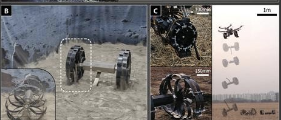
The wheel’s genius lies in its simple, hinge-free mechanical design. It’s constructed from elastic steel strips arranged in a woven, crossed-helical pattern, forming a soft, airless structure. The hub connects two sides that rotate in opposite directions, allowing the wheel to expand radially from a compact 230mm diameter to a fully deployed 500mm diameter. This compact-to-large transformation is crucial for spacecraft, where every cubic centimeter of storage is precious.
READ ALSO: https://modernmechanics24.com/post/world-first-fully-playable-ai-game/
Why is such a wheel needed? Lunar pits and caves are top targets for future missions, as they offer natural shelter from deadly radiation and wild temperature swings. However, reaching them requires navigating treacherous, rocky terrain. Traditional heavy, rigid rovers risk getting stuck or damaged. This new wheel offers a safer, more adaptable alternative. “The results highlighted the deployable wheel’s ability to combine adaptability, durability, and operational efficiency,” the authors noted in their study.
After rigorous lab tests, the team put their invention through a punishing field trial. They mounted two wheels on a dummy rover and subjected it to a gauntlet of challenges. The rover successfully navigated simulated lunar soil, climbed over large obstacles, and demonstrated astonishing resilience. It remained fully operational after enduring the impact of a 4-meter vertical drop and even after driving directly through fire.
This combination of traits—compact storage, on-demand deployment, and near-indestructibility—makes the technology a prime candidate for future lunar exploration missions. The wheel’s airless, flexible design eliminates the risk of punctures, and its ability to absorb massive shocks could allow rovers to be delivered to the lunar surface via more daring, direct methods.
The research, published in the journal Science Robotics, represents a significant leap in mobility for extreme environments. By moving beyond traditional inflatable or rigid wheels, Seong-Bin Lee and colleagues have provided a compelling blueprint for the rovers that might one day roll into the dark, mysterious caves of the Moon, paving the way for human habitation.