DZYNE has introduced Blitz, a new expendable Group 1 unmanned aerial system designed for affordable large-scale drone operations.
The company revealed the system ahead of SOF Week 2026, during which it will showcase the aircraft’s modular design, swarm-deployment options, and autonomous mission capabilities.
Blitz is aimed at military units seeking low-cost drones that support reconnaissance, electronic warfare, and coordinated multi-aircraft missions.
DZYNE Blitz UAV Unveiled
DZYNE Technologies says Blitz was built to meet the growing military demand for low-cost, rapidly deployable drones.
Modern conflicts have shown that small unmanned aircraft are becoming increasingly important for surveillance, electronic warfare, and precision operations. Defense agencies are now focusing on systems that can be produced quickly and deployed in large numbers.
READ ALSO: US-based Aalo Atomics Teams with Baker Hughes for Nuclear Reactor
Blitz falls under the Group 1 UAV category, which includes lightweight drones typically used for short-range tactical missions. Unlike larger military drones, Group 1 systems are easier to transport and operate in the field. These aircraft are often used by small military units because they require less infrastructure and training.
The company describes Blitz as an expendable drone designed for attritable operations. In military terms, attritable systems are affordable enough to risk during combat missions without major financial losses.
This approach has become increasingly important as armed forces look for cheaper alternatives to expensive unmanned platforms.
DZYNE says the aircraft combines affordability with modularity. Operators can quickly swap payloads, batteries, and navigation modules depending on mission requirements. This allows the same drone platform to support multiple tasks without needing separate aircraft types.
The drone can fit inside an 80-liter backpack after being folded for transport. According to the company, operators can assemble and prepare the aircraft for flight in less than two minutes. This portability is intended to help frontline units deploy drones rapidly during time-sensitive missions.
Modular Payloads and Swarm Deployment Features
Blitz supports several mission types, including intelligence, surveillance, reconnaissance, and electronic warfare. The drone can also carry deception payloads designed to confuse enemy sensors or communications systems. DZYNE says the aircraft can carry payloads weighing up to five pounds.
The UAV offers an estimated operational range of 80 to 150 kilometers, depending on configuration. It can remain airborne for 1 to 2 hours, depending on the battery option. Cruise speeds range from 40 to 75 knots equivalent airspeed.
WATCH ALSO: US Air Force’s Sentinel missile brings improved range, accuracy, resiliency and flexibility
The aircraft uses electric propulsion, which helps reduce noise and visual detection. Quiet drones are valued in military operations because they are harder to detect during surveillance or infiltration missions. Low-signature systems are especially useful for special operations forces and reconnaissance teams.
One of Blitz’s main characteristics is its open architecture design. The system supports Modular Open Systems Approach (MOSA). It allows easier integration of third party hardware and software. This means that military users can install their own payloads or adapt the aircraft to new mission requirements without major redesign.
The drone also supports ATAK and MAVLink integration. The Android Tactical Assault Kit (ATAK) is used by military personnel for battlefield coordination and situational awareness. MAVLink is a communication protocol commonly used for drone control and data exchange.
DZYNE designed the UAV with interchangeable nose sections, payload bays, telemetry tails, and battery systems. These parts can be replaced quickly in the field with minimal tools.
The company says this flexibility allows operators to switch between reconnaissance and electronic warfare missions more quickly than with traditional drone systems.
BlitzBox Expands Drone Missions
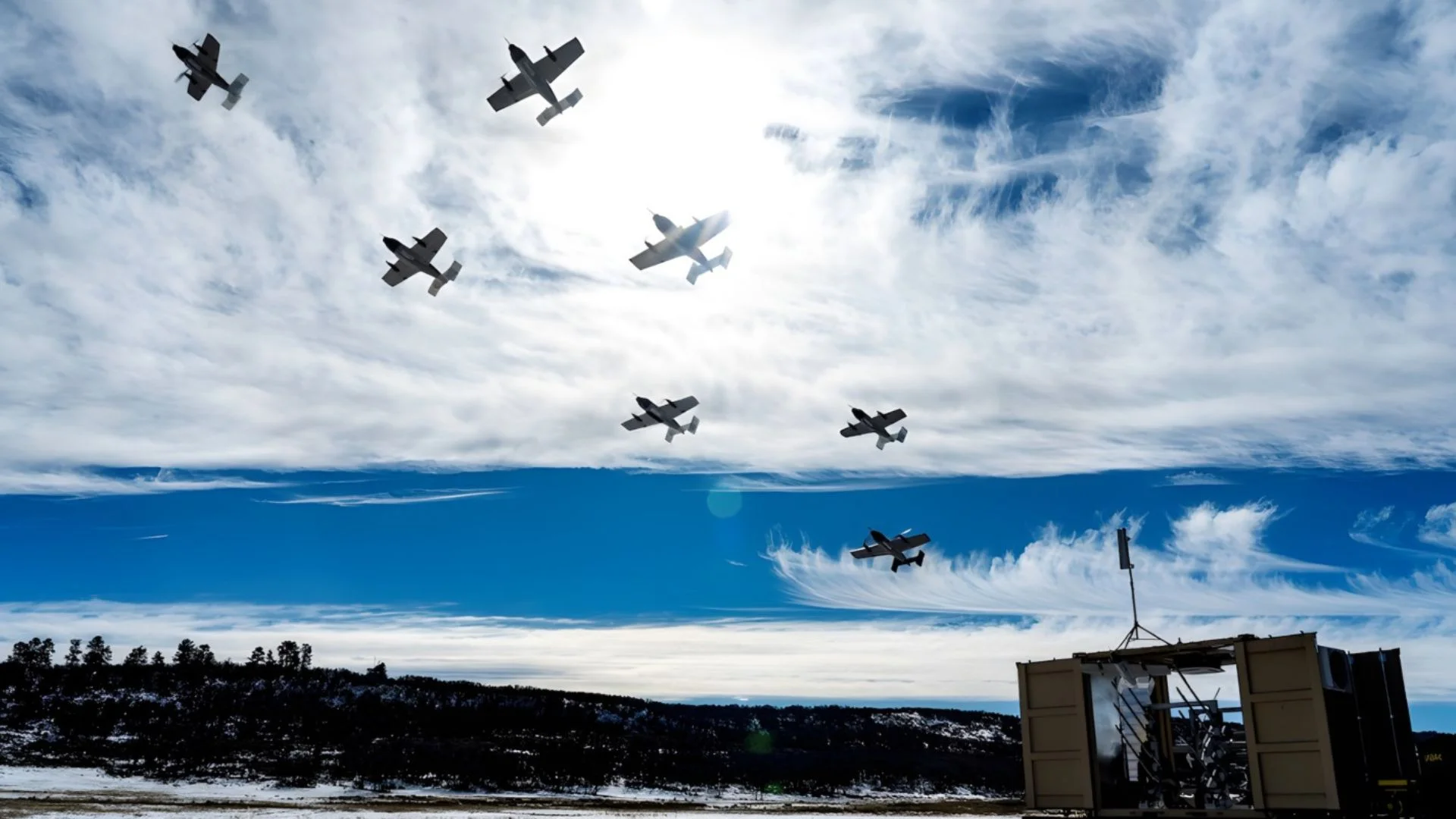
DZYNE also introduced several deployment methods for Blitz. Operators can launch a single aircraft by hand for smaller tactical missions. The company also developed a four-pack rail launcher for rapid multi-sortie operations.
READ ALSO: Trump’s Failed Superweapon Returns? US Navy Fires Railgun Again After Years
The largest deployment option is called BlitzBox, an ISO container-based launcher system. According to DZYNE, BlitzBox can deploy dozens of UAVs in coordinated operations. This setup is intended to support synchronized swarm missions in which multiple drones operate simultaneously.
Swarm drone operations are becoming a major focus of military planners worldwide. Large numbers of smaller drones can overwhelm defenses, collect larger battlefield intelligence and create operational complexity for opposing forces. Countries including the US, China and Russia are heavily committed to self-governing swarm technologies.
DZYNE says Blitz was designed to simplify operator training. The company claims unfamiliar users can learn to operate the system in under two hours. Faster training may help military units integrate drones more quickly during large-scale deployments or emergency operations.
WATCH ALSO: This US supersonic aircraft could slash flight times and silence the sonic boom
DZYNE confirmed that Blitz is available for demonstrations and procurement for eligible US and allies customers. The unveiling comes as defense organizations continue to search for expandable unmanned systems that manage cost, flexibility and operational functionality.
Blitz shows a wider shift within the military strategy toward affordable autonomous systems that can be deployed in large numbers. With drone warfare continuing to evolve, modular and low cost UAVs are expected to play a larger role in future battlefield operations.