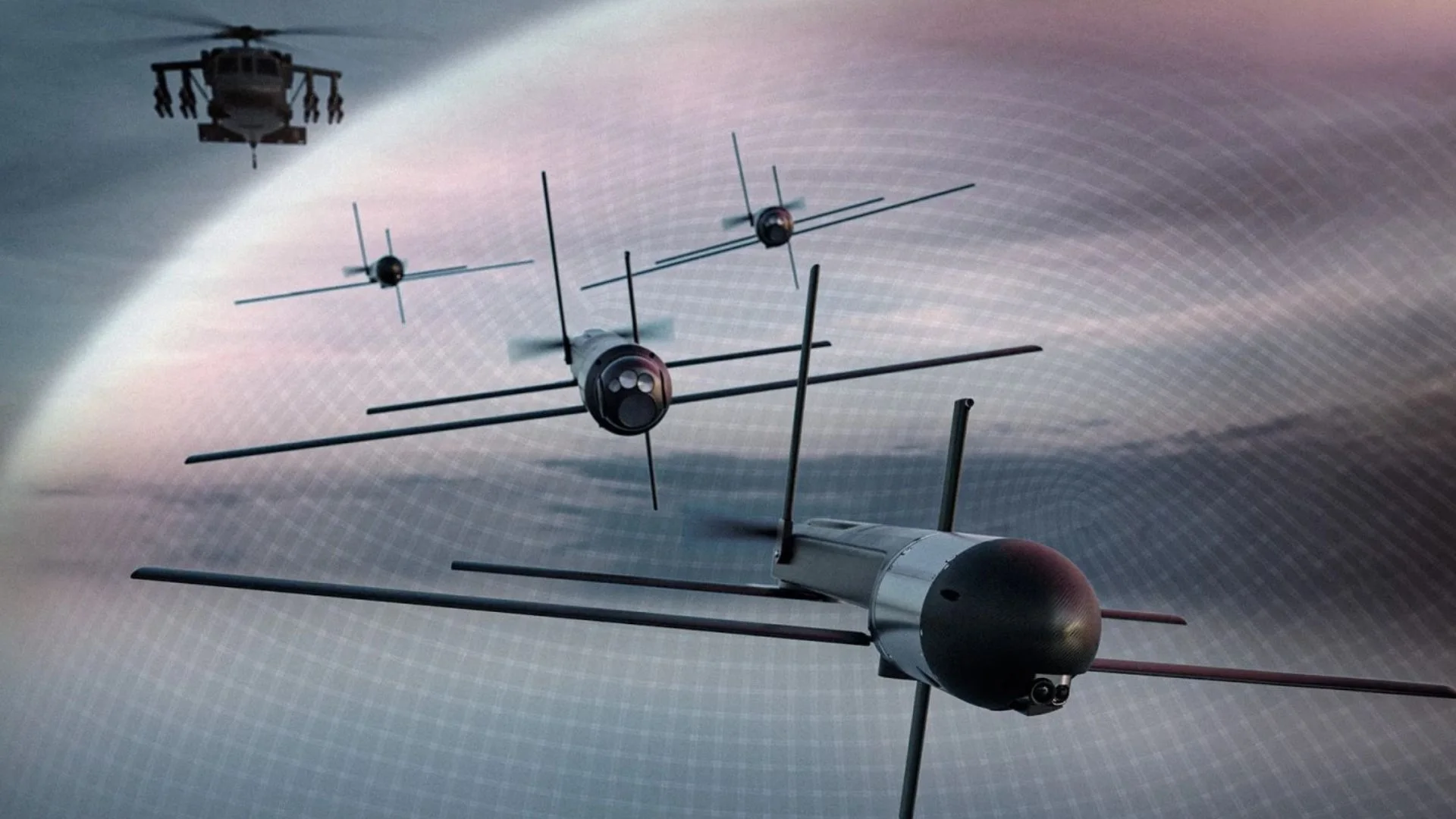
AeroVironment has officially revealed the Mayhem 10 ‘launched effects’ drone during the Army Aviation Association of America’s summit in Nashville.
The system is designed to meet the growing demand for compact, highly adaptable unmanned combat platforms. The drone also targets future requirements under the US Army’s Launched Effects-Short Range program.
Mayhem 10 is based on lessons learned from the company’s widely used Switchblade drone family.
However, company officials say the new system goes far beyond the role of a traditional loitering munition. Instead of focusing only on anti-armor strikes, the drone is designed for multiple combat and support missions.
The drone can carry payloads weighing up to 10 pounds. It has a reported operational range of around 62 miles and can remain airborne for up to 50 minutes. Operators can assemble and launch the system in less than five minutes, making it suitable for fast-moving battlefield operations.
READ ALSO: Fattah-2 vs US Supercarrier: Can Iran Sink USS Abraham Lincoln?
The company designed the drone to launch from several different platforms. Troops can fire it from the ground, while aircraft and vehicles can also deploy the system using common launch tubes. The company even released promotional material showing launches from an H-60 Black Hawk helicopter.
Unlike older Switchblade systems, Mayhem 10 uses rocket-assisted launch technology. This method allows faster deployment and corresponds to the US Army’s increasing interest in rocket-assisted ‘launched effects’ systems. The launcher itself is self contained and portable for mobile operations.
Mayhem 10 Modular Payloads Expand Combat Roles
The biggest feature of Mayhem 10 is its modular design. Operators can quickly replace payloads depending on mission requirements without redesigning the drone. This allows a single platform to support a wide range of battlefield tasks.
The drone can perform intelligence, surveillance and reconnaissance tasks. It can also handle electronic warfare, communications relay, decoy operations as well as precision strikes against enemy targets. Such flexibility reduces the need for multiple specialized drones in combat zones.
A removable front section allows crews to swap payloads quickly in the field. AeroVironment says it has already integrated more than eight payload types into the platform.
Engineers designed the system using an open architecture approach so third-party suppliers can also develop compatible payloads.
Company officials explained that the drone supports a Modular Open Systems Approach( MOSA). This design standard allows easier upgrades and faster integration of new technologies. The approach also helps military users avoid dependence on a single supplier.
WATCH ALSO: A Tesla car’s software systems have shown ultra-fast decision making during a ride
One of the most notable payloads under development focuses on enemy radar detection and destruction. AeroVironment compared the capability to anti-radiation missiles like the AGM-88 HARM. Such payloads allow the drone to identify hostile radar signals and attack them directly.
The company also demonstrated how quickly outside payload developers can work with the platform. AeroVironment shared technical interface data with vendors through standardized documentation and digital access systems.
In one test event, a supplier reportedly integrated a new payload within 90 minutes after arriving at the company facility.
Swarm Warfare and AI Features Shape Battlefield Future
Mayhem 10 is also designed for coordinated swarm operations. Multiple drones can communicate with each other through AeroVironment’s AV_Halo Command network. This allows groups of drones to perform different missions simultaneously during a single operation.
Some drones in the swarm can jam enemy communications using electronic warfare payloads. Others can conduct reconnaissance or carry out kinetic strikes against ground targets. This creates layered battlefield effects while reducing risk to soldiers and expensive military assets.
The system uses AI-enabled processors to support operations in contested environments. The drone can continue functioning even when GPS signals or communications are disrupted. This feature is important as modern battlefields become more dependent on electronic warfare and signal jamming.
Secure communications rely on M-Code GPS and Silvus datalink technology. A MANET-based mesh network helps maintain command-and-control links over distances of 16 to 25 miles. This networking ability allows distributed operations across large areas.
The company has already completed more than 50 internally funded flight tests. These tests included live ordnance flights, electronic warfare missions, and communications relay operations.
READ ALSO: Are Space Storms Blocking Alien Messages? New SETI Research Explains
AeroVironment says the system is approaching Technology Readiness Level 8, meaning it has already passed advanced testing and qualification stages.
The company plans to begin low-rate initial production later this year. Current manufacturing activities are taking place in Simi Valley, California. AeroVironment is also building a new facility in Salt Lake City, Utah, to expand production capacity.
The future production target ranges from 1,000 to 2,000 drones per year. This scale reflects growing global demand for launched effects systems and low-cost combat drones.
Militaries worldwide are increasingly investing in smaller and more networked unmanned systems after observing recent battlefield trends in Europe and the Middle East.
The growing use of swarm drones has changed how military planners think about combat power. Instead of relying solely on large, expensive aircraft, armed forces are now focusing on distributed systems that can overwhelm enemy defenses through numbers and coordination. Mayhem 10 fits directly into this changing military strategy.
The system also enters a crowded market for tactical drones. Defense companies in the US, Europe and Asia are developing similar ‘launched effects’ platforms for modern warfare requirements.
WATCH ALSO: This robot that you see mimicking meditation is a Chinese company’s new humanoid
Success in the US Army program could position Mayhem 10 as one of the next major systems in the rapidly expanding unmanned warfare sector.
As military forces continue shifting toward autonomous and networked operations, systems like Mayhem 10 are expected to play a larger role in future combat missions.
Its combination of modular payloads, swarm coordination, rapid deployment, and electronic warfare capabilities highlights how battlefield technology is evolving toward flexible and highly adaptable drone systems.