Cyborg Dynamics Engineering demonstrated an AI-powered robot that remotely tackles fires without exposing firefighters to life-threatening conditions.
In partnership with Griffith University, this trial showed the strong potential of collaborative robotic teams in real-world firefighting scenarios.
Funded by the Queensland Defence Science Alliance (QDSA), the project successfully tested a coordinated system of unmanned ground vehicles (UGVs) designed to detect, navigate, and autonomously extinguish fires.
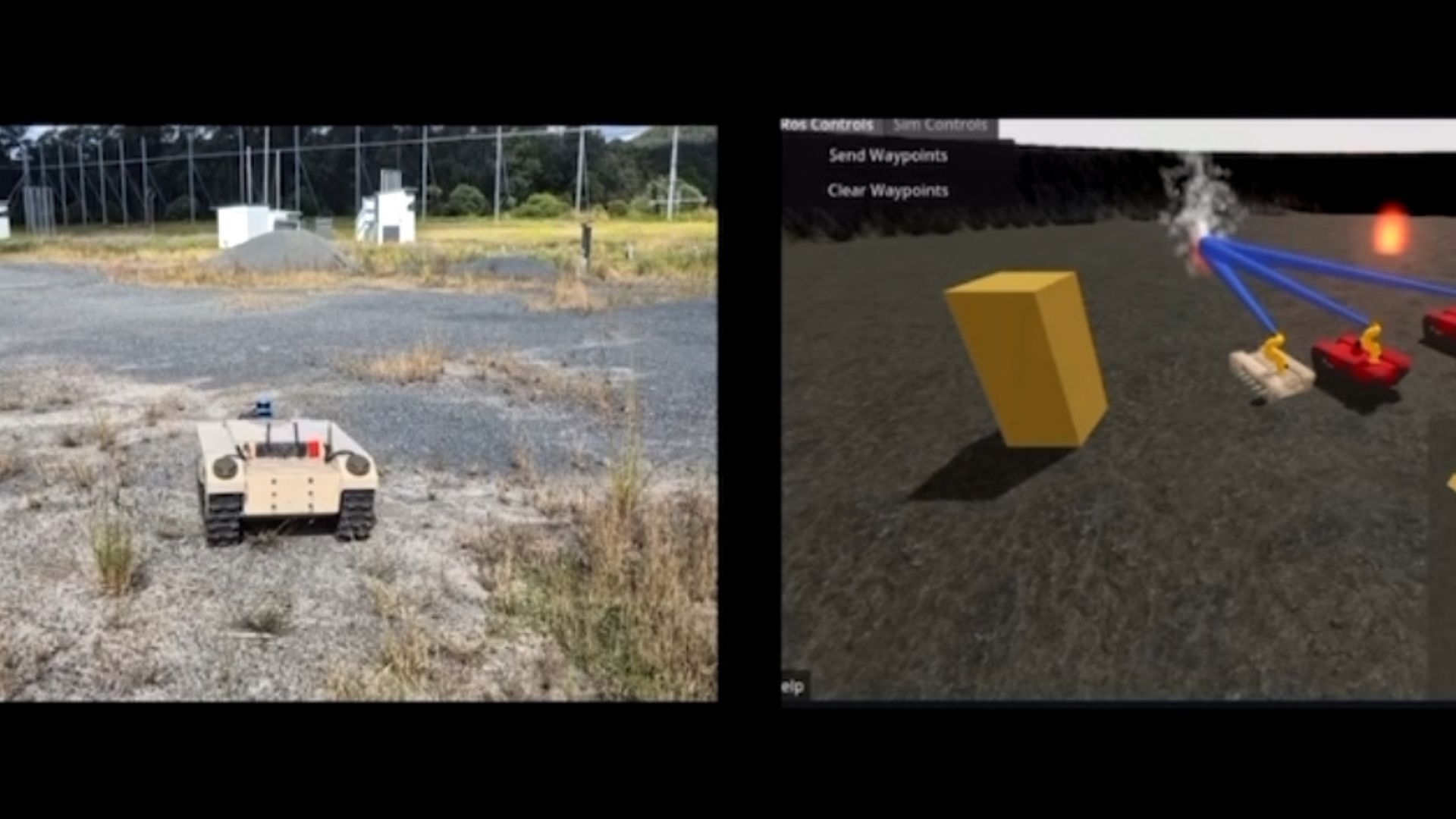
The trial combined both simulated and hybrid simulation-physical demonstrations, with one physical UGV working alongside up to four simulated robotic teammates to combat multiple fire outbreaks.
READ ALSO: https://modernmechanics24.com/post/f-35-software-jailbreak-remark-security/
During the demonstration, the UGV maneuvered around physical obstacles while collaborating with its virtual counterparts to identify and extinguish simulated fires.
According to the team, the system achieved a 99.67 per cent success rate in navigating complex environments and suppressing two fires. This was a promising indicator of its readiness for field deployment.
Dr Zhe Hou, Project Lead Chief Investigator from Griffith University’s School of Information and Communication Technology, said the results validated the system’s operational strength.
“We demonstrated that multiple real and simulated UGVs, trained through a structured three-stage AI learning curriculum, could learn to perform both low-level navigation and high-level collaborative tasks,” Hou said.
“This confirms the operational potential of our approach for practical case studies such as autonomous navigation and firefighting.”
The team used an advanced artificial intelligence technique known as multi-agent reinforcement learning (MARL). This method enables multiple AI agents to learn from interaction and cooperation within dynamic environments.
Researchers trained the robots through a carefully structured curriculum. The learning process began with basic single-robot navigation, progressed to multi-robot obstacle avoidance, and culminated in complex multi-fire response scenarios requiring coordinated decision-making.
One of the system’s most significant features is its ability to self-organise. The robotic units can autonomously allocate tasks, splitting into sub-teams to manage separate fire outbreaks. This dramatically reduces the cognitive load on human operators and enhances both safety and operational efficiency.
Ryan Marple, General Manager of Cyborg Dynamics Engineering, highlighted the technology’s practical impact.
“We have developed the control systems for firefighting UGVs that are currently deployed on mine sites across Australia,” Marple said.
WATCH ALSO: https://modernmechanics24.com/post/explore-raytheons-giant-radar-making-facility/
“These units are remotely controlled by a human, a bit like an RC car. They have been an extremely effective measure in removing human firefighters from dangerous situations and enabling high-value assets to be saved from fires.”
He added that integrating AI significantly expands their capability.
“By ingesting data from a wide variety of sensors, these systems can make decisions quickly, which just isn’t possible by the very limited situational awareness of a human looking at a screen,” he said.
Looking further, researchers plan to refine neural network architectures and improve sim-to-real transfer techniques to ensure smoother real-world deployment. The team is also exploring using the same AI framework across other autonomous systems, including underwater vehicles, aerial drones, and hybrid multi-vehicle teams.