

A nuclear reactor does not stop producing heat when its chain reaction ends. The fuel continues to release decay heat after shutdown, so reliable heat removal is essential to nuclear safety.
Researchers at the US Department of Energy’s Argonne National Laboratory are testing how passive cooling systems respond as heat levels and operating conditions change.
The latest research focuses on the Reactor Cavity Cooling System (RCCS), which is being considered for several advanced reactor designs. The system removes heat without electric pumps or mechanical controls. Instead, it uses natural forces such as gravity and buoyancy to keep coolant moving.
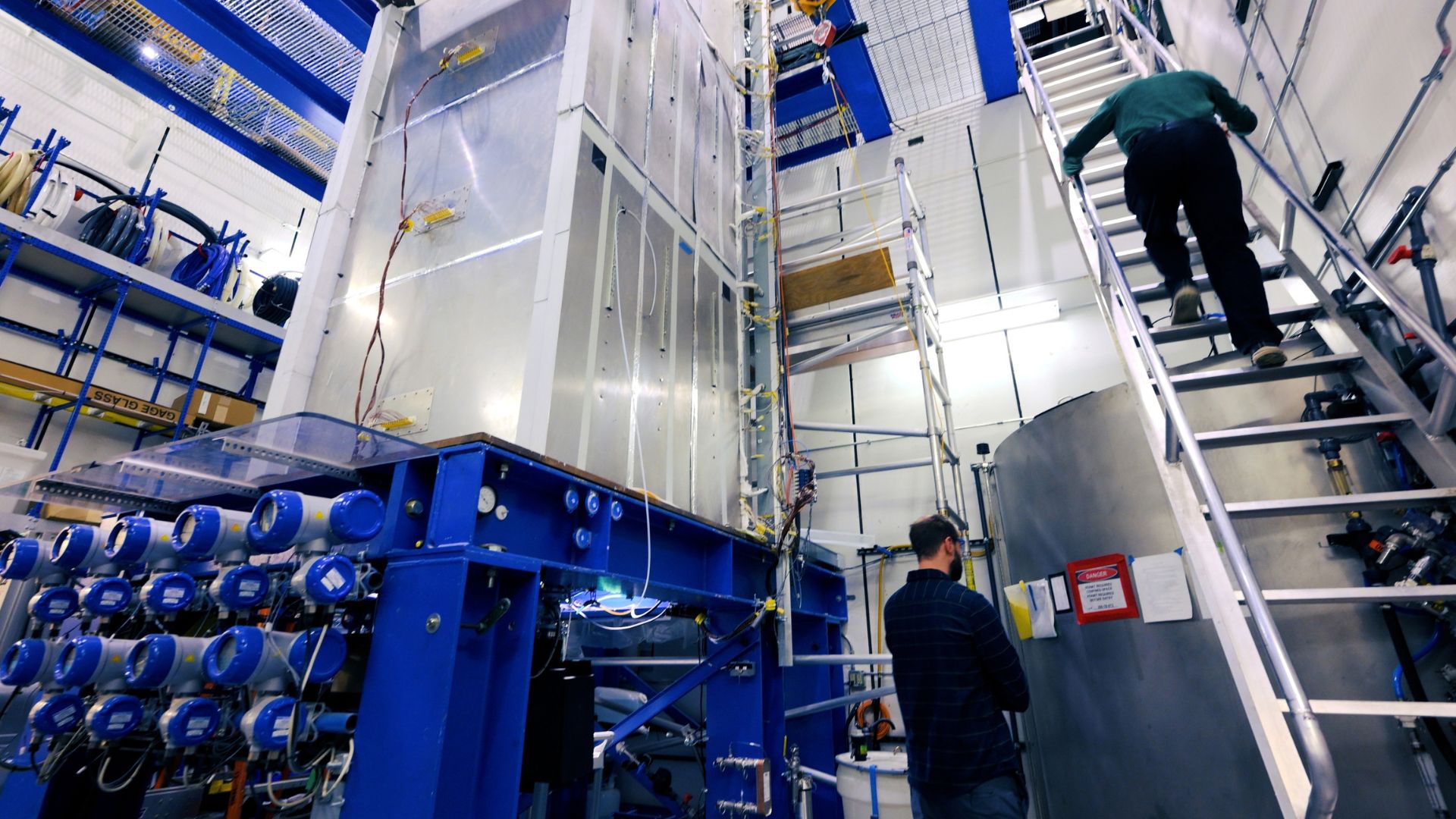
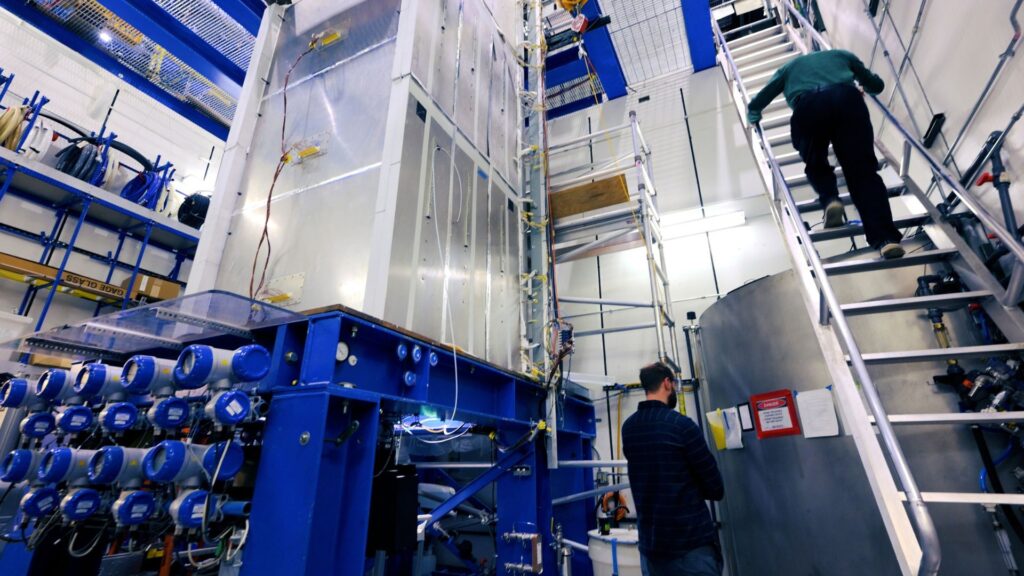
Argonne conducted the experiments at its Natural Convection Shutdown Heat Removal Test Facility (NSTF). The facility is designed to study passive heat removal under conditions expected in advanced nuclear reactors. Its 59-foot-tall loop is roughly half the size of a large commercial reactor system.
Testing Passive Cooling Systems
The research examined two factors that can affect RCCS performance. One was the amount of decay heat entering the cooling system, while the other was the height of the main water tank connection. Both can influence how water and steam circulate through the system.
Argonne nuclear engineer Qiuping Lu said the team wanted to understand what happens when decay heat is higher or lower than expected in design calculations.
Researchers also examined whether changing the height of the tank connection affects the reliability of natural circulation. These questions are important because passive systems are designed to continue removing heat without pumps or active operator intervention during accident conditions.
The RCCS uses a relatively simple physical process. Metal tubes around the outside of a reactor vessel absorb heat from the vessel and transfer it to water inside the tubes. As the water warms, it rises while cooler water moves downward, creating a natural circulation loop.
The heated water then carries energy toward a large storage tank positioned at a higher elevation. As temperatures increase, some water can turn into steam, creating a mixture of liquid water and vapor. Engineers therefore need to understand how the system behaves when boiling starts and steam moves through different parts of the loop.
READ ALSO: https://modernmechanics24.com/post/nel-asa-wins-collins-order-submarine/
How Boiling Changes Flow
Argonne researchers gradually increased the test power over several hours. The selected power levels represented different portions of the decay-heat range expected in a full-scale reactor following shutdown. This allowed the team to observe how the cooling loop responded as the heat load increased.
One important behavior observed during the experiments was flashing. Flashing occurs when water moving through the lower part of the system rises to a different pressure and suddenly changes into steam without receiving additional heat at that location. These rapid steam formations can alter water and steam flow, affecting cooling performance and placing additional loads on system components.
The researchers tracked where these flow changes began and how they developed through the system. They also examined whether the fluctuations grew stronger or gradually weakened. The results provide information about the conditions under which natural circulation remains stable.
The experiments showed that power level affected how quickly boiling and flashing moved through the system. At an equivalent full-scale power of 2.4 megawatts, steam produced through flashing reached the upper chimney about 20 minutes after boiling began in the tank. At 1.75 megawatts, it took about 90 minutes.
At 1.4 megawatts, steam did not reach the chimney during the test. The results showed that lower heat levels slowed boiling and flashing from the tank toward the chimney. This difference matters because decay heat changes continuously after a reactor shuts down, starting high and gradually decreasing.
Tank Height Changed Stability
The researchers also found that the tank inlet position affected system behavior. With the inlet at a mid-level position, boiling and flashing reached the chimney in less than 15 minutes under the tested conditions—a lower inlet produced flashing-related instability throughout the tests.
The team identified a clear boundary where measured system behavior changed as inlet position and operating conditions varied. The results indicated that a mid-level inlet produced more stable conditions in some scenarios. This gives reactor designers additional information when assessing different RCCS configurations.
The height of the tank connection affects the amount of water available to the circulation loop. It also changes how water and steam move as temperature and pressure vary. Even small differences in system geometry can therefore influence natural circulation without mechanical equipment.
Passive safety is a feature of many advanced nuclear reactor concepts. Conventional cooling arrangements can depend on pumps, electrical power or active controls, while passive systems rely on physical processes that continue without those inputs. Gravity and buoyancy can maintain coolant movement when normal plant systems are unavailable.
However, passive operation still requires detailed testing. Engineers need to understand how these systems respond to different power levels, temperatures, flow conditions and physical configurations. Facilities such as NSTF provide experimental data that can be compared with computer models and safety calculations.
Data For Reactor Designers
Argonne said the NSTF experiments are intended to provide data for reactor developers evaluating passive safety systems. The results can support technical assessments of RCCS performance across different operating conditions. They also provide information on how changes in tank geometry can influence natural circulation.
For advanced reactor developers, experimental evidence is part of demonstrating safety to regulators. Developers need to show how safety systems perform under expected conditions and during accident scenarios. Test data can help determine whether computer models accurately represent the cooling system’s physical behavior.
The US Department of Energy’s Office of Nuclear Energy supported the research through its Advanced Reactor Technologies program. The program supports research into technologies for future nuclear reactor systems. Argonne’s work adds experimental data on passive heat removal to that wider research effort.
READ ALSO: https://modernmechanics24.com/post/first-embodied-ai-theme-park-robots/
The findings also show why passive safety systems need evaluation across changing conditions rather than at a single operating point. Decay heat changes after shutdown, while features such as tank inlet height can alter water and steam movement. Understanding these interactions helps engineers assess how a cooling system behaves throughout an accident sequence.
What The Tests Show
The Argonne experiments provide a clearer view of how an RCCS responds when its heat load and physical configuration change. The tests recorded significant differences in the time taken for boiling and flashing to move through the system at 2.4, 1.75 and 1.4 megawatts of equivalent full-scale power. They also showed that the tank inlet position affected flow behavior and stability.
For reactor developers, the findings can help refine system designs and safety calculations. The data can also support further assessments of passive cooling systems intended to remove residual heat without powered equipment. Additional testing and analysis will be needed as advanced reactor concepts progress through development and regulatory review.
Argonne’s work shows the role of large-scale experiments in understanding natural circulation inside advanced nuclear safety systems.
By examining how decay heat and system geometry affect boiling, flashing and flow, researchers can give designers more detailed evidence about passive heat removal. These data will support the technical assessments used to evaluate the safety performance of next-generation nuclear reactors.








One Response