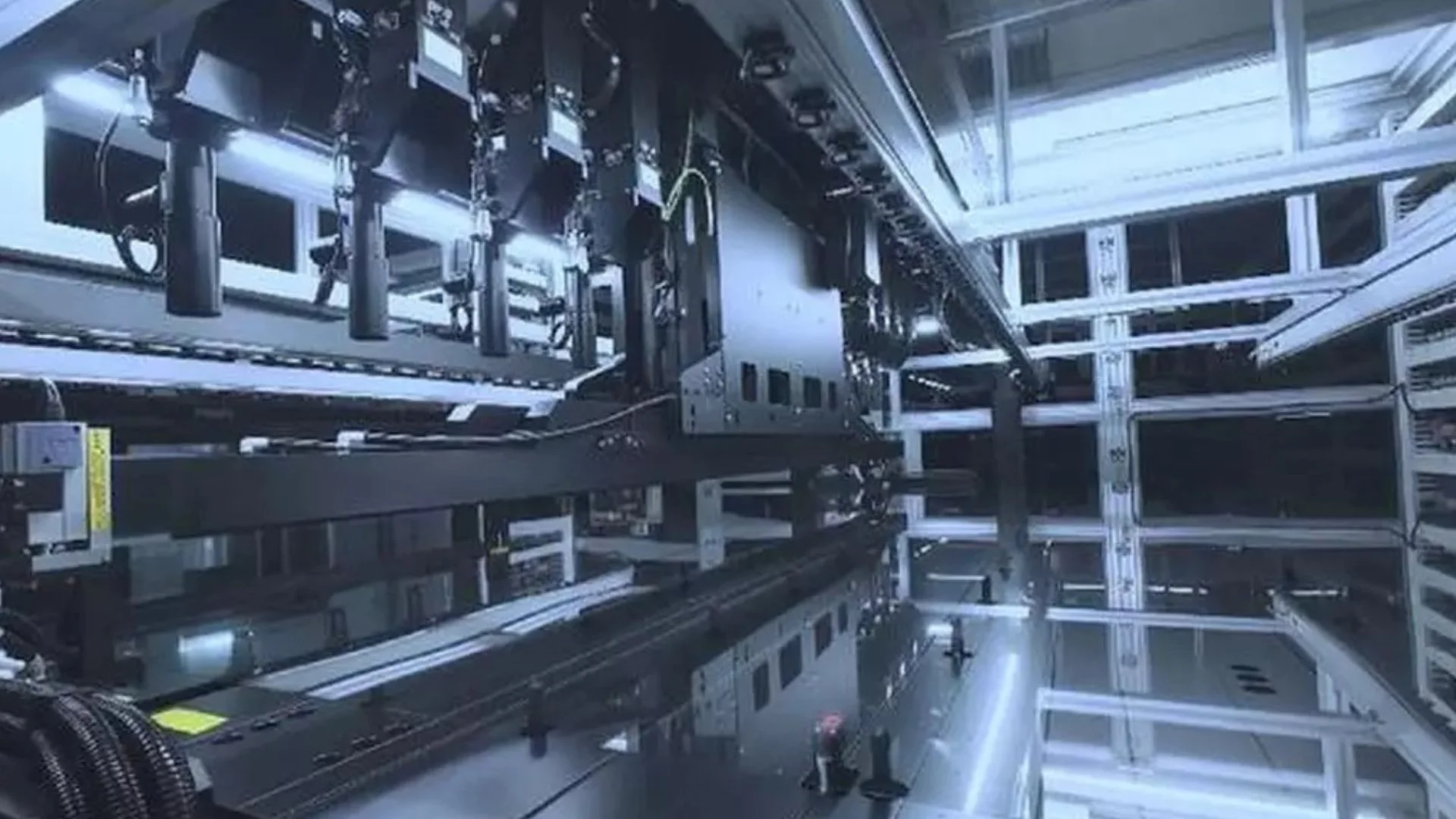
China’s first next-generation flexible display production line entered mass production in Chengdu, the capital of Sichuan province.
The facility is operated by BOE Technology Group, one of the world’s largest display panel manufacturers. It focuses on premium medium-sized display panels used in laptops and tablets.
The production line is among the world’s first Gen-8.6 AMOLED facilities. Gen-8.6 refers to the size of the glass substrates used to manufacture display panels. Larger substrates enable manufacturers to produce more screens simultaneously, improving efficiency and reducing production costs.
BOE invested 63 billion yuan, or about $9.3 billion, in the project. It is currently the largest single industrial investment in China’s display sector. The site covers 92.5 hectares, an area roughly equal to 130 standard football fields.
The facility has a planned production capacity of 32,000 glass substrates every month. Each substrate measures 2.29 meters by 2.62 meters. These large sheets are later cut into multiple display panels for commercial devices.
Why AMOLED Displays Matter
AMOLED stands for Active-Matrix Organic Light-Emitting Diode. Unlike traditional liquid crystal displays (LCDs), AMOLED screens do not require a separate backlight. This allows manufacturers to create thinner and lighter devices.
The technology also produces deeper black levels and more vibrant colors. Because individual pixels can switch off completely, AMOLED displays can improve power efficiency in many applications. These advantages have made OLED technology increasingly popular in premium consumer electronics.
READ ALSO: Perovskite Tandem Solar Cell Sets New Benchmark for Efficiency
Flexible AMOLED panels can bend without damaging the display. This capability supports the development of foldable laptops, foldable tablets, and other innovative device designs. As production scales up, these advanced screens are expected to become more widely available.
Industry researcher Geng Yi said the project represents more than simply producing larger displays. He explained that medium-sized AMOLED panels require significant advances in materials, glass substrates, manufacturing equipment, and driver chips. The achievement reflects progress across multiple parts of the display supply chain.
Global Competition and Industry Impact
China and the Republic of Korea are currently the only countries operating next-generation Gen-8.6 AMOLED production lines. BOE’s facility is also among the fastest worldwide to move from construction to mass production. This strengthens China’s position in the global OLED market.
The new production line marks an important shift in China’s OLED industry. In recent years, Chinese manufacturers built strong positions in smartphone displays. The new facility expands that focus into larger IT products such as laptops and tablets.
BOE CEO Feng Qiang said the company plans to continue increasing research and development investment. He added that BOE will work closely with major technology brands to accelerate OLED adoption in the IT sector. The company expects the new production line to support wider use of AMOLED displays across computing devices.
The project is also expected to strengthen the broader manufacturing ecosystem. More than 200 suppliers and partners across the supply chain are expected to benefit from the facility’s operations. This includes companies involved in materials, equipment, components, and display manufacturing services.
READ ALSO: USNS Point Loma Officially Handed Over to the Navy
Chengdu has emerged as one of China’s most important hubs for display technology. The city is home to more than 100 major display-related companies. Revenue from the local display industry reached 109 billion yuan in 2025, representing annual growth of 17.2 percent.
The sector has now recorded double-digit growth for five consecutive years. A complete industrial ecosystem has developed in the region, covering everything from raw materials and production equipment to finished display products. This concentration of expertise continues to attract global suppliers.
International companies such as Messer, Idemitsu Kosan, and LG Chem have expanded their operations in Sichuan. Their presence highlights the growing importance of China’s display manufacturing sector within global supply chains. The region is becoming an increasingly important center for advanced display production.
According to local estimates, flexible displays produced in Chengdu could account for more than 20 percent of the global market once the new line reaches full capacity. This would further strengthen China’s influence in the display industry. It also reflects the country’s continued investment in advanced manufacturing technologies.
WATCH ALSO: ISRO successfully conducts test of main parachutes for Gaganyan Crew module
China already leads the world in both display production and consumption. Industry estimates indicate that the country’s display sector generated more than 800 billion yuan in output value during 2025. That figure represented nearly 54 percent of global display industry output.
The launch of BOE’s Gen-8.6 AMOLED production line comes as demand grows for AI-powered devices, foldable products, and premium computing hardware.