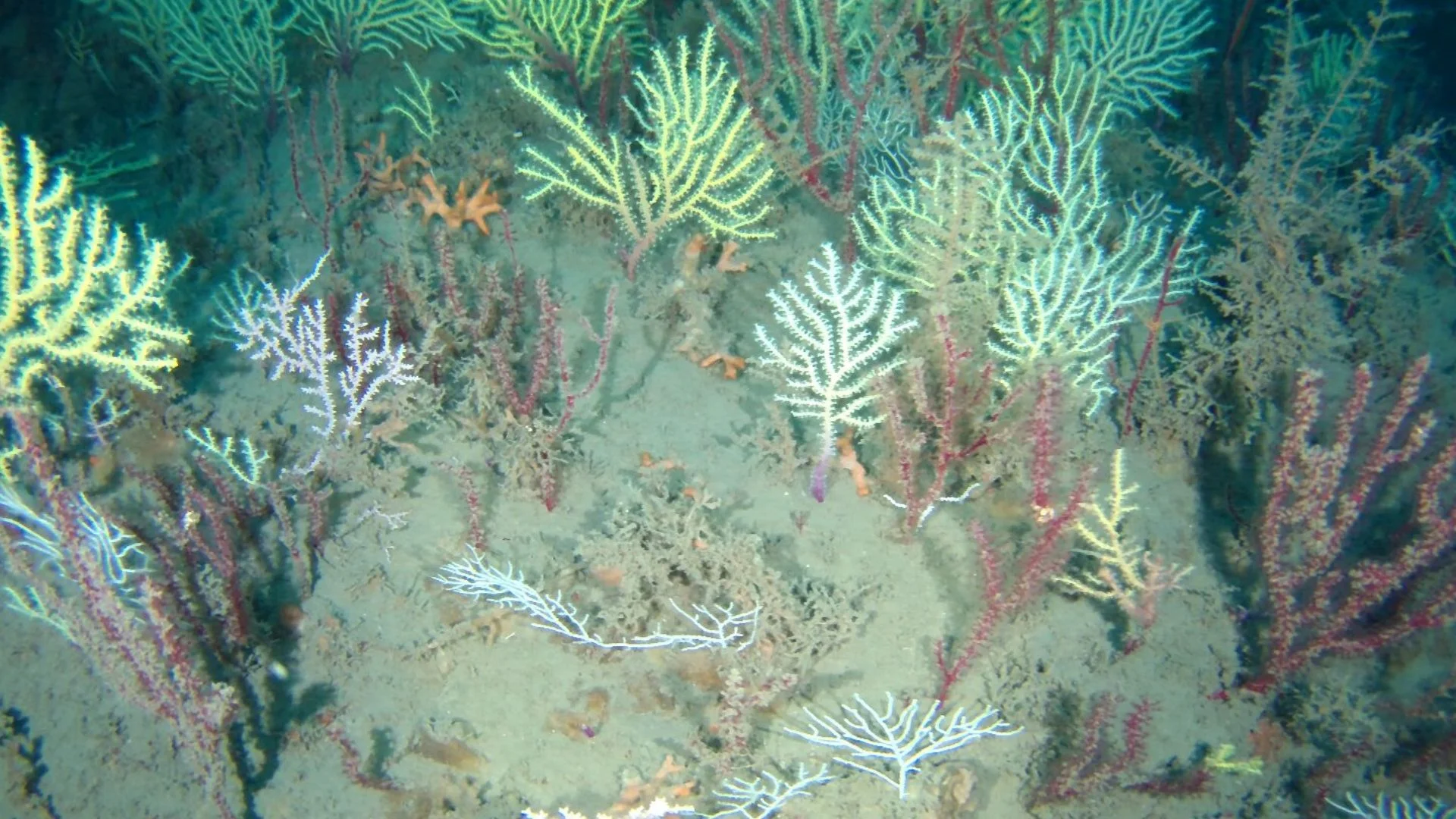
Scientists have confirmed the existence of a healthy coral reef off the coast of Benin that had long been presumed dead.
The discovery was made using modern sonar mapping and underwater drones during a marine survey in the Gulf of Guinea. Researchers say the finding highlights how much remains unknown about deep-water ecosystems along the West African coastline.
The reef was first mentioned during fishing surveys carried out in the 1960s. At that time, scientists detected signs of a reef more than 50 meters below the surface but assumed it was no longer alive. The area remained largely unexplored for decades because of limited technology and research opportunities.
Historic Records Revisited
A research team led by Gérard Zinzindohoué from the Institut de Recherches Halieutiques et Océanologiques du Bénin decided to revisit the old survey records. They believed the site might contain a mesophotic coral ecosystem, which grows deeper than most coral reefs. These reefs survive in low-light conditions where sunlight is much weaker than in shallow waters.
Unlike tropical coral reefs that often form long continuous structures, mesophotic reefs usually appear in scattered patches. They grow on rocky surfaces that provide suitable conditions for coral colonies. This makes them harder to detect without detailed underwater surveys.
The team mapped around 11.5 kilometers of the seabed using sonar technology. Sonar works by sending sound waves toward the seafloor and measuring the returning signals to create an underwater map. The survey identified two locations that showed patterns consistent with coral reef structures.
READ ALSO: US Army MV-75 Cheyenne Gets RTX Systems That Redefine Long-Range Air Assault Missions
Confirming The Coral Reef
Researchers then deployed an underwater drone along with the Deep Sea Camera System developed by the National Geographic Exploration Technology Lab. These camera systems operate like underwater trail cameras, allowing scientists to observe the seafloor without disturbing marine life. The images confirmed that living coral colonies were present across rocky sections of the seabed.
“It was not an easy field campaign,” said Gérard Zinzindohoué. He explained that the team faced long days at sea, technical issues, and uncertainty before spotting promising sonar signatures that suggested they were close to finding the reef.
He said seeing the first underwater images was an unforgettable moment. “Next, we surveyed the structures with an underwater drone and the Deep Sea Camera System,” Zinzindohoué said.
He added that the team felt both excitement and disbelief after finally seeing the reef that had existed only in historical records for many years.
The recorded footage revealed a healthy marine habitat supporting at least eight coral types. Scientists also observed eight fish species living around the reef, using the corals for food and shelter. These included golden African snappers, blackbar soldierfish, Guinean angelfish, West African goatfish, the Monrovia doctorfish, three-banded butterflyfish, and two species of damselfish.
Rich Marine Habitat
Researchers found that the reef is not a single continuous barrier. Instead, it consists of separate coral patches growing on rocky areas that provide favorable conditions. They believe additional surveys may reveal more coral communities nearby.
According to Zinzindohoué, this is the first confirmed living mesophotic coral ecosystem recorded on the continental shelf of the Gulf of Guinea.
He said the discovery likely reflects how little scientists know about many coastal areas in West Africa. The finding also raises the possibility that other undocumented reefs remain hidden beneath the region’s waters.
The scientists cautioned that more work is needed before reaching final conclusions. They have not yet collected physical coral samples, so species identification remains based on images alone. Detailed sampling will be necessary to confirm exactly which coral species are present.
Researchers also cannot determine whether the reef was actually dead during the 1960s surveys. Without historical biological samples, it is impossible to know whether the corals later recovered or survived unnoticed all along. Future studies may help answer those questions.
READ ALSO: AGIBOT Reveals Four New AI Robots at WAIC 2026 With Focus on Real-World Industrial Use
Next Research Steps
Historical records suggest the reef system may extend for roughly 40 kilometers parallel to Benin’s coastline. However, the current expedition examined only a small portion of that area. Scientists say much larger surveys will be needed to understand the reef’s full size and ecological importance.
Zinzindohoué said that if additional funding becomes available, the team plans to return with scientific diving equipment and sampling tools. Direct observations and laboratory analysis would provide more detailed information about coral health, age, biodiversity, and environmental conditions. Such work would improve understanding of marine ecosystems that remain poorly studied in this region.
The discovery also demonstrates the value of combining historical records with modern technology. Old survey reports provided the initial clues, while sonar mapping and underwater drones supplied the detailed evidence needed to confirm the reef’s existence. Similar approaches may help scientists rediscover other forgotten marine habitats around the world.
Coral reefs play an important role in supporting marine biodiversity and local fisheries. Even deep-water reefs provide shelter, breeding grounds, and feeding areas for many fish and other sea creatures. Understanding these ecosystems is becoming important as oceans face pressures from climate change, pollution, and human activity.
The Benin reef now offers researchers an opportunity to study how deep-water coral ecosystems develop and survive over long periods. Continued exploration may uncover additional hidden reefs across the Gulf of Guinea while improving conservation planning for West Africa’s marine environments. The findings also show that many important discoveries may still be waiting beneath the ocean surface.