Southwest Research Institute (SwRI) and Southern Methodist University (SMU) have partnered to develop a more reliable solid-state battery architecture that addresses one of the technology’s biggest technical challenges.
The collaboration focuses on improving the stability of battery components that often degrade during operation, limiting performance and lifespan.
The research is supported by a $128,896 grant from the Seed Projects Aligning Research, Knowledge and Skills (SPARKS) joint program, which promotes long-term research partnerships between the two organizations.
Improving Battery Performance
Most electric vehicles today rely on lithium-ion batteries that use a liquid electrolyte to move lithium ions between the battery’s positive and negative electrodes.
While this technology is widely used, the liquid electrolyte is highly flammable and limits charging speed, energy storage, and overall performance. Solid-state batteries replace the liquid with a solid electrolyte and use a lithium metal anode, making them safer while offering faster charging and higher energy density.
These advantages have made solid-state batteries one of the most promising technologies for the next generation of electric vehicles. However, several manufacturing and material challenges have slowed their commercial adoption. Researchers believe solving these issues is essential before the technology can be widely deployed.
“Solid-state batteries are a next-generation technology with huge potential for energy storage, particularly for electric vehicles, but they haven’t been widely commercialized because of manufacturing and materials challenges,” said Dr. John Hemmerling, a senior research engineer in SwRI’s Materials Engineering Department.
He added that one of the biggest technical obstacles is the unstable interface between the lithium metal anode and the solid electrolyte.
Addressing Critical Challenges
In a solid-state battery, the lithium metal anode remains in direct contact with the solid electrolyte throughout battery operation. Lithium is highly reactive, making this contact area difficult to maintain over long periods without damaging surrounding materials. As the interface weakens, battery efficiency, stability, and lifespan gradually decline.
READ ALSO: ORNL Installs Pathfinder Quantum Computer to Boost Hybrid Computing Research
Another challenge comes from the uneven growth of lithium deposits known as dendrites. These needle-like structures impede lithium-ion movement and damage the contact surface within the battery. Hemmerling said this process accelerates battery degradation and reduces overall performance over time.
Solid-State Battery Breakthrough Ahead
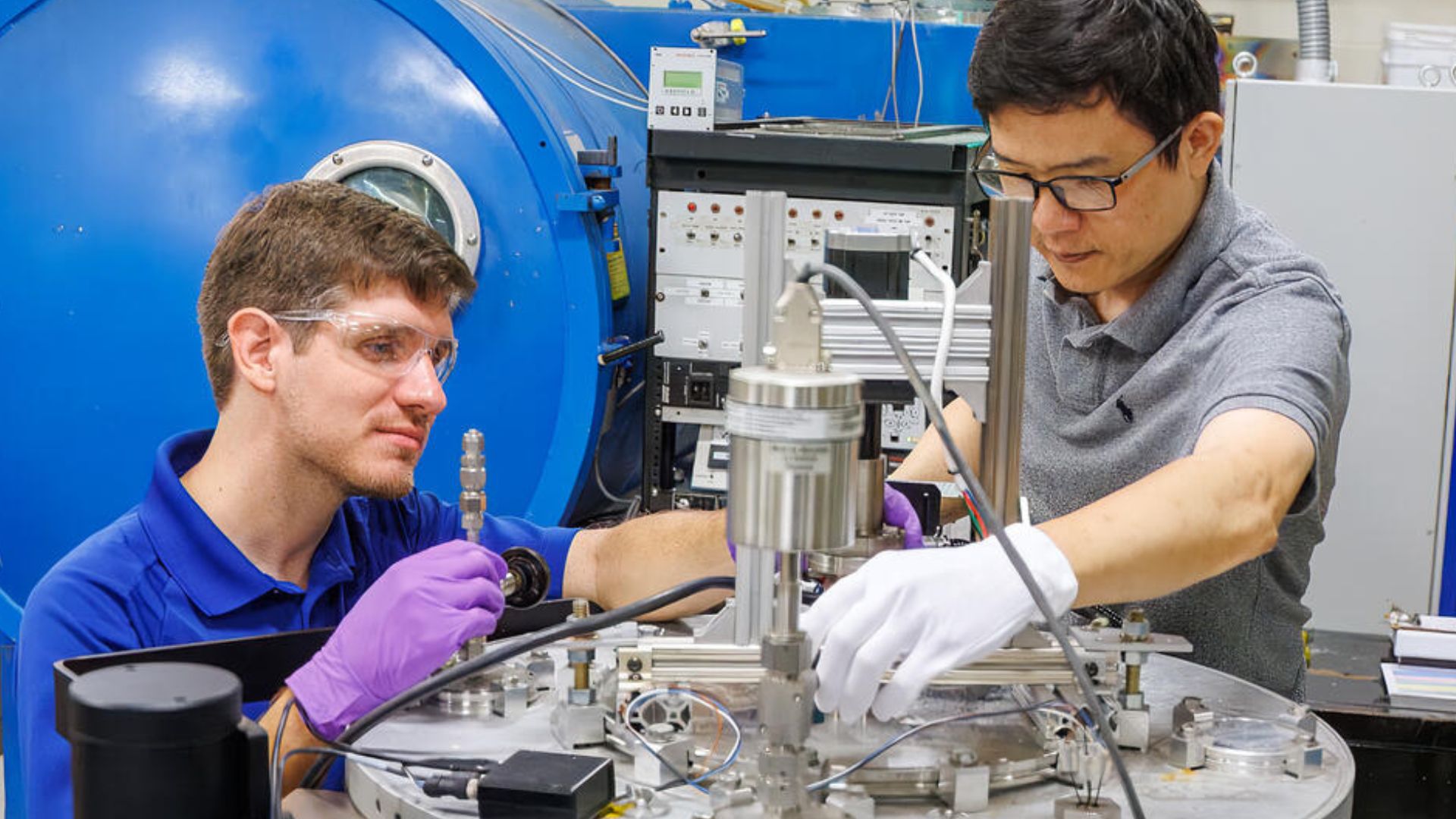
To overcome these problems, Hemmerling will work with SwRI Staff Scientist Dr. Jianliang Lin and SMU J. Lindsay Embrey Professor and Assistant Professor of Mechanical Engineering Dr. Rong Kou. Their research will focus on strengthening the connection between the lithium metal anode and the solid electrolyte. The goal is to improve battery reliability while reducing degradation during repeated charging and discharging cycles.
Ultra Thin Film
The team will use a method called interfacial engineering to create protective ultra-thin films on the battery’s lithium metal anode. These coatings, measuring only tens to hundreds of nanometers thick, will consist of carefully selected metals, metal oxides, and metal alloys. The protective layers are designed to stabilize the battery interface, reduce resistance, and support smoother lithium movement.
The project combines SwRI’s experience in thin-film deposition with SMU’s expertise in solid-state battery development. Researchers will study how the chemistry of these coatings affects lithium growth and long-term battery performance. The findings are expected to establish clear links between material design and battery efficiency.
Future Manufacturing Potential
Although the current project focuses on proof-of-concept laboratory testing, the researchers are already considering future manufacturing applications.
“Although our current work is focused on a small, proof-of-concept scale, the thin-film deposition techniques we’re using are scalable, so if the concepts prove successful, they can be adapted relatively easily to larger-scale manufacturing,” Hemmerling said. This means the production methods being tested today may eventually support commercial battery manufacturing.
The project is funded by Southern Methodist University Lyle School of Engineering and Southwest Research Institute through the SPARKS program.
As research continues, the partnership aims to develop stronger, safer, and longer-lasting solid-state batteries to meet the growing demand for electric vehicles and advanced energy storage systems. Success in this work could help accelerate the transition toward more efficient battery technologies while strengthening future transportation and clean energy infrastructure.