Researchers at the Massachusetts Institute of Technology (MIT) have developed a new way to design 3D-printed concrete structures that are easier to manufacture and use less material.
The team combined advanced design software with the real-world capabilities of existing construction printers to create structures that can be printed without extensive redesign. Their work highlights how improvements in printing hardware can play a major role in reducing waste and lowering carbon emissions from construction.
Concrete remains the world’s most widely used construction material, but its production also generates a significant share of global carbon emissions. Large-scale 3D printing has emerged as a promising alternative because it places concrete only where it is structurally needed and removes the need for traditional molds. However, many computer-generated designs remain too complex for current printers to produce efficiently.
Bridging Design Limits
Engineers often use a method called topology optimization to create structures that deliver maximum strength with minimum material. The process produces highly efficient shapes by removing unnecessary material while maintaining structural performance. These designs frequently include complex curves and thin sections that existing concrete printers cannot easily handle.
To solve this problem, MIT researchers created a framework that accounts for printer limitations from the outset of the design process. Instead of producing an ideal shape that later requires major adjustments, the system generates designs that are ready for printing. The research was published in the journal Additive Manufacturing.
The project was led by researchers from MIT’s Department of Civil and Environmental Engineering. Co-first author Hajin Kim-Tackowiak explained that many highly optimized computer designs become difficult to manufacture because they ignore practical constraints of printing. She said the gap between digital design and real construction had become much larger than expected.
The research team worked closely with experts at Autodesk’s Technology Center in Boston through the Autodesk Research Residency Program. Discussions with machine operators helped identify the practical challenges faced during large-scale concrete printing. These insights became the foundation of the new design method.
READ ALSO: SwRI and SMU Join Forces to Improve Solid-State Batteries for Faster, Safer Electric Vehicles
Smarter Printing Process
The researchers identified three major limits that today’s printers face during construction. Printers require concrete to be deposited in beads of a minimum width, cannot make extremely sharp turns, and work best when printing a continuous path without stopping. The new framework converts these practical requirements into mathematical rules during the design stage.
Traditional methods usually optimize a structure first and then spend days modifying the design so that it becomes printable. According to the research team, this post-processing step is both time-consuming and computationally demanding. Their new system completed the same task in around two minutes using a standard laptop.
The speed also proved useful during the bridge demonstration. When the structure needed to be slightly resized before printing, researchers simply reran the software and received an updated design within minutes. This flexibility makes the process more practical for real construction projects where changes often occur.
Co-first author Zane Schemmer said advances in mathematical optimization software made the work possible. The framework relies on mixed-integer optimization, a technique that was previously considered too difficult for such large engineering problems. Improvements in computing power and algorithms have now made these calculations much more practical.
MIT 3D-Printed Bridge Test Results
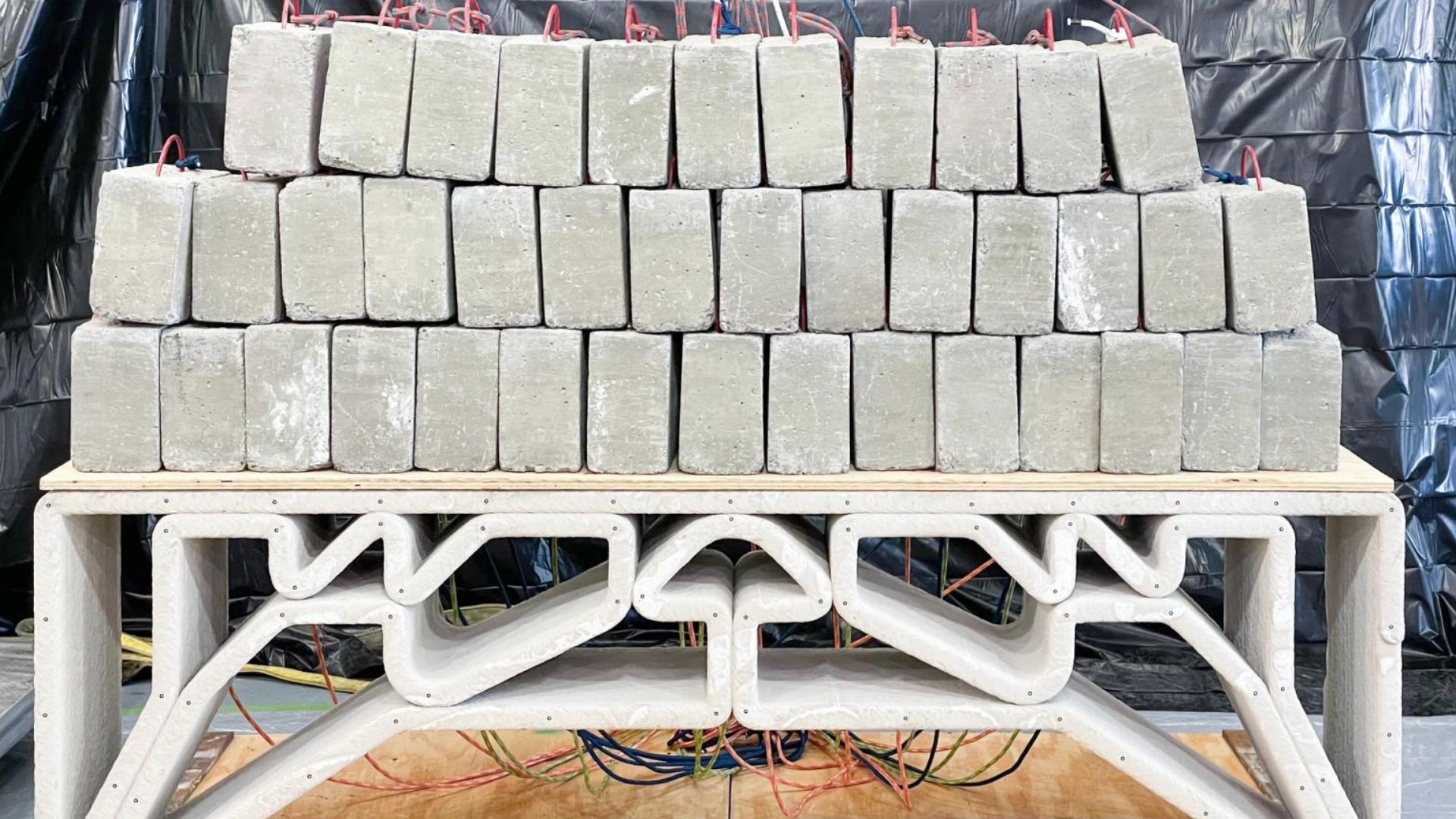
To validate the framework, the team designed and printed a concrete bridge measuring 2.3 meters in length. The bridge was produced at Autodesk’s facility using commercially available mortar rather than a specially developed concrete mixture. Printing the entire structure required only about 30 minutes.
The completed bridge weighed roughly 900 pounds before testing began. Researchers then applied more than 2,000 pounds of evenly distributed load across the bridge. The structure showed almost no measurable bending, and its performance closely matched computer simulations.
The testing also revealed an important finding about current construction technology. The bridge remained much stronger than necessary for the applied loads because printer limitations forced the design to use more material than structural physics required. In simple terms, the printer’s capabilities, rather than the concrete’s strength, determined the final shape.
Researchers found that the bridge design remained governed by manufacturing restrictions over an extremely wide range of loading conditions. Only at much higher theoretical loads did the structural behavior of concrete become the controlling factor. This showed that better printers could unlock much lighter and more efficient designs.
Another important feature of the bridge was that every part worked entirely in compression. Concrete performs very well under compression but loses strength under tension. The design ensured that the printed material carried only compressive forces during normal use.
Future Construction Impact
Because the optimization method identifies the best possible printable design, researchers could measure the effect of each printer limitation separately. They discovered that the width of the printed concrete bead had the greatest influence on material use. The bridge was printed using a bead approximately four centimeters wide.
The team calculated that reducing the bead width to one centimeter would reduce material use by up to 76 percent while still maintaining safe structural performance. Researchers originally expected the requirement for continuous printing to have the greatest effect. Instead, bead size proved to be the largest factor limiting efficiency.
These findings provide useful guidance for companies developing future construction printers. Even modest improvements in printing hardware may significantly reduce concrete consumption and lower emissions associated with building projects. The study therefore offers practical direction for both equipment manufacturers and the construction industry.
The research also highlights another environmental advantage of concrete 3D printing. Traditional concrete construction requires temporary molds known as formwork, which consume additional materials and labor before being removed. Direct printing eliminates this requirement, making customized structures faster and less wasteful to produce.
Researchers believe the technology may be especially valuable in disaster recovery and emergency infrastructure projects. Portable printers can quickly construct bridges or other essential structures without waiting for custom molds to be manufactured. This flexibility could speed up rebuilding efforts following natural disasters.
The bridge also demonstrated an important engineering lesson after formal testing ended. Although it safely supported more than 2,000 pounds during load tests, it fractured when one corner was lifted slightly for cleaning beneath it. Lifting introduced tension into parts of the bridge that had been designed only for compression, illustrating concrete’s natural weakness under pulling forces.
The team now plans to extend the framework to reinforced concrete structures that include steel reinforcement bars. Integrating reinforcement into automated concrete printing remains a significant engineering challenge because steel bars must be accurately positioned while the printer continues building the structure. Solving this issue would allow printed concrete to handle both compression and tension more effectively.
The research received funding from the US National Science Foundation and support from the MIT Center for Advanced Production Technologies. Additional contributors included Pittipat Wongsittikan and Jackson Jewett, who worked alongside the MIT research team throughout the project.
As 3D printing technology continues to improve, this design approach may help the construction industry build stronger, lighter, and more sustainable infrastructure with far less material than today’s methods require.