The US military is moving closer to deploying laser weapons as part of its frontline air defense strategy.
After years of testing high-energy laser systems, the next challenge is building vehicles capable of supplying enough power to keep these weapons operating in real combat.
The Army and Marine Corps are now developing new vehicle platforms designed to support laser-based counter-drone systems on future battlefields.
Laser weapons have become one of the military’s most important technologies for defeating small drones. Unlike missiles, lasers do not run out of traditional ammunition and can engage multiple targets as long as enough electrical power is available. This makes them an attractive option as armed drones become more common in modern warfare.
Recent testing has shown that laser systems can successfully operate from light tactical vehicles. The focus has now shifted toward creating vehicles with enough electrical power, battery capacity, and mobility to support these weapons during extended operations.
Hybrids Power Laser Weapons
The US Army recently ended its Stryker-based Directed Energy-Maneuver Short Range Air Defense (DE-MSHORAD) program. Instead, the service has redirected its efforts toward lighter, faster tactical vehicles that better meet future battlefield requirements.
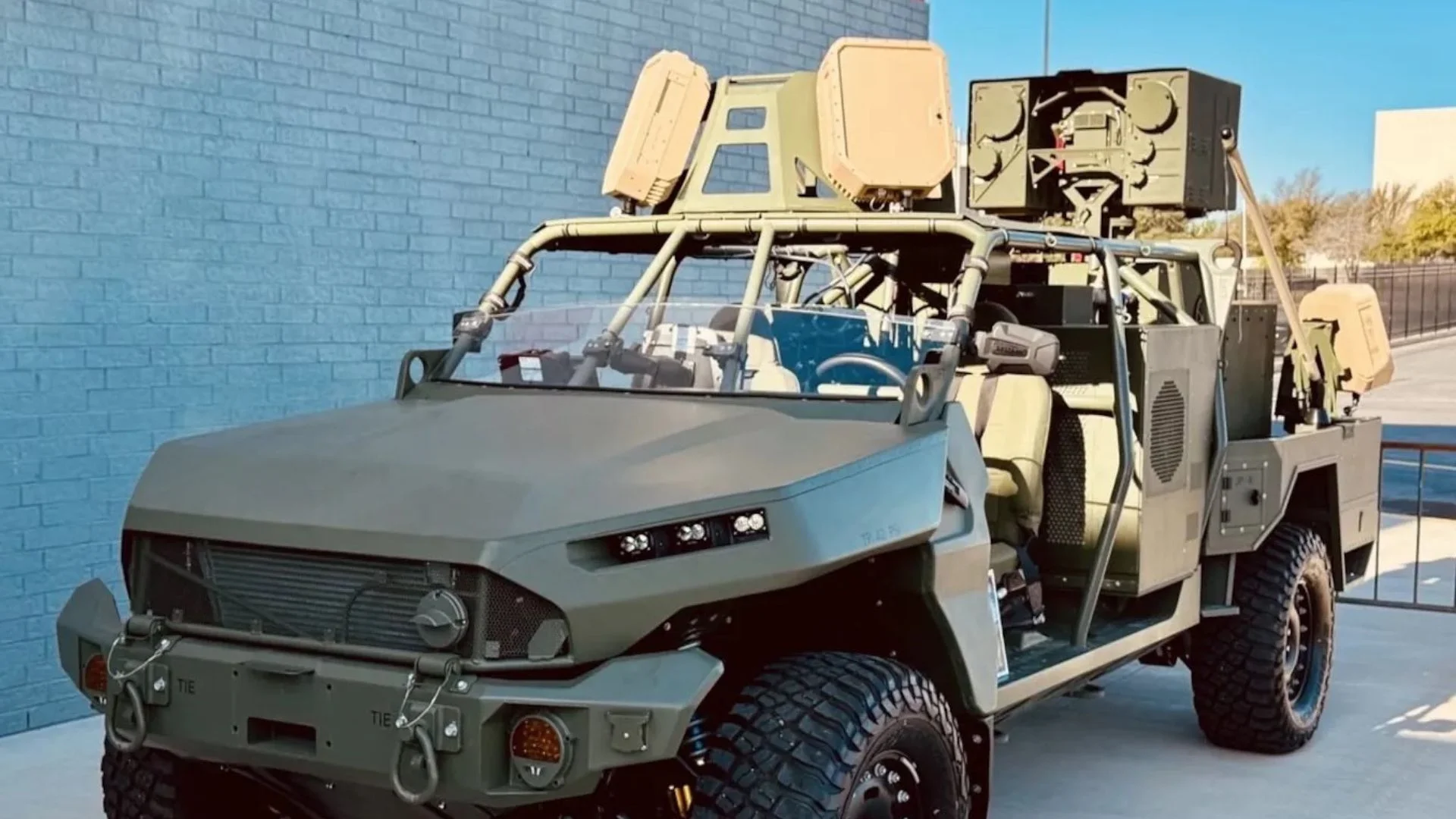
One of the leading laser systems is AeroVironment’s 20-kilowatt LOCUST Laser Weapon System. The system has already completed operational testing on both the Infantry Squad Vehicle (ISV) and the Joint Light Tactical Vehicle (JLTV) through the Army’s Multi-Purpose High Energy Laser (AMP-HEL) program.
These tests proved that compact tactical vehicles can carry and operate laser weapons under field conditions. They also demonstrated that lightweight vehicles align with the Army’s future concept of highly mobile, distributed combat operations.
The Army is now expanding this effort through its Enduring High Energy Laser (E-HEL) program. Unlike earlier demonstrations, E-HEL is designed to become a permanent military capability rather than a temporary technology project.
READ ALSO: Dead Trees, Corals and Oyster Shells Keep Shaping Ecosystems, New Study Reveals
The Infantry Squad Vehicle has become one of the Army’s preferred platforms for this effort. Designed for speed and mobility, the vehicle allows soldiers to move quickly across difficult terrain while supporting modern battlefield missions.
The Marine Corps also depends heavily on the Joint Light Tactical Vehicle. The JLTV serves as the foundation for several important Marine air defense and missile systems used by the service’s Marine Littoral Regiments.
Despite their different missions, both vehicles share the same challenge. Neither produces enough electrical power to operate advanced laser weapons continuously.
Modern battlefields rely heavily on electronics. Soldiers now carry communications equipment, sensors, computers, electronic warfare systems, and counter-drone technology, all of which require reliable electrical power.
This growing demand has become a serious logistical issue. During operations in the Global War on Terror, a 30-soldier infantry platoon carried nearly 400 pounds of batteries during a three-day mission simply to keep equipment running.
Military researchers have spent years searching for better power solutions. Laser weapons have made this challenge even more urgent because they require large bursts of electricity within seconds.
Unlike conventional weapons, lasers consume electricity instead of ammunition. A laser beam only lasts a few seconds, but those few seconds require an enormous amount of energy delivered almost instantly.
Traditional generators are not designed for these sudden power spikes. They perform best when producing a constant flow of electricity rather than short bursts of extremely high output.
Running large generators continuously also creates problems on the battlefield. Engines generate heat and noise, making military vehicles easier for enemy drones and surveillance systems to detect.
Defense experts say hybrid power systems provide a better solution. These systems combine generators with high-capacity batteries that store energy and release it instantly whenever the laser fires.
The battery handles the sudden power demand while the generator slowly recharges it afterward. This reduces fuel use, lowers noise, and minimizes heat signatures during operations.
Hybrid systems also allow vehicles to power many other battlefield technologies. Besides laser weapons, they can support command centers, radar systems, electronic warfare equipment, communications networks, and drone charging stations.
The Army has already tested several hybrid military vehicles over the past two years. In early 2024, GM Defense demonstrated its Next Generation Tactical Vehicle-Hybrid during exercises with soldiers in Germany.
The demonstration vehicle used a Chevrolet Silverado HD 3500 platform equipped with a Duramax diesel engine and a battery capable of storing roughly 300 kilowatt-hours of electricity. The Army evaluated the vehicle’s performance under realistic military conditions.
READ ALSO: China Delivers Two 174,000-Cubic-Meter LNG Carriers as It Expands Global Shipbuilding
Another demonstration followed at Aberdeen Proving Ground in Maryland. The Army tested a hybrid Humvee capable of silent driving, silent surveillance, increased onboard power generation, and greater export of electricity for mission equipment.
Later, Army officials launched a market survey seeking proposals for a new hybrid-electric light tactical vehicle. The goal was to identify production-ready technology capable of meeting future battlefield power demands.
Army Pushes ISV-Heavy, Marines Explore Hybrid JLTV
The Army’s newest answer is the Infantry Squad Vehicle-Heavy(ISV-H). Despite its name, the vehicle focuses more on electrical power generation than additional armor.
Army planning documents require the ISV-H to produce at least 60 kilowatts of continuous high-voltage direct current power. That electricity will support communications equipment, radar systems, electronic warfare payloads, and future laser weapons.
Army acquisition officials describe the ISV-H as filling the gap between today’s lightweight Infantry Squad Vehicle and the heavier Joint Light Tactical Vehicle. The platform is intended to serve as a mobile battlefield power station while still carrying soldiers and mission equipment.
Senior Army leaders have identified mobile power generation as one of the service’s biggest capability gaps. Future combat formations require reliable power to operate advanced sensors, drones, communications systems, and directed-energy weapons.
Development of the ISV-H is moving quickly. The Army’s fiscal year 2027 budget requests funding for an initial purchase of 34 vehicles at an estimated unit cost of about $463,000.
The Army plans to eventually buy 606 ISV-H vehicles. Officials expect contract awards in 2027, followed by the first deliveries in early 2028.
GM Defense has already announced plans to compete using a version of its previously demonstrated hybrid tactical vehicle. Its experience with hybrid military technology places the company among the leading contenders.
While the Army develops a new platform, the Marine Corps faces a different challenge. The Marines already rely heavily on the Joint Light Tactical Vehicle for several key combat missions.
The Marine Air Defense Integrated System, known as MADIS, uses JLTVs equipped with 30mm cannons and Stinger missiles to defend against drones and aircraft. Another major system, the Navy-Marine Corps Expeditionary Ship Interdiction System (NMESIS), carries Naval Strike Missiles on JLTVs for coastal defense missions.
The future of the JLTV program has become uncertain because the Army has reduced its own purchases. In 2025, Army leaders announced plans to stop buying additional JLTVs and instead invest more heavily in the Infantry Squad Vehicle.
Production challenges have also affected the program. AM General’s newer JLTV A2 variant has experienced significant manufacturing delays, while lawmakers have proposed reducing program funding.
The Marine Corps still plans to continue fielding the vehicle because its future force structure depends heavily on JLTV-mounted systems. However, lower Army purchases could increase production costs for Marine orders.
To protect future supply, the Marine Corps has asked industry to provide production-ready alternatives capable of replacing or supplementing existing JLTV manufacturing.
Oshkosh Defense, the original JLTV manufacturer, has responded with its upgraded hybrid-electric eJLTV. The company recently showcased the latest version during the Eurosatory 2026 defense exhibition in Paris.
The hybrid eJLTV can export up to 115 kilowatts of electrical power while supporting silent driving and silent observation modes. According to Oshkosh, short power bursts can reach approximately 250 kilowatts for demanding mission equipment.
Company officials say the vehicle was specifically designed with future laser weapons in mind. The platform can also support other advanced military systems requiring high electrical output.
WATCH ALSO: SpaceX is gearing up to conduct 11th flight test of Starship on October 13
Because many Marines already operate JLTVs, transitioning to the hybrid version would simplify training, maintenance, and logistics. Existing spare parts and support infrastructure would also remain useful.
Laser Trucks Move Closer
Together, the Army’s ISV-H and Oshkosh’s eJLTV represent two different paths toward deploying operational laser weapons. One is a newly designed power-focused vehicle, while the other upgrades an existing military platform.
Both approaches address the same requirement. Modern laser weapons need reliable electrical power, reduced battlefield signatures, and enough mobility to operate alongside frontline combat units.
Several challenges still remain before these vehicles enter widespread service. The Army has not yet selected the ISV-H manufacturer, while the Marine Corps continues to monitor JLTV production and funding.
Military leaders also continue evaluating how quickly laser weapons can be produced, maintained, and deployed across the force. Building enough vehicles with the required power systems will be just as important as producing the laser weapons themselves.
The progress made during recent testing shows that mobile laser weapons are moving beyond experimental demonstrations. As hybrid tactical vehicles enter service over the coming years, they are expected to become an important part of the US military‘s evolving counter-drone strategy and future battlefield air defense network.