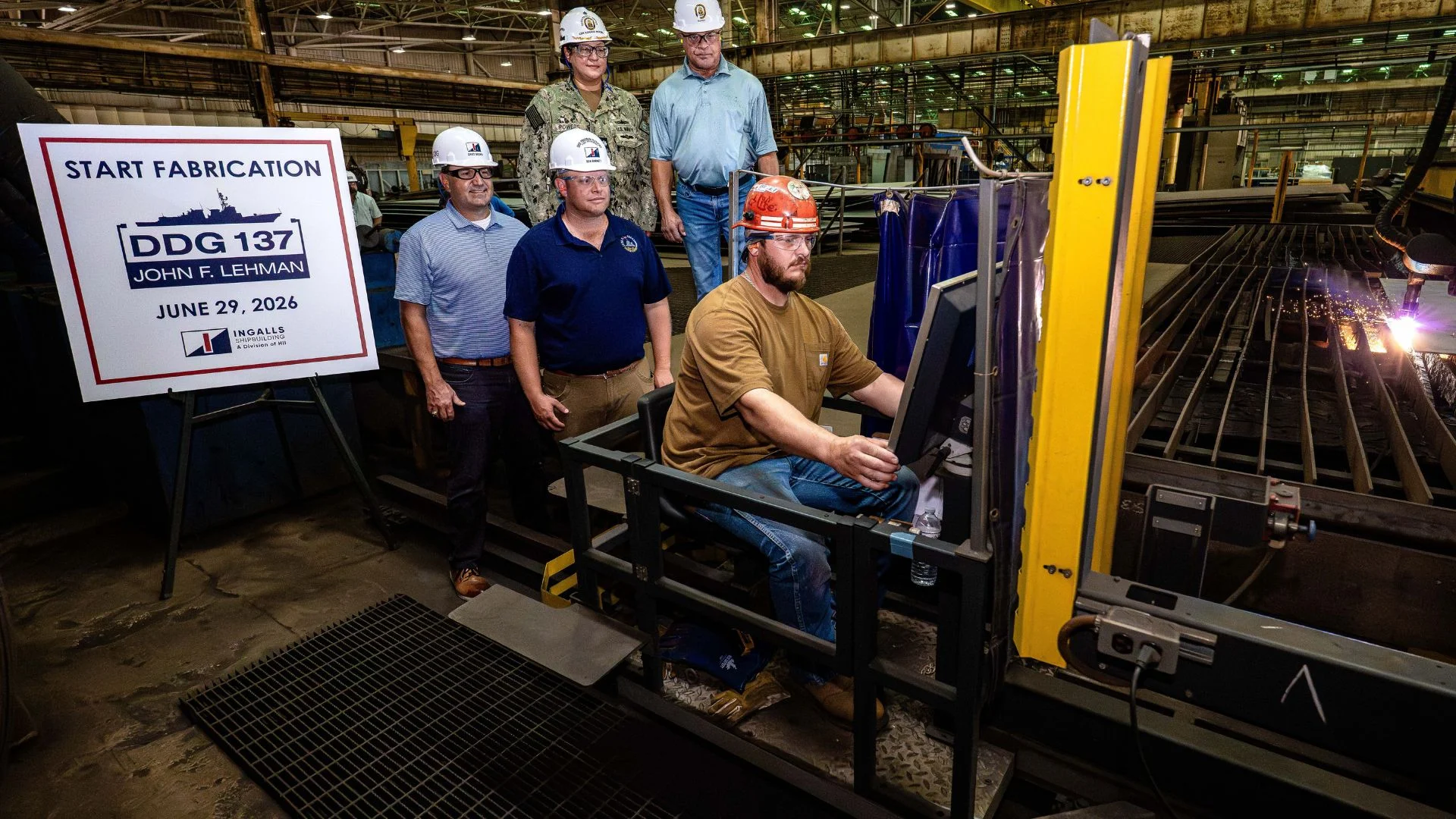
HII’s Ingalls Shipbuilding division has started fabrication of the future USS John F. Lehman (DDG 137).
The milestone officially marks the beginning of construction for the Navy’s newest Flight III Arleigh Burke-class guided-missile destroyer. The ship will join the growing fleet of advanced destroyers designed for modern naval operations.
The start of fabrication follows months of preparation across several production facilities. Instead of building every section in one location, HII is using a distributed shipbuilding approach. This method allows different shipyards to build major parts before they are transported for final assembly.
For DDG 137, six partner shipyards in Texas, Louisiana, Mississippi, and Florida are producing large structural sections. This approach increases production capacity by leveraging skilled workers and facilities outside Ingalls’ traditional workforce area. It also helps reduce pressure on a single shipyard during construction.
READ ALSO: NASA’s New Space Refueling Test Brings Moon and Mars Missions One Step Closer to Reality
USS John F. Lehman Enters Production
According to Ingalls Shipbuilding DDG-51 Program Manager Chris Brown, the company’s workforce has worked steadily to reach the fabrication milestone.
He said partner shipyards allow Ingalls to focus more on final assembly and system integration. Brown added that the company understands the Navy’s need for capable warships and is working with urgency to deliver them.
The distributed production model also strengthens the wider US shipbuilding industry. By sharing work among multiple qualified shipyards, companies across several states remain active in naval construction. This approach also improves supply chain flexibility and supports long-term industrial resilience.
HII plans to outsource more than 2.5 million hours of shipbuilding work during 2026. The effort will provide additional work to partner shipyards while increasing overall production capacity. It also helps maintain skilled jobs across the American maritime manufacturing sector.
READ ALSO: Dead Trees, Corals and Oyster Shells Keep Shaping Ecosystems, New Study Reveals
Flight III Destroyers Bring Advanced Combat Capabilities
USS John F. Lehman will become the seventh Flight III destroyer built by Ingalls Shipbuilding. Flight III ships represent the latest version of the long-serving Arleigh Burke-class destroyers, which have formed the backbone of the US Navy for decades. These vessels are designed to operate in increasingly complex maritime environments.
One of the biggest upgrades is the AN/SPY-6(V)1 radar system. This advanced radar can detect and track aircraft, missiles, drones, and other threats at greater distances and with higher accuracy than previous systems. The improved radar gives commanders more time to respond during combat operations.
The destroyer will also carry the Aegis Baseline 10 combat system. This integrated system connects the ship’s sensors, weapons, and command systems into a single combat network. It enables the vessel to defend itself, protect nearby ships, and support missile defense missions.
Flight III destroyers continue the proven design of earlier Arleigh Burke-class ships while adding more powerful electronics and improved combat performance. This combination allows the Navy to modernize its fleet without developing an entirely new destroyer class. The result is a lower-risk upgrade that builds on decades of operational experience.
WATCH ALSO: SpaceX is gearing up to conduct 11th flight test of Starship on October 13
Ingalls currently has five Flight III destroyers under construction. Another seven ships are in the early planning and material procurement stages. These projects reflect the Navy’s continued investment in maintaining a modern and capable surface fleet.
The construction of USS John F. Lehman highlights both the Navy’s modernization plans and HII’s evolving production strategy.
As more Flight III destroyers enter service over the coming years, they will strengthen the Navy’s ability to address future maritime security challenges while supporting America’s shipbuilding industrial base.