Researchers at the University of Central Florida (UCF) are investigating one of the biggest challenges in amphibious drone technology: the transition from water to air.
The study focuses on how wing shape and movement influence drone performance during takeoff from the water’s surface. Scientists hope the findings will help improve the stability and reliability of future amphibious unmanned aerial vehicles (UAVs).
Inspired by animals such as seabirds and rays that move seamlessly between water and air, the team is examining the forces involved in this complex maneuver. The process, known as egress, occurs when a drone exits the water and begins flying. While water entry has been widely studied, far less is known about the physics of water-to-air transitions.
Researchers are particularly interested in sudden changes in lift that can affect a drone’s balance and control. The results could support the development of advanced UAVs for military missions, search-and-rescue operations, environmental monitoring, and disaster response.
The research is being led by Associate Professor Samik Bhattacharya and aerospace engineering master’s student Dominic Polidoro. Their work focuses on how wing design influences stability and lift during takeoff from water. The team hopes to develop mathematical models that can guide future drone designs.
Amphibious drones are aircraft that can operate both in water and in the air. These systems have attracted growing interest because they combine the capabilities of boats and aircraft. Such flexibility can support a wide range of missions.
Why Water Exit Remains a Challenge
Scientists have spent years studying how drones enter water safely. Comparatively little research has focused on what happens when drones leave the water. This knowledge gap has slowed the development of reliable amphibious aircraft.
WATCH ALSO: Microsoft delivers first large scale production cluster with more than 4,600 NVIDIA GB300 NVL72
Earlier studies found that a wing experiences unusual lift changes during egress. Lift is the force that helps an aircraft rise into the air. As the wing emerges from the water, lift first increases sharply, then suddenly drops, and then stabilizes.
Researchers still do not fully understand why this happens. These rapid changes can make a drone unstable at a critical stage of flight. In some situations, the aircraft could lose control if the forces are not properly managed.
According to Bhattacharya, a drone experiences a lift overshoot followed by a sudden decrease as it exits the water. Such fluctuations can affect balance and flight performance. Understanding these effects is essential for designing safer and more dependable systems.
The research also offers insights into how animals perform similar movements. Many birds, fish, and marine animals transition between water and air with remarkable efficiency. Studying these natural examples can help engineers develop better technologies.
Testing Wing Shape and Fluid Force
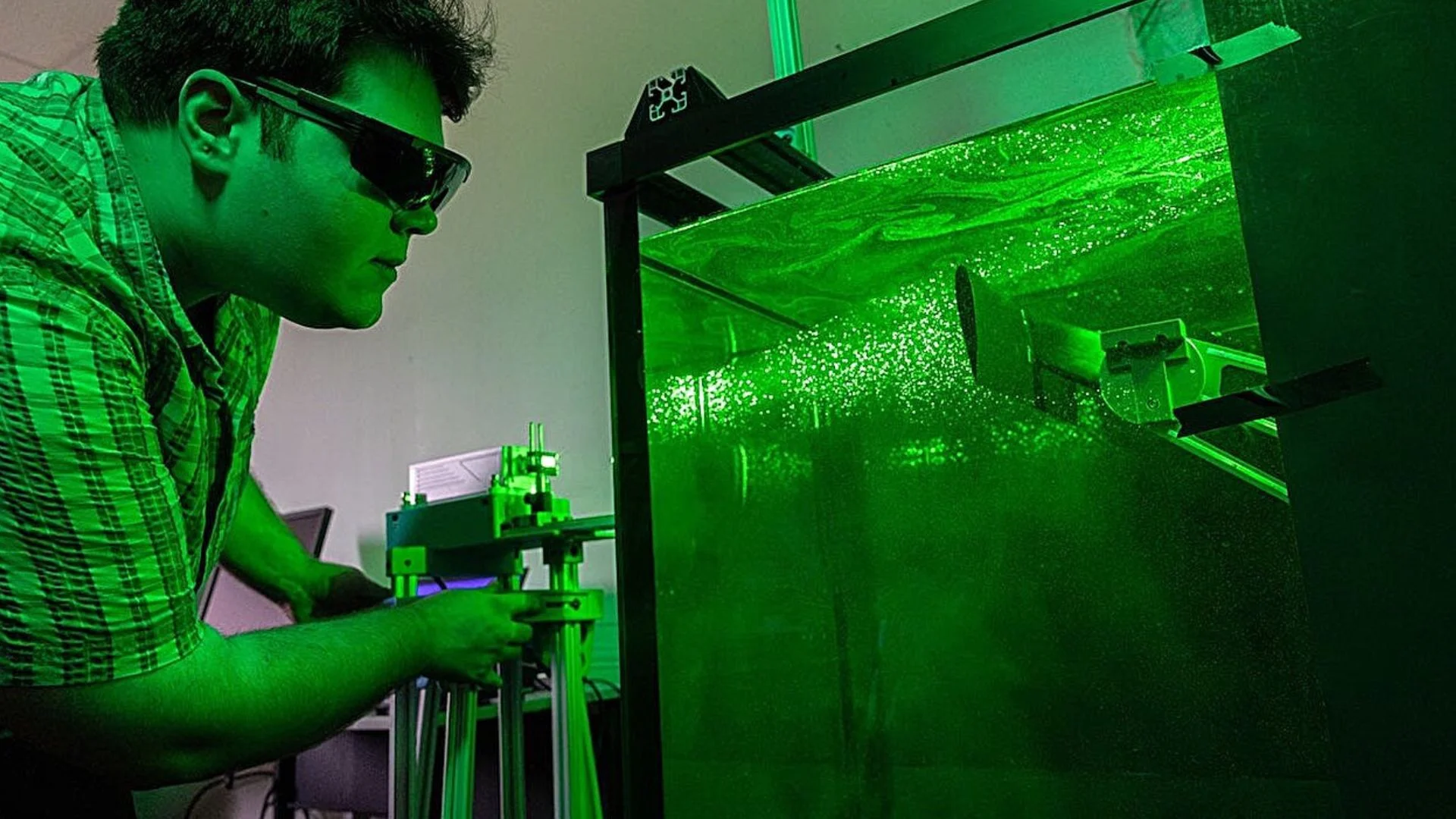
The experiments take place inside UCF’s Experimental Fluid Mechanics Lab. Researchers use a water tank and specially designed 3D-printed wings to recreate water-to-air transitions. This setup allows them to observe the process in a controlled environment.
The team is investigating several factors that influence wing performance. These include water surface deformation, wave formation, and vortex shedding. Vortex shedding occurs when swirling flows of water and air form around a moving object.
WATCH ALSO: Tesla’s Optimus humanoid robot steals spotlight at ‘Tron: Ares’ premiere
Each of these effects can alter the forces acting on a wing. The challenge is that they occur nearly at the same time. Their interactions occur within fractions of a second, making them difficult to analyze separately.
By collecting detailed measurements, researchers hope to identify the exact causes of lift fluctuations. The resulting data will support the development of predictive engineering models. These models can then be used to improve future aircraft designs.
The team previously shared early findings at the 2026 American Institute of Aeronautics and Astronautics SciTech Forum. Their presentation highlighted ongoing efforts to better understand the physics of egress. The work continues as researchers gather more data and refine their models.
READ ALSO: Lightweight X-Ray Telescope Designed to Map the Moon’s Chemical Composition From Orbit
Amphibious drones have potential applications beyond military use. They can support search-and-rescue missions in coastal regions and areas affected by floods. They can also assist with ocean monitoring, environmental surveys, and disaster response operations.
Reliable water-to-air capability could reduce the need for separate vehicles in some missions. A single platform could travel across water, dive when needed, and then return to flight. This flexibility would improve efficiency in challenging environments.
Research into wing shapes and fluid dynamics is helping engineers solve one of aviation’s toughest problems. The knowledge gained today could shape the next generation of amphibious drones used worldwide.