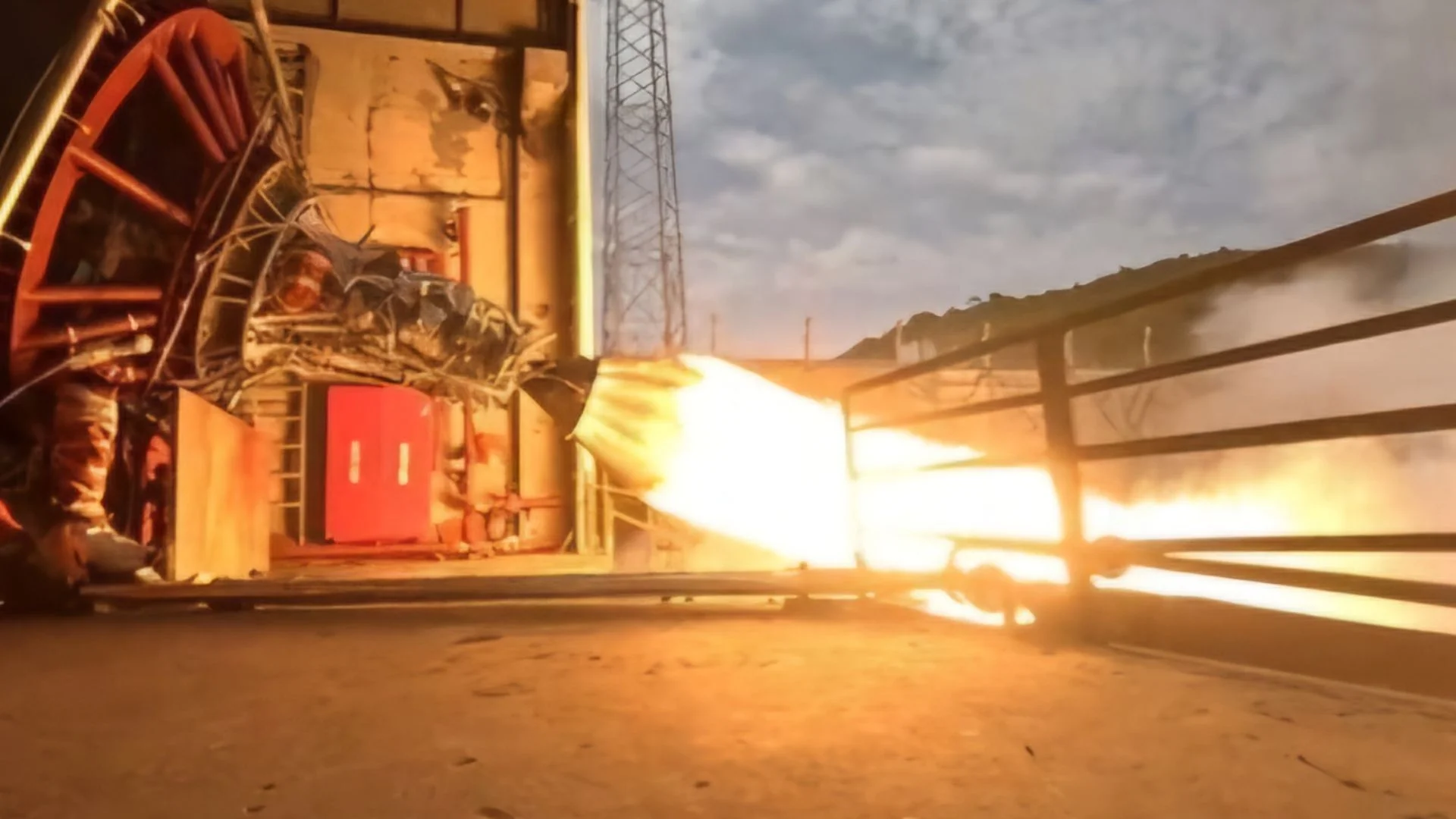
Chinese space startup Mega Engine has successfully tested a reusable liquid rocket engine designed for future commercial launch vehicles.
The company completed a long-duration hot-fire test of its ‘Chi’ engine, an advanced kerosene-liquid oxygen engine built for reusable rockets. The test signals the arrival of another serious propulsion company in China’s rapidly growing private space sector.
Mega Engine is based in Xi’an, a major center for China’s aerospace industry. The company announced that one engine completed 1,000 seconds of operation under rated conditions during testing. Total accumulated testing across the program has now reached 2,000 seconds.
The company said the engine performed stably throughout the test. Engineers also confirmed that the hardware remained in good condition after inspection. The engine demonstrated rapid startup and reliable operation during repeated firing sequences.
The Chi engine uses an oxygen-rich staged-combustion cycle, one of the most complex rocket-engine technologies in the world.
In this design, fuel and oxygen partially burn in a preburner before entering the main combustion chamber. This process improves fuel efficiency and allows the engine to deliver higher performance than simpler engine cycles.
Mega Engine designed the engine for reusable launch systems. The company said the engine supports variable thrust levels and multiple restarts during flight. These features are important for reusable rockets because they allow more control during landing and upper-stage operations.
READ ALSO: Boeing Unveils MQ-28 Ghost Bat Features, Targets Indo-Pacific Sales
Rocket Engine Reusability Designed
The engine produces between 35 and 75 tons of thrust at sea level. In vacuum conditions, the engine can generate up to 87 tons of thrust. Its specific impulse, a measure of fuel efficiency, reaches 350 seconds in space, demonstrating competitive performance for a kerosene-liquid oxygen engine.
The company said the engine is suitable for medium and large-sized rockets. It can also work as a first-stage engine for smaller launch vehicles. Mega Engine aims to become a supplier of propulsion systems for Chinese commercial launch companies.
China’s private space sector has expanded rapidly in recent years. The government has encouraged private investment and commercial partnerships to increase the country’s launch capacity. Several Chinese companies are now developing reusable rockets, satellite networks, and advanced propulsion systems.
Mega Engine appears to have started operations only in early 2024. Despite its short history, the company has already completed advanced engine development and long-duration testing. Industry observers see this as a sign of strong technical expertise within the company.
A 2025 conference summary identified Zhang Chenxing as a co-founder of Mega Engine. Zhang reportedly holds a PhD from the Massachusetts Institute of Technology. The company has not publicly detailed the previous affiliations of its engineering team.
READ ALSO: Green Fireball Meteor Explodes Over Erupting Mount Mayon in Rare Philippines Sky Event
Xi’an is also home to the Academy of Aerospace Propulsion Technology, China’s main state-owned liquid rocket engine developer. The institute developed the YF engine family, which is used in many Chinese rockets. Those engines include the YF-100 and YF-100K oxygen-rich staged-combustion engines.
China’s commercial launch companies have mostly focused on simpler rocket engine systems in recent years. Many startups have preferred methane-fueled engines or open-cycle kerosene engines because they are easier to develop. High-pressure staged-combustion engines require more advanced engineering and manufacturing capabilities.
Mega Engine plans to expand beyond the Chi engine. The company said it is developing a larger ‘Yan’ engine with 200 tons of thrust. Development of the heavy engine is expected to move forward in 2026.
The company described advanced staged-combustion technology as one of the most difficult areas in commercial rocket propulsion. Very few Chinese private companies have attempted to build engines of this class. State-owned organizations have traditionally dominated this field because of the technical challenges involved.
China is currently supporting several major satellite constellation projects, including Guowang and Qianfan. These projects require a large number of rocket launches to place satellites into orbit. Increasing launch frequency has become a major national priority for China’s commercial space industry.
WATCH ALSO: Apple launches iPhone 17 lineup with contoured edges, and thinner borders
Mega Engine’s reusable engine plans align with the growing demand for lower-cost, more frequent launches. Reusable rockets can reduce launch costs by allowing engines and rocket stages to fly multiple times. Companies around the world are investing heavily in reusable launch systems for future satellite deployment and deep-space missions.
The successful Chi engine tests place Mega Engine among a new group of Chinese companies pushing advanced rocket technology into the commercial market. The company’s next challenge will be integrating the engine into operational launch vehicles.