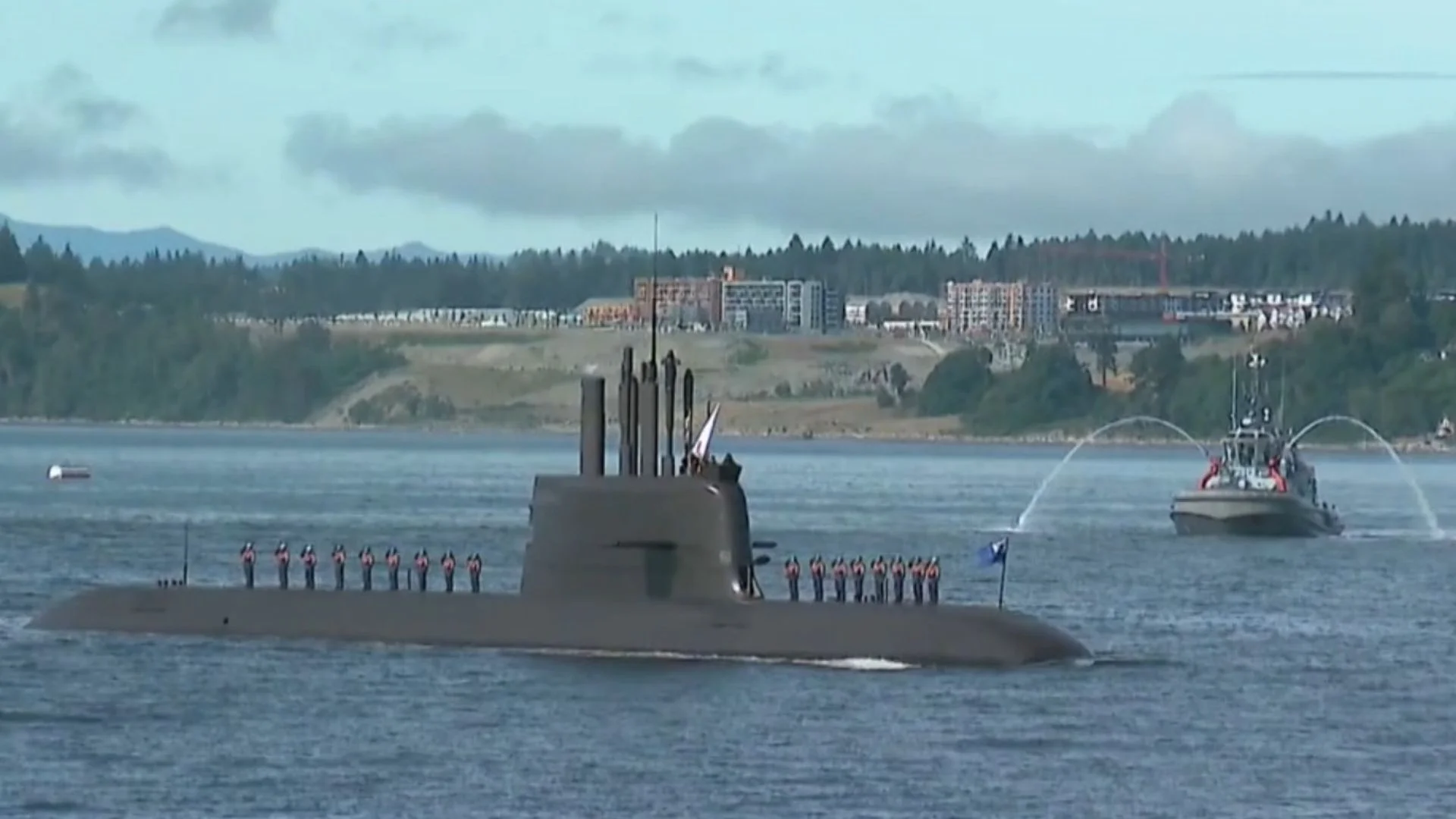
A South Korean military submarine has entered Canadian waters as Ottawa moves ahead with plans to modernize its naval fleet.
The visit comes just weeks before the Canadian government is expected to select a supplier for a major submarine program valued at nearly $25 billion. The deployment also highlights the growing rivalry between Asian and European defense companies competing for the contract.
The submarine, Dosan Ahn Changho, reached CFB Esquimalt in Victoria on Saturday after crossing the Pacific Ocean. Built under South Korea’s KSS-III program by Hanwha Aerospace, the vessel is among the finalists being considered by Canada for its next-generation submarine fleet. Canada plans to purchase up to 12 diesel-electric submarines for the Royal Canadian Navy.
The submarine travelled close to 15,000 kilometres during its journey to Canada. South Korean naval officials said the mission marked the longest overseas deployment ever completed by one of the country’s submarines. The voyage was intended to showcase the submarine’s endurance and ability to operate far from home waters.
Canada is currently evaluating two competing submarine proposals. The South Korean KSS-III is facing competition from the Type 212CD submarine offered by German and Norwegian partners through Thyssenkrupp Marine Systems. Canadian officials are expected to announce the winning bid in the coming weeks.
READ ALSO: Ancient Tectonic Movements Linked to 72% of Rare Earth Mineral Deposits, Study Finds
Canada Plans Major Naval Modernization
Canada plans to replace its aging Victoria-class submarines, which were originally purchased second-hand from the UK. Those submarines were first built during the 1980s and have faced operational challenges for years. At present, only one of Canada’s four submarines remains fully operational.
Rear-Admiral David Patchell of the Canadian Maritime Forces said the country urgently needs a modern submarine fleet. He explained that Canada has the world’s longest coastline, stretching across the Atlantic, Pacific, and Arctic oceans. He added that submarines are important for surveillance, defense, and the protection of national waters.
The Canadian government wants submarines capable of operating in Arctic conditions. Both competing submarine designs include features designed for cold-weather and under-ice operations. Arctic capability has become increasingly important as countries expand military and economic activities in the region.
The KSS-III submarine is considered one of the most advanced conventional submarines currently in service. It uses diesel-electric propulsion, allowing it to operate quietly underwater for long periods. Quiet submarines are harder to detect, making them valuable for naval patrol and intelligence missions.
The rival Type 212CD submarine also emphasizes stealth technology. Its builders say the submarine is designed to remain extremely quiet and difficult to detect using underwater magnetic sensors. This feature is important in modern naval warfare, where detection technology continues to improve.
Glenn Copeland, CEO of Hanwha Canada, said the South Korean submarine offers a low-risk option for Ottawa. He pointed out that the submarine is already operational and physically present in Canada for inspection. He also said the company can provide predictable delivery schedules and cost certainty.
WATCH ALSO: India recently tested carried out the successful launch of Intermediate Range Agni-Prime Missile
The submarine competition also carries economic importance for Canada. Both South Korean and European bidders have promised to create jobs and industrial partnerships inside Canada. The project is expected to support work in shipbuilding, defense manufacturing, and technology sectors.
Canada has operated submarines for more than 100 years, but officials believe the country now needs a much larger and more reliable fleet. Rear-Admiral Patchell said a fleet of 12 submarines would allow Canada to maintain continuous operations across all three oceans throughout the year. That would represent a major expansion of Canada’s underwater naval capability.
The submarine decision also reflects wider global security concerns. Many countries are increasing defense spending amid rising tensions in the Indo-Pacific region and as Arctic waters gain strategic importance. Canada’s future submarine fleet will play a major role in its military planning for decades.
Ottawa’s upcoming decision will shape not only the future of the Royal Canadian Navy but also Canada’s defense partnerships and industrial strategy. The arrival of the South Korean submarine has added momentum to the competition as the government moves closer to selecting its next-generation naval fleet.