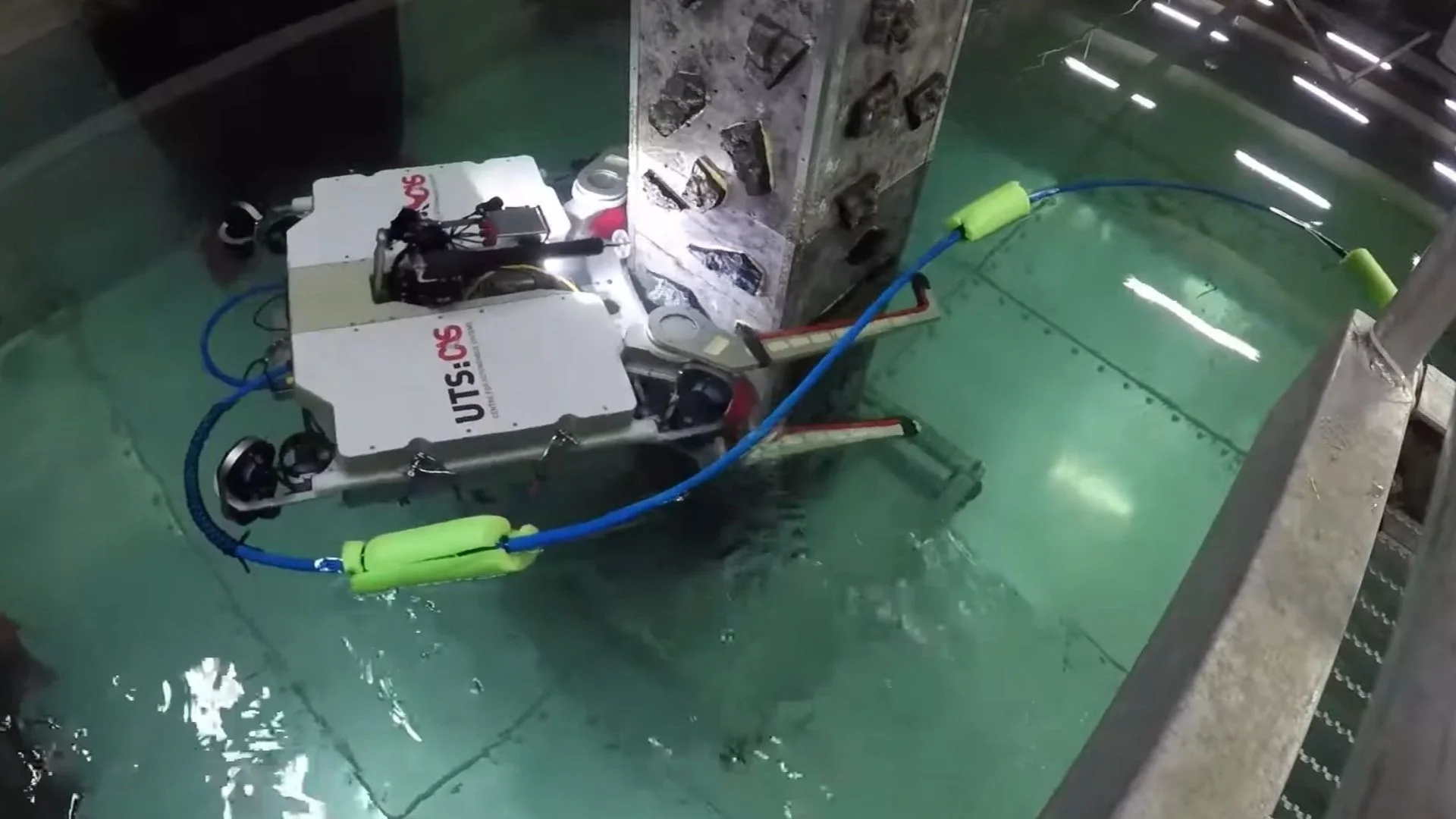
Researchers in Australia have developed an autonomous underwater robot that can clean and inspect bridge supports without putting divers at risk.
The machines were created by the University of Technology Sydney in partnership with Transport for NSW. The technology is designed to improve infrastructure safety, reduce costs, and speed up inspections across thousands of bridges and ports.
The robots can clean and inspect underwater supports used in bridges, wharves, and ports. The project aims to reduce the risks to human divers during inspection work.
Divers often work in difficult, hazardous underwater conditions. They deal with strong currents, low visibility, and heavy equipment during inspections. In some areas, they also face threats from dangerous marine animals, such as crocodiles.
The research team was led by Distinguished Professor Dikai Liu from the Centre for Autonomous Systems. The group worked closely with Transport for NSW to build the robotic system. Engineers also consulted experienced divers to better understand real working conditions underwater.
READ ALSO: Blue Energy, GE Vernova Plan 2.5GW Texas Gas-Nuclear Project for AI Power Surge
The robot system is called the Submersible Pile Inspection Robot(SPIR). It is designed to move around underwater support piles and clean marine growth from their surfaces. The machine can then inspect the structure and capture detailed images for engineers above water.
How the SPIR Underwater Robot Works
The robot uses claw-like arms to hold onto underwater bridge piles. Another set of arms sprays high-pressure water jets to remove barnacles, oysters, and other marine growth. Cameras and sensors help the robot understand its surroundings and guide its movement.
Advanced software enables the robot to operate with minimal human control. The system can scan the pile surface and measure the thickness and type of marine growth. Some underwater structures collect marine layers up to 20 centimeters thick over time.
After scanning the pile, the robot automatically plans its cleaning path. It moves around the structure and docks at various points to complete the cleaning. Once the surface is cleared, the robot captures high-definition images for inspection teams.
The collected images are used to create a detailed 3D map of the structure. Engineers can study the digital model to identify cracks, corrosion, or damage. This process gives inspectors a clearer view than traditional manual checks.
READ ALSO: China Unveils First 20K Rapeseed Gene Chip to Cut Crop Breeding Time to 3 Years
Current inspection methods often rely on partial sampling. Divers usually clean only narrow strips on selected piles because full inspections take too much time and effort. That leaves the possibility that hidden damage remains unnoticed in uncleaned sections.
The SPIR system allows much larger areas to be inspected more often. Researchers say this can improve infrastructure safety and extend the lifespan of bridges and wharves. Better inspections also help authorities plan repairs before problems become serious.
The robots have already completed successful trials on several bridges in New South Wales. Australia has around 50,000 bridges and about 70 ports that require regular underwater inspections. The technology offers a scalable solution for maintaining this large infrastructure network.
Researchers say the robots can work continuously without the fatigue limits faced by divers. One operator can also supervise several robots simultaneously. This increases productivity and lowers long-term maintenance costs.
Ports also benefit because operations do not need to stop during inspections. Traditional diving work can force temporary closures at busy wharves. According to researchers, such shutdowns can cost port authorities up to $100,000 per day.
The underwater robots are also being considered for other industries. Future versions could clean ship hulls, underwater tunnels, pipelines, offshore wind farms, and oil platforms. These sectors require regular underwater maintenance that is expensive and time-consuming when done manually.
WATCH ALSO: United Launch Alliance launches launches third batch of Amazon’s Project Kuiper satellites
Autonomous robots are becoming more important as countries invest heavily in infrastructure upgrades. Governments and industries are seeking safer, faster maintenance methods. Technologies like SPIR support that shift by combining robotics, artificial intelligence, and remote operations.
The research team says the current SPIR system is still a prototype. However, the successful trials show that autonomous underwater inspection is becoming practical for real-world use.