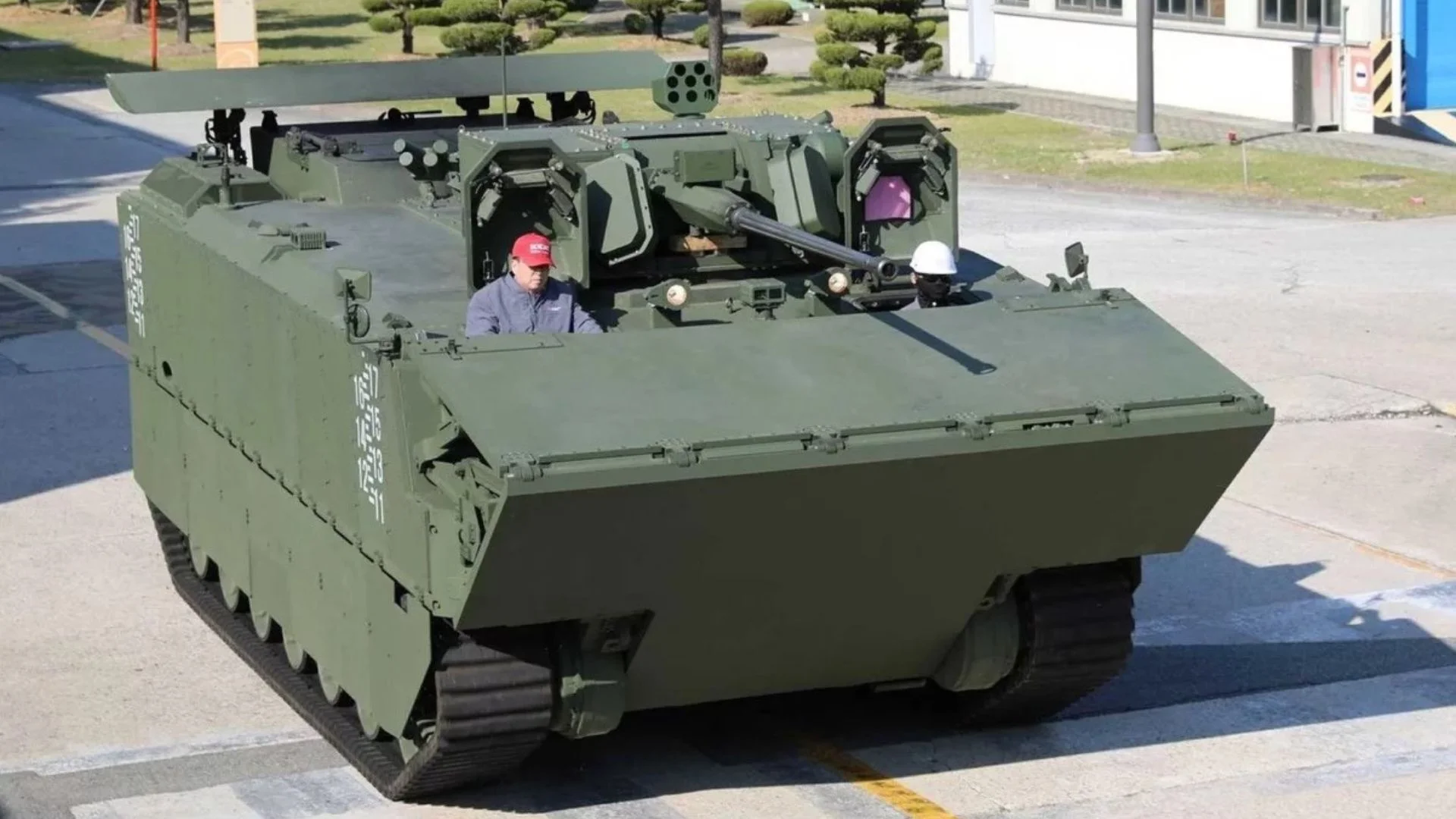
South Korea has unveiled a new amphibious assault vehicle designed to modernize its Marine Corps and strengthen coastal assault operations.
The new KAAV-II prototype was presented by Hanwha Aerospace during a visit to its Changwon facility on May 18, 2026.
The vehicle offers higher water speed, stronger armor protection, and heavier firepower than the current KAAV fleet used by the South Korean Marines.
The KAAV-II is being developed as a replacement for South Korea’s aging Korea Amphibious Assault Vehicle fleet. Those vehicles are based on the American AAVP-7A1 platform that has served for decades in amphibious transport missions. South Korea now wants a more survivable and faster platform for modern coastal warfare.
Hanwha KAAV-II Modern Amphibious Warfare
The unveiling took place during a visit by National Assembly Defense Committee member Yoo Yong-won to Hanwha’s production facility in Changwon. The presentation offered the clearest public look yet at the KAAV-II program. South Korea plans to complete development by 2028 and start mass production in 2029.
The new vehicle mirrors the evolving military threats across Northeast Asia. Coastal areas are now heavily defended with anti-ship missiles, drones, artillery systems and anti-armor weapons. Amphibious forces must move faster and operate farther from shore to avoid these threats.
The KAAV-II uses a high speed planing hull for faster waterborne movement. This design allows part of the hull to rise above the surface of the water while in transit. That reduces drag and increases speed compared to traditional amphibious armored vehicles.
The overall shape of the KAAV-II closely resembles the canceled American Expeditionary Fighting Vehicle program. The US program aimed to develop a high-speed amphibious assault vehicle for the US Marine Corps, but it was canceled in 2011 due to rising costs and technical issues. South Korea appears to have adopted many of the same operational ideas while keeping performance targets more realistic.
READ ALSO: Perovskite Solar Cells Reach 24.3% Efficiency With New Solvent-Free Vacuum Process
The current KAAV can move at around 13 kilometers per hour in water. The KAAV-II is expected to reach at least 20 kilometers per hour during amphibious operations. Some development concepts reportedly targeted speeds closer to 30 kilometers per hour.
Faster water speed is important during amphibious assaults. It reduces the time troops spend exposed while traveling between ships and shorelines. It also allows assault ships to launch vehicles farther offshore and outside some missile engagement zones.
The KAAV-II is also expected to travel much faster on land than the existing vehicle. Reports suggest the platform could approach 100 kilometers per hour despite weighing more than 35 tons. The current KAAV weighs around 25.6 tons and has lower protection levels.
Marines Stronger Battlefield Firepower
One of the biggest changes is the vehicle’s new unmanned turret system. The KAAV-II carries a 40mm CTA autocannon instead of the heavy machine gun and grenade launcher used on current KAAV vehicles. This gives the Marine Corps much stronger firepower during amphibious assaults.
CTA stands for Cased Telescoped Ammunition. In this system, the projectile is fully enclosed inside the cartridge case, reducing ammunition size and saving internal space. The design also allows for a smaller turret and more efficient ammunition handling.
The 40mm cannon offers more firepower than the 30mm guns commonly used in many infantry fighting vehicles. It is intended to destroy armored vehicles, coastal bunkers and fortified firing positions. The weapon also can engage low-flying drones and airborne threats.
Several ammunition types are reportedly under development for the new cannon. These include armor-piercing rounds, high-explosive shells, and programmable airburst munitions. Airburst ammunition can explode above targets and strike infantry hiding behind cover.
The unmanned turret improves troop safety inside the vehicle. Traditional manned turrets take up internal space and expose crew members during combat. By removing the turret basket, the KAAV-II creates more room for soldiers and onboard electronics.
The vehicle is also expected to transport more troops than earlier concepts. South Korea’s current KAAV can carry 21-25 Marines, along with a crew of three. The KAAV-II focuses on combining troop transport with direct combat capability.
Electronic battlefield systems are another important feature of the program. The vehicle is expected to include modern communication, fire control systems, and battlefield networking technologies. These systems allow vehicles to share combat information in real time during operations.
READ ALSO: NASA Satellite Will Test Orbital ‘Gas Station’ Tech to Fuel Moon and Mars Missions
Protection and survivability became major priorities during development. Existing KAAV vehicles count on aluminum armor with additional protection kits later attached. These vehicles continue to be vulnerable to mines, shaped-charge weapons and top-attack attacks.
Combat experiences involving American amphibious vehicles in Iraq also influenced the program. Earlier assault amphibious vehicles suffered heavy losses from roadside bombs and improvised explosive devices. South Korea wants the KAAV-II to provide stronger blast resistance and better crew protection.
The new platform reportedly features thicker armor and redesigned troop seating. Shock-absorbing seats and improved internal layouts are intended to reduce injuries during explosions or crashes. Development studies also examined modular armor packages and active protection systems.
Maritime safety became an even larger concern after a deadly testing accident in 2023. During maritime trials near Pohang, a KAAV-II prototype reportedly lost buoyancy and flooded. Two people died during the incident, leading to renewed focus on flotation systems and emergency escape measures.
Hanwha and the South Korean Marine Corps have since placed greater emphasis on compartment sealing and maritime safety procedures.
Engineers are also working on improving flotation margins during high-speed operations. These features are critical because the vehicle is expected to operate in rough coastal conditions around the Korean Peninsula.
The KAAV-II program also highlights South Korea’s growing defense industry capabilities. Earlier armored vehicle programs relied heavily on American technology transfers and imported systems. Newer projects increasingly use indigenous designs, propulsion systems, and electronic technologies.
The program overlaps with several other next-generation South Korean combat vehicle efforts. These include the K-NIFV infantry fighting vehicle project and future combat engineering vehicles. Hanwha has also explored robotic amphibious systems and unmanned assault variants for future operations.
Unlike the US Marine Corps, which shifted toward lighter, more distributed island operations after canceling the Expeditionary Fighting Vehicle, South Korea continues to prioritize heavy, mechanized amphibious assaults.
WATCH ALSO: Blue dogs spotted in Chernobyl nuclear disaster site spark concern
Military planners in Seoul still see armored landing forces as essential for rapid coastal penetration missions. The KAAV-II shows that South Korea is preparing its Marine Corps for future amphibious warfare in heavily defended environments.
If development remains on schedule, the KAAV-II will become one of the most heavily armed and fastest amphibious assault vehicles in Asia.
The platform also represents South Korea’s wider push to strengthen domestic defense manufacturing and advanced armored vehicle design. Its future deployment could reshape how the South Korean Marine Corps conducts coastal assault operations in the coming decades.