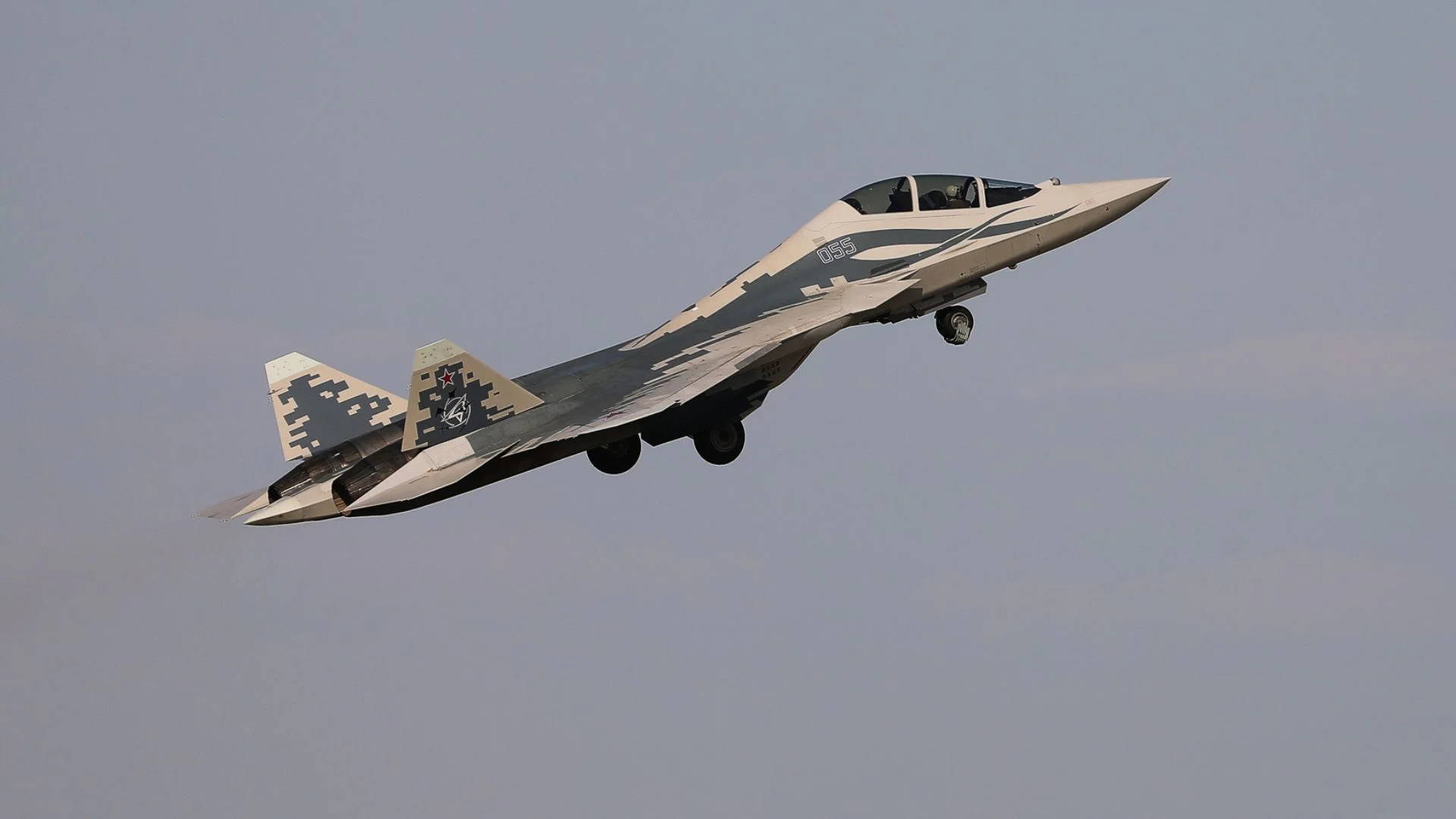
Russia has started flight testing its new two-seat Su-57D stealth fighter, marking a major step in the evolution of the country’s fifth-generation combat aircraft program.
The aircraft completed its first test flight under the control of veteran Sukhoi test pilot Sergey Bogdan.
The new version of the Su-57 adds a second crew station and introduces new roles focused on drone coordination, combat management, and pilot training.
Russia’s United Aircraft Corporation (UAC), part of the state-owned Rostec group, officially announced the first flight of the Su-57D prototype. Sergey Bogdan, chief test pilot at the Sukhoi Design Bureau and a Hero of Russia, piloted the aircraft during the flight.
Russian officials described the aircraft as a major upgrade of the standard Su-57 stealth fighter already in service.
First Deputy Prime Minister Denis Manturov said the aircraft combines combat capabilities with training and battlefield control functions. He added that the project was developed proactively by Russian aircraft designers.
READ ALSO: Hanwha Reveals KAAV-II Amphibious Assault Vehicle With 40mm Cannon and High-Speed Hull
The Su-57 is Russia’s most advanced fifth-generation fighter aircraft. It is designed to attack air, ground, and naval targets in different weather and combat conditions. The aircraft also uses stealth features intended to reduce detection by enemy radar systems.
Newly released images of the Su-57D reveal major design changes compared to the single-seat version. The fighter now has an extended canopy and a raised rear cockpit for the second crew member. The redesign gives the aircraft a different silhouette while maintaining most of the original Su-57 airframe.
Su-57D Expands Drone Warfare
Russian defense officials said the second crew member can help manage combat operations involving unmanned aircraft. This includes future missions with loyal wingman drones and unmanned combat air vehicles. The added crew position is expected to reduce pilot workload during complex operations.
The Su-57D is closely linked to Russia’s growing interest in crewed-uncrewed teaming concepts.
In this setup, a fighter pilot works together with drones during missions such as reconnaissance, strike operations, and electronic warfare. Russia has already tested cooperation between the Su-57 and the Sukhoi S-70 Okhotnik-B stealth drone.
Experts believe the second crew member can control drone formations while the pilot focuses on flying and combat tasks. This setup is similar to modern concepts being explored by other major military powers. It also reflects the changing nature of air warfare, where drones are becoming increasingly important on the battlefield.
WATCH ALSO: China sends 3 astronauts, 4 mice to space station for mammal study in orbit
China is currently the only other country publicly known to have developed a two-seat fifth-generation fighter. Its Chengdu J-20S stealth fighter is also linked to drone control and command missions. The appearance of the Su-57D places Russia among a very small group of nations developing this type of advanced aircraft.
The aircraft can also serve as a combat trainer for new Su-57 pilots. Training missions in advanced stealth fighters are often difficult because of their highly complex systems and sensors. A second instructor seat allows pilots to learn operations more safely and efficiently.
Challenges for Su-57 Program
Russian officials also see the Su-57D as an opportunity to improve export interest in the aircraft.
UAC chief executive Vadim Badekha said the new version will strengthen the fighter’s position in international markets. Russia has struggled to secure major foreign buyers for the Su-57 in recent years.
The project also brings attention back to the canceled Indo-Russian FGFA fighter program. India had earlier requested a twin-seat version of the Su-57 during negotiations for the joint project. However, disagreements over technology sharing, aircraft performance, and production plans eventually ended the partnership.
Adding a second seat required engineers to redesign parts of the aircraft’s internal structure. This includes changes to fuel storage areas, avionics compartments, and mission systems. The new cockpit layout may also affect some of the fighter’s stealth performance because of changes to its outer shape.
The Su-57 program has faced criticism in Western defense circles over its production pace and operational history.
Sanctions, limited aircraft numbers, and questions about stealth performance have affected the program’s reputation. Despite this, Russia continues to develop upgrades and experimental technologies for the fighter.
Recent reports indicate Russia is testing new low-observable engine nozzles and updated propulsion systems for the Su-57. These upgrades are intended to improve maneuverability, survivability, and overall combat performance. The Su-57D now adds another major development path for the aircraft platform.
READ ALSO: Rotor Built With 99% Pure Rare Earth Recycled Magnets Passes Ford’s EV Tests in UK
Rostec stated that the twin-seat fighter was developed on UAC’s own initiative rather than through a direct government order.
This suggests the project is also aimed at future export customers looking for advanced multi-role stealth aircraft. Countries interested in drone-integrated air combat systems may closely watch the program’s progress.
The first flight of the Su-57D marks an important stage for Russia’s next-generation fighter ambitions. The aircraft combines stealth technology, drone coordination, and training functions into a single platform.