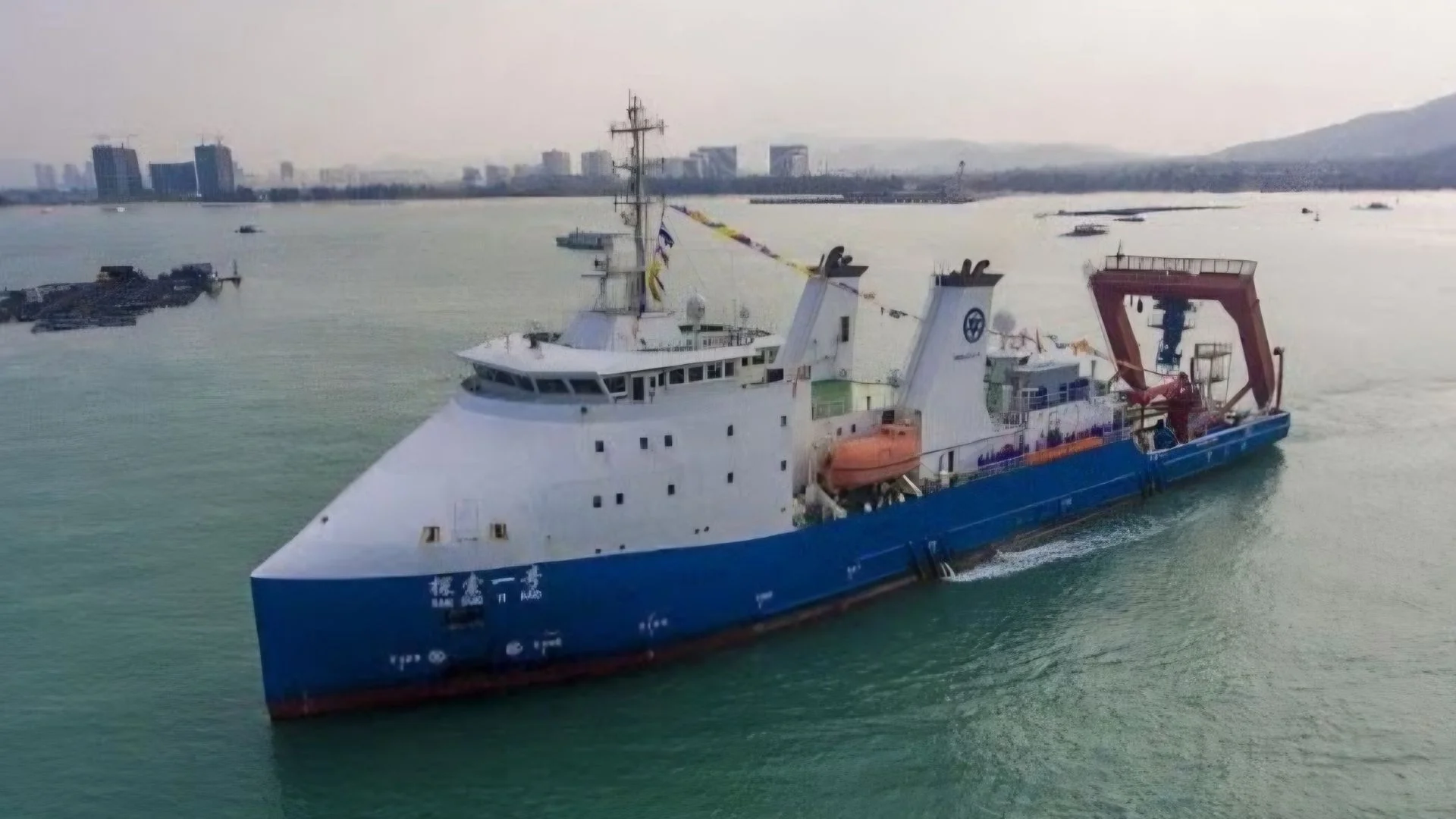
China’s research vessel Tansuo-1 arrived in Guangzhou after completing a 156-day deep-sea expedition across the Pacific Ocean.
The mission was conducted under the Global Hadal Exploration Program and included the first joint China-Chile manned exploration of the Atacama Trench.
Scientists described the operation as one of the largest and most detailed hadal research missions carried out in recent years.
The expedition began on December 6, 2025, when the vessel departed from Sanya in southern China. During the mission, the ship traveled more than 40,000 kilometers, covering a distance similar to circling the Earth along the equator. Researchers explored the Atacama Trench off the coast of South America and the Mussau Trench in the western Pacific Ocean.
A total of 83 scientists from China, Chile, Germany, Denmark, Canada, and Spain joined the mission. The team studied deep-sea biodiversity, underwater geological activity, plate movement, and ecosystems powered by chemical reactions rather than sunlight. The expedition combined marine biology, geology, and environmental science into a single large research program.
READ ALSO: Turkey Unveils Kuzgun Kamikaze Drone Built for 1,000 Km Deep-Strike and Air-Defense Saturation
China’s manned submersible Fendouzhe played a central role during the mission. The underwater vehicle completed 63 dives, including 50 descents deeper than 6,000 meters. Researchers used the submersible to collect biological samples, geological material, and high-definition underwater images from some of the planet’s least explored environments.
Scientists collected more than 3,500 biological specimens during the dives. Many of these organisms may represent species that have never been documented before. Researchers observed several types of hadal snailfish and many seabed creatures living together in extreme deep-sea conditions.
Tansuo-1 Finds Deep-Sea Life, Quake Clues
One of the mission’s most important discoveries was the identification of the deepest known chemosynthetic ecosystem in the southern hemisphere.
Chemosynthetic ecosystems survive without sunlight and instead depend on chemical energy released from fluids beneath the ocean floor. These ecosystems are considered important because they help scientists study how life survives in harsh environments.
Researchers said the finding supports the theory of a global chemosynthetic life corridor. This idea suggests that deep-sea life associated with geological fluid activity may occur across multiple ocean trenches worldwide. The discovery provides fresh evidence that life in extreme ocean environments may be more widespread than previously believed.
The team also found seabed fault structures linked to historic underwater earthquakes. These formations provide direct evidence of how seismic activity reshapes the deep ocean floor over time. Scientists believe the data will help improve understanding of underwater earthquakes and their effects on marine habitats.
WATCH ALSO: American company’s next-generation ejection seat offers a 92% survivability rate
Experts say such discoveries are valuable because the hadal zone remains one of Earth’s least explored regions. The hadal zone extends to depths below 6,000 meters, where pressure is extreme and sunlight cannot reach. Conditions in these areas are considered among the harshest anywhere on the planet.
The mission also focused on how deep-sea geological activity influences ocean chemistry and marine ecosystems. Scientists studied fluid circulation beneath the seabed and the movement of tectonic plates deep below the ocean floor. The findings may improve research related to climate change, ocean carbon storage, and Earth’s geological processes.
China’s deep-sea exploration capabilities have expanded rapidly in recent years.
According to researchers involved in the project, the Fendouzhe submersible uses domestically developed titanium alloys that can withstand the intense pressure found in trenches such as the Mariana Trench. The submersible also uses advanced control and acoustic positioning systems that allow precise underwater navigation.
Wang Peng from the Beijing Academy of Social Sciences said deep-sea technology has benefits beyond marine science. He explained that equipment tested in extreme underwater environments can provide useful data for industries such as aerospace and nuclear energy. Engineers often use harsh environments to improve material durability and system reliability.
Researchers also believe deep-sea studies may improve understanding of the origins of life on Earth. Organisms living near chemical vents and deep-sea fluids survive in conditions once thought to be inhospitable to life. Scientists say these ecosystems may offer clues about how life first developed on the planet billions of years ago.
The mission also strengthened scientific cooperation between China and other countries. Researchers from six nations shared scientific data, conducted joint dives, and trained together during the expedition. The project created new opportunities for long-term international research in deep-sea science.
The Global Hadal Exploration Program is part of the United Nations Decade of Ocean Science for Sustainable Development running from 2021 to 2030.
READ ALSO: AeroKoi Used a 3D Printer to Recreate Classic Steam Locomotive Whistle Sounds
The initiative aims to improve global understanding of the world’s deepest oceans through international cooperation and advanced marine technology. China’s participation in the program reflects its growing interest in ocean research and deep-sea industries.
China has recently increased policy support for deep-sea science and technology. In 2025, the Chinese government included deep-sea science in its official government work report for the first time. Officials described the sector as part of the country’s emerging strategic industries alongside commercial space and low-altitude aviation technologies.
Scientists expect the data collected during the expedition to support future research for many years. The information may help improve climate studies, disaster prediction systems, and understanding of deep-ocean ecosystems.
Researchers also hope that future missions will continue to expand knowledge of the hidden environments in the deepest parts of Earth’s oceans.